
Translated material
Ex-head of the IMF told the Russians about the dangers of offshores
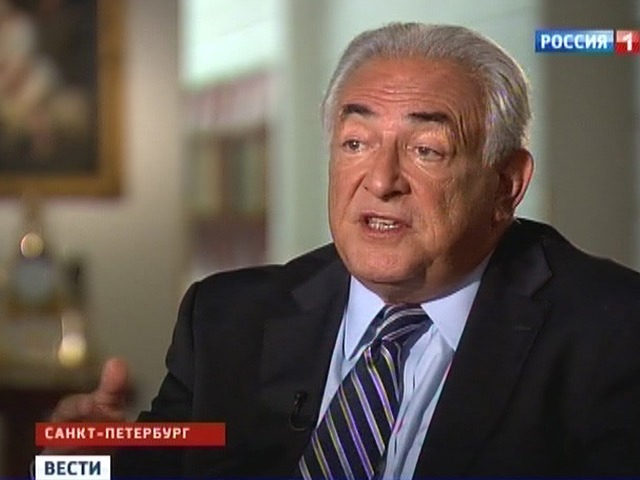
The former head of the IMF Dominic Stross-Kang in an interview with ITAR-TASS and the Rossiya 24 television channel said that he intends to focus on work as an adviser to governments and large enterprises of different countries. He considers participation in the political life of France to a passed stage in life.
Speaking about his appointment to the observation councils of the Russian Direct Investment Fund (RDIP) and the All-Russian Bank for the Development of the Regions, controlled by Rosneft, Strauss-Kan noted that both of these companies "set themselves the task of having a wider vision of all markets in the world."
"The leaders of these enterprises decided that my knowledge will be useful to these companies, and such work is suitable for me, because I believe that all economic forces must work together," the French expert noted.
Russia, Tross-Kan believes, has a lot of internal needs. “Therefore, it is fair that most of Russia’s resources are aimed at internal development today. But you can’t live without relations with the world, you cannot try to invest only in the economy of its country,” he concluded. “Russia is not necessary tomorrow, but in the coming years and decades to significantly internationalize its economic activity. And thus investing in other countries of the world and Europe.”
The former head of the IMF also called the current chairmanship of Russia in the "big twenty" successful, emphasizing that the final assessment will depend on how the final G20 summit in St. Petersburg takes place.
“I think that all members of the Twenty Group agree that the Russian chairmanship was successful,” said the interlocutor. “Let's see how the final meeting will pass, but so far everything is going well.”
The French expert recalled that "the organization played a significant role during the crisis," but now, he emphasized, it does not work as expected. “I think that we still have to revise the system of managing world processes,” he remarked. “The group of twenty could not become a real decision -making tool because it has become heavy. Too much bureaucracy.”
The former head of the IMF also noted that, contrary to statements by a number of political leaders, many states of the world are actively using offshores in their interests.
"There are still many state enterprises. The management of participation in state enterprises is carried out centrally in the ministries. But with centralization of the ministry, they strive to make sure that enterprises earn as much money as possible. And if it is necessary to apply legal tax rules that are immoral from the point of view of common sense, enterprises allow enterprises to do this. And when the state allows them to do this, it means that it itself uses offshore zones," the former head explained, "the former head explained," the former head explained, "the former head explained," the former head explained, "the former head explained," the former head explained, "the former head explained IMF.
Strauss-Kan said that he carefully monitors the statements of world leaders on this issue, but so far these words are not supported by actions. “In reality, nothing or almost nothing happened,” he summed up. “The problem of offshore zones - cancer tumors of the economy - lies not in the absence of technical means, but in a lack of political will to put an end to this phenomenon.”
Answering the question about the possible ways to modernize world financial architecture, Dominic Struss-Kan expressed the opinion that the decisive role should be assigned to the International Monetary Fund. “I believe that the IMF should be at the Center for the Reform of the World Financial Management. For this, it is necessary to change its charter, which is very difficult to do, since its members are more than 280 states,” the former head of the Fund explained. “Or you need to choose a more pragmatic approach: not to touch the methods of work. They need to change them in any case, so that the IMF begins to play a more important role than earlier.”
However, according to Strauss-Kan, the World Financial Administration requires a multilateral approach. “Large meetings, for example, at the level of“ Group twenty ”are not enough, so I think that the IMF will be able to play an important role in this matter.“ He said. “The organization has the necessary advantages and competencies. It has a working network that has been created in Asia, Africa, Latin America. The IMF managed to restore the prestige that it has lost in the last years. That is why I believe that the IMF is that I think that the IMF I think that the IMP It should become a valuable tool for all major players of the international community, including Russia. "
The main condition for solving the main economic problems in the world, Dominic Struss-Kan considers the "political choice". “We must decide whether we want or not to act by cooperation in large blocks,” he summed up. “My answer is yes, we need cooperation between the American bloc, the European bloc, the South American, Chinese, Russian blocks. And if we really want it, then there will always be means to achieve such cooperation.”
At the same time, speaking of the struggle against offshore zones declared by world leaders, Dominic Stross-Kan noted that the words have not yet been supported by actions.
“In reality, nothing or almost nothing happened. The problem of offshore zones - cancer tumors of the economy - is not in the absence of technical means, but in a lack of political will to put an end to this phenomenon,” he said.
Recall that in the past, Dominic Struss-Kan held the post of Minister of Economics of Finance and Industry of France, and then led the IMF for four years and was one of the most likely applicants for the post of president of France in the last election, but in May 2011 his political career ended: he was forced to resign after he was accused of sexual harassment in relation to an employee of the hotel. Strauss-Kan even spent several days under arrest. Then, however, the case fell apart. Currently, its main place of work is the consulting company Parnasse.