
Translated material
Marginals from Dudachkino
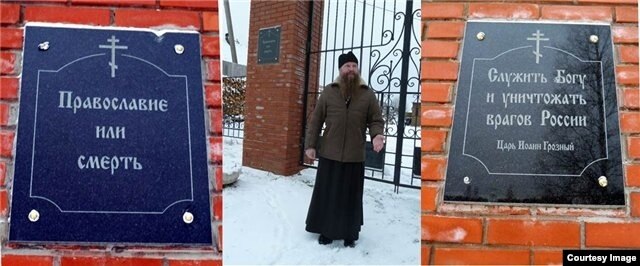
The decision to dismantle a few months ago by the Volkhov prosecutor’s office, which recognized the inscription on it "exciting religious enmity and promoting the superiority of citizens of one religion in relation to another." De Jure can understand the following decision of the prosecutor's office: the slogan "Orthodoxy or death" was recognized as an extremist Cheremushkinsky court of Moscow back in 2010. However, such close attention of the authorities to the abbot of the temple of the Protection of the Blessed Virgin Mary Fr. Alexander Dryov is not explained at all in a sign on the stone arched gates of his parish.
In 2007, the then abbot of the Pokrovsky Church, the former St. Petersburg lawyer Alexander Sukhov transferred from the Russian Orthodox Church to the Russian Orthodox Church abroad, and moved along with all his flocks (150 people), which travels to the village of Dudachkino to services from St. Petersburg and the Leningrad Region. With this, the authorities began to closely attention to the "rebellious" arrival. Numerous inspectors began to visit the village. In October 2011, a group of 20 people, led by Prosecutor of Volkhov, searched all church premises, threatening to take away the land plot from the community. The main claim to about. Alexander Dryov is that he refuses to remember the Patriarch of the Russian Orthodox Church during the service.
Archbishop of St. Petersburg and North Russian ROCZ Sofroniy said Radio Liberty:
- As for the arrival in the village of Dudachkino, the prosecutor's office of the Leningrad Region was intently for the life of our parishioners. In the village of Dudachkino, in addition to the arrival, there is a convent under the abbess of Igumeni Sofronia, where the prosecutor's office with searches for the manufacture of explosives recently came. Along with the inquiry officers and investigators, a man also arrived who freezed all land and fields. During the discussions, we were told: "If the patriarch was remembered, then there would be no searches." Since the community has come out of the subordination of the Moscow Patriarchate, there are no kind of interest in the arrival of the authorities, so the prosecutor’s office applied to the court with a claim for recognition of Fr. Alexander as an extremist and signs - extremist. Thank God the most humane in the world our court did not recognize Fr. Alexandra is an extremist, but the sign was not left alone. But not in the sign is a matter, but in the very life that these parishioners want to live. In their hearts, they wrote these words and follow them in their life, and this is not like the official church. The nuns and parishioners convict the lie who reigns in the Moscow Patriarchate. See with what zeal they took up this parish. There was no such week that one of the bosses did not come to the village. Either from the district, then from the region, from the local administration, then firefighters, then land surveyors with electricians. And give everyone a story why we do not remember the patriarch. Several times the arrivals said that they were forced to go: "We are bonded. We called on top to check the pillars, so we check, and we don’t know what to check them." The persons of the inspectors show that they have more fear of God than those from whose blessing they come. We’ll wait, see.
Himself about. Alexander Sukhov repeatedly categorically denied the extremist meaning of the inscription "Orthodoxy or death." This statement, according to the priest, originally arose in the monastery of the Esfigman on Athos and means that Orthodoxy is a saving faith, and if it is not, then spiritual death occurs. Moreover, this slogan was recognized as extremist in combination with an exclamation mark, skull and bones, but there are no temple on the sign. But the statement about. Alexander did not convince the judges.
Here's what the professor of St. Petersburg State University Alexander Panchenko thinks about this story:
- The slogan "Orthodoxy or death" in recent decades received
Quite widespread in an environment of radical
Believers of the Russian Orthodox Church of the Moscow Patriarchate. He is of Greek origin, appeared in the Athos Monastery of the Espigman, known for its religious conservatism, and in Russia of the 1990-2000s became one of the motto of the Orthodox conservatives and opponents of ecumenism. It can be interpreted in different ways, including, if I may say so, in the "spiritual and foreign" sense: they say, we are talking about the fact that a person who does not profess the Orthodox faith is waiting for spiritual death. At the same time, in the Russian language context, this slogan sounds ambiguous and rather aggressive. Its wording does not allow with sufficient accuracy to determine the addressee and addressee of the statement. Simply put, the third -party reader of these words cannot be sure to whom and from whose behalf they are addressed. Maybe we are talking about some group of believers who decided that they can avoid death (spiritual or physical), only being Orthodox, and simply notify everyone around them about their motto? Or do they treat this motto to everyone else - Christians and not Christians who believe and not believes - warning about the fatality of any spiritual ways besides the Orthodox? Or is it a direct threat to all Gentiles, atheists and agnostics? Probably, such a slogan, with all its expression, would be appropriate in a society where people are forced to renounce their religion; In this context, it can be considered a declaration of readiness for martyrdom for faith. However, in modern Russia, no one pursues the Orthodox, on the contrary , today it is the Orthodox who often turn out to be pursuers of religious and other minorities.
Be that as it may, the general meaning of the slogan "Orthodoxy or death"
Obviously, it implies the superiority of Orthodoxy in relation to all other religions and worldview doctrines, therefore, in my opinion, he was quite deservedly recognized as extremist. I must say that he is condemned by many clergy and laity people of the Russian Orthodox Church of the Moscow Patriarchate. I must say that in religious and ideological terms, modern Russian Orthodoxy is heterogeneous: in the church, both reasonable people and religious paranoids, who see exclusively devilish intrigues in the surrounding world, signs of the “kingdom of antichrist” and all kinds of conspiracies against the Russian people. ”
Unfortunately, in the public space, the activity of such marginals is often more noticeable. But what can you do! We have to admit that many specific features of the “religious revival” in post -Soviet Russia can be described using the old proverb: make the fool pray to God - he will break his forehead.