
Translated material
The number of special receivers for migrants by the end of the year will double
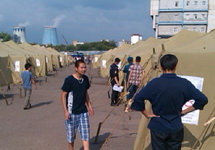
Until the end of the year, 43 receiver-distributor for illegal migrants will operate in Russia, ITAR-TASS reports with reference to the Federal Migration Service. Now there are 21 such institutions in the country - therefore, over the remaining five months, the number of them will increase more than half. So far, the receivers are maintained by the Ministry of Internal Affairs, but from January 1, 2014 they will become controlled by the migration service.
The FMS noticed that then they intend to increase the number of special receptionists for migrants. Their total number will be determined based on the needs of the regions.
At the same time, the migration service officials denied the information that tent camps like migrants like the Golyanovo, which opened in the Moscow district, will organize. It is about the creation of special institutions, they assured the FMS.
Meanwhile, the deputy chairman of the Public Council at the Moscow Central Internal Affairs Directorate and a member of the capital's PMC Anton Tsvetkov called the conditions for the detention of migrants in the Golyanovsky camp quite acceptable. “Yes, this is not a pioneer camp, but the conditions here are better than if they were all placed in the center for the temporary detention of foreigners,” Interfax quotes Tsvetkova. “The common information that people live in inhuman conditions are not true,” added a member of the council.
Tsvetkov explained that the need to create a camp is due to a large number of detained migrants, since the Center for temporary content accommodates no more than 400 people. “They have three meals a day - buckwheat with stew,” he remarked regarding the conditions in the Golyanovsky camp, “they can freely move around the camp, while in the CVS they would sit in a closed space.”
On Monday morning, the head of the consular department of the Vietnam Embassy in Moscow, Le Hong Chyong, called the conditions for the detention of migrants in this camp inhuman. "40 people are in one tent size of 50 square meters - these are simply inhuman conditions," he said.
Le added that the Vietnamese diplomatic mission has already addressed Russian officials with a request to provide accurate official information about the number of Vietnam citizens in the camp and about the situation in the camp. Nevertheless, according to the diplomat, the embassy has not yet received an answer.
Earlier on the same day, it became known that the Federal Migration Service prepared a bill on the creation of 83 new camps in Russia for the maintenance of illegal migrants and an increase in the staff of the department by 4.5 thousand people. The document justifies the need to create a whole network in Russia "special institutions for maintaining by a court of foreign citizens subject to administrative expulsion outside the Russian Federation or deportation." In an explanatory note to the bill, representatives of the department propose to create special institutions in 81 subjects of the Federation and, accordingly, increase the staff of the service.
The tent camp for 900 people in the 2nd Irtysh Lane, opened on August 1, is already almost filled. 200 army tarpaulin tents with bunk beds were installed on the asphalt. At noon on August 4 there, according to the Ministry of Internal Affairs, were more than 500 people. However, according to human rights activists, new detainees were delivered to the camp all day.
According to human rights activists, the camp has no legal status, its inhabitants are deprived of freedom without any legal basis.
The next series of anti -migrant raids is held in Moscow since July 29. The reason for her was the incident, which occurred on July 27 in the Matveevsky market of Moscow, when the watermelon merchant Magomed Rasulov from Dagestan attacked the threat operative Anton Kudryashov while trying to detain the characteristic of the Dagestan. Although Russian citizens participated in the fight, the police launched primarily on foreign immigrants.
At a meeting with President Vladimir Putin, on the evening of July 31, the head of the Ministry of Internal Affairs Vladimir Kolokoltsev announced the need to strengthen the fight against ethnopreset.