
Translated material
"There are sure to be 20 young participants who do not care where to exhibit"
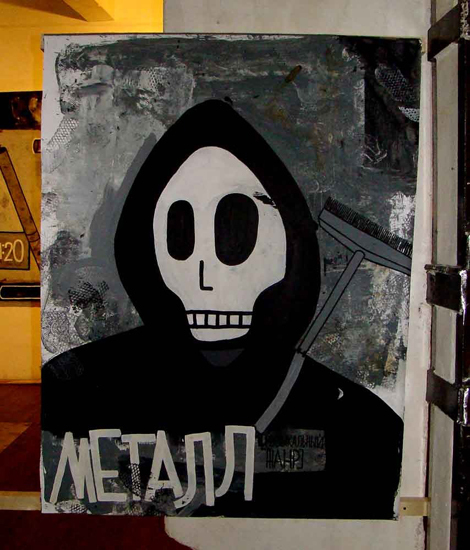
В самом начале сентября откроется организованный ЦСИ «Винзавод» и галереей «Риджина» специальный проект Пятой Московской биеннале Heavy Metal , в котором примут участие 11 художников: группа «ЕлиКука» (Евгений Куковеров и Олег Елисеев), Иван Горшков, Валерий Чтак, Михаил Most, Илья Долгов, Влад Кульков, Григорий Ющенко, Vladimir Logutov, Egor Koshelev, Ilya Romanov. One of the main initiators, if not ideologists, project - artist Yegor Koshelev told Evgeny Nazarov about the boring exhibitions of the same art education and why it is important to emphasize his identity.
- What kind of project will it be?
- In fact, the project was born from several conversations on the vernisages, where, except about art, there is nothing to talk about, and everyone was already tired of everyone. And everyone either begins to wash the bones to each other, or look for abstract topics. With a number of my friends-artists, the conversation ranged the conversation to heavy music. It turned out that we had quite similar musical tastes, and there was something to talk about with much greater heat and interest.
The main thing was the conversation with Valera Chestak, who turned out to be a connoisseur of extreme Geners of heavy music. It became clear to me that I had to do this exhibition when I saw the work of the read dedicated to the Graindkor. When a person spends time to speak out on the topic of little -known and inaccessible to understand the general public of the musical genre, this should be presented in more detail to the viewer.
The depressing uniformity in the theme of Moscow exhibitions and the general course of the art process suggested that it will be very appropriate to make this exhibition right now, within the framework of the Biennale. Because, if you look at the names of its special projects, the slope becomes noticeable either in entertaining botanist, or in literature, or in superficial social activism. All this was already packed, and we want to make a more tough, direct and honest project where random people could not get. The latter became important, because now, if there is a crazy curator, who, for example, says: “Guys, two months later we make an exhibition called“ Hitler's enthusiasm ””, - Be sure to find 20 young participants, who do not care where to exhibit and on what topic to speak out. The wandering, familiar composition of artists goes from one exhibition to another, regardless of what the topic and who are the curator. By the way, we also have familiar people, but there will not be those who were not really interested in the topic. What is important, it will not be an exhibition of orthodox metallists. The task is more likely to give a more complex interpretation of a given topic, although frankly clear, software statements regarding this or that sucker of heavy music, will also be, as well as Formal statements that examine the plastic aspects of the material.
The wandering, familiar composition of artists goes from one exhibition to another, regardless of what the topic and who are the curator.
- Love for Heavy Metal from childhood? In the nineties it was a powerful movement.
- Certainly. I would even say that it was like that from the second half of the 80s.
- And there were a lot of visual attributes.
-The fact of the matter is that this is a whole layer of culture, which is quite sealed.
-But now he somehow resolved.
- No. It’s just that it is in Russia, in Russia, in general, quite populated, boring and superficial mass culture. And in Europe, for some clerk, it’s quite normal to listen to Black Metal or Grindcore . This is part of his identity, which persists throughout life. And there is no problem with this.
Naturally, Heavy Metal has been and remains protest music. And the energy of protest is always preserved in a normal civil society. The thirst for activity and changes in the surrounding life goes well with radical directions in music. And the same festivals of heavy music in Europe exist quite successfully, for example, the German Wacken Open Air gathers hundreds of thousands of people. In the same Europe, the once radical directions in music go to the mainstream. Among the average hipsters, it has already become the rule of good tone to keep a couple of albums of such black metal in the playlist - groups, like Darkthrone and Burzum , not to mention the hipster brake like Liturgy or Deafheaven .
For us, a similar taste seems to be exotic, something strange. We have it like a closed subculture, so it remains. But it is curious that heavy music made its way in Russia in parallel with radical political changes. I remember the first concert at which I was in childhood-“Monsters of Rock” in Tushin in the 91st year, where Pantera , AC/DC, Metallica performed. I was then 11 years old , and I went there with my grandmother. For both of us, it was the brightest experience. True, my grandmother did not understand anything, she considered that it was just an unpleasant noise and frightening cluster of shaggy people. For me, heavy music has become part of my own identity. Namely, with her, our artists have been working little lately.
For some American artist, it is important to emphasize that he, for example, the Filipino, gay and avid skateboarder.
- By the way, the visual manifestations of the life of this subculture almost completely disappeared.
- Yes. And artists who participate in the project, among other things, will work with external incarnations This phenomenon and the world of cliches, which have overgrown with a heavy musical culture. This is a very rich layer. H EVY METAL with his interest in mysticism, otherworldly, death attributes, quasisacral practices and satanism rhymes with the problem of the romantic hero in Byron or Shelley, the superman near Nietzsche . All this can be interpreted as a later, bizarre and strange conclusion from romanticism.
Through heavy music, it is clearly conducted and very well feels how mass culture conveys to us images formed in the eras, remote from us in time. The dark romanticism, which is adopted by English rock, starting with Black Sabbath , and then transformed into recognizable codes of mass culture. This is a very interesting moment.
-Perhaps , due to the lack of genetic ties with romanticism, our heavy music has been largely on the path of socially engaged texts.
- She just followed the path of texts, not music.
- And for you Heavy Metal where did it start?
- In childhood, we borrowed most of the music from older guys, and at that time we gained power of the extreme directions of heavy music - Thrash Metal , Death Metal and Grindcore , so it all started with the same Pantera . By the 93rd year, Black Metal has already gone. In such an environment, my musical tastes were formed.
A kind of academicism arises, that is, a certain system of common values, which seems to be correct and is separated by everyone, but the young artist most often does not cause personal attitude.
-Has anything changed over the years?
- If earlier the day could begin with Napalm Death and end Sepult U RA, now everything is somewhat different. I am not a person recorded on heavy music. I listen to a lot of academic avant-garde, Free jazz.
Returning to the issue of identity: this problem is over Western artists Demol has been from the 80s. For some American artist, it is important to emphasize that he , for example , the Filipino, gay and avid skateboarder. All this can organically enter his creative practices, reproduce in his statements. We have a relatively little identity. This is not good and not bad, it just happened . And now a lot of statements are in no way connected with the personality of the speaker.
For example, a young man enters the territory of contemporary art and begins to speak out on the topic of sorrowful fate of migrant workers (of course, they deserve the hottest participation!) Or other sad social processes, which, most likely, has a very weak idea of. He Rodchenko or IPSI (Institute of Problems of Contemporary Art. - Ed .) Parably went to school, he was given several correct lectures on what topics the art should be and what it should be. He thinks: "Yes, why not." As a result, you get sluggish, boring, unlikely, absolutely impersonal statements that reproduce a standard set of topics that have risen recently. This leads to total unification of all authors. A kind of academicism arises, that is, a certain system of common values, which seems to be correct and is separated by everyone, but the young artist most often does not cause personal attitude. Such images are born that roam from the author to the author, from the exhibition to the exhibition, allowing little to understand about the artist himself and what he was In fact Interesting. Then, somewhere on the vernisage, these artists meet and, having agreed to any topic such as Heavy Metal , understand that this is great, there is a different, more acute perception of the cultural situation .
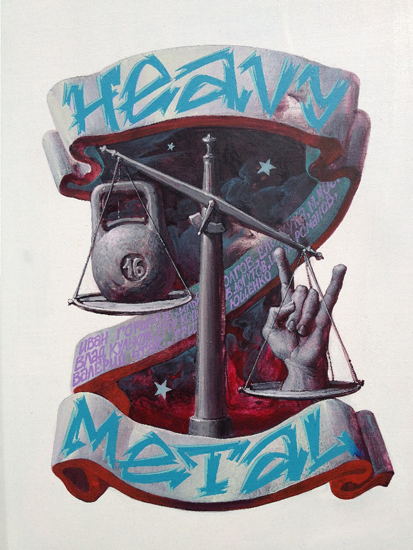 Egor Koshelev. Heavy Metal. 2013
- In general, this is a curious phenomenon of the art scene that all supported and seemingly important topics, being expressed in works, often have no acuteness. And sometimes such, it would seem, do not require additional reflection and explanations of the topic, like Heavy Metal , have a much stronger effect on the viewer.
- Not so long ago I was in Vienna and visited the local Academy of Arts, where I was really shocked. There are people who are 20-23 years old, they had an exhibition of creative works. The abundance of authors, very similar to our typical artists, struck. It would seem that another country, other people, other thoughts. But it turns out that we have one circle of topics, only interests, only plastic tricks. They wander internationally, with equal indifference, reproducing in the work of artists from different countries.
But there are examples of how an artist can cling to something really important for him and burst out to a large and significant statement, without looking back at the fact that today in Favor, which can hypothetically arouse interest among critics and an interested audience. So, one Canadian artist was infringed with the statement of the prime minister, who was abandoned in a casually, that Quebec is a dirty city. He began to make flying garbage, attached the motors to the waste and launched them in the space of the gallery. All this had a pronounced political character and was saturated with local nationalism, which today is not very clear to us. It turns out that a small moment in the local political life, on the basis of which a creative method was built, caused a fairly wide international resonance.
And in an exhibition about Heavy Metal, we would like to indicate constants in our own identification, which are important to us, which define us as a generation and individually as authors. Many participants in the exhibition will create precisely the plastic monument to their favorite music.
Despite the fact that we constantly speak out about the shortage of new artists and complain about the presence everywhere and the same persons, we have exactly as many artists as we need.
-If we return to the art schools: over the past few years, we have increased, and this clearly increased the unification coefficient in the work of young authors, about the deficiency of diversity among which a lot is mentioned. Is this increase in educational institutions useful for the artistic process?
- Art is a too complicated phenomenon to unambiguously speak out on this issue. Obviously, our academic institutions cannot cope. People from them come out in the best case in a state of professional confusion, and at worst-depressed, torn to be torn to become artists, but want to somehow stumble and earn their piece of bread. But to be honest, despite the fact that we constantly speak out about the shortage of new artists and complain about the presence everywhere and the same persons, we have exactly as many artists as we need. Today's Russian society is not needed by artists. Today's Russian man almost does not know his artists, even classical, not to mention modern ones . He still does not realize How to perceive visual art. If this is some part of the entertainment sphere, then what is interesting here, explain? Or is it a part of a serious world of culture, the understanding of which still needs to be learned (what you don’t really want to do)? And if so, why for the most part - how does the average person see it - representatives of this world of serious culture behave like complete idiots?
If a person graduates from the base “Base” and fiercely hates Osmolovsky, this is great, because on this hatred people move on in art.
New schools, making useful shifts in the modern art process, give rise to the phenomenon of new academism. After all, academicism is not about the fact that a person learns to draw correctly, build a flavor and composition, but that a generalized system of values is imposed, which is broadcast through a team of mentors . And then the listener assigns it to such an extent that he is not the master of his creative statement, but this very intellectual base that he receives in an educational institution. He cannot modify her in something really interesting. He is simply an instrument in the hands of an impersonal academic system. At the same time, the appearance of the Academy can be absolutely any: from the classical Imperial Academy of Painting, Sculpture and Architecture a model of the XIX century to the Academy of Cubism or any of the schools of contemporary art, which do not work on Creative education of the authors, and on their correct opening. This is all the same academicism, just in different clothes. And the artists who go to study should understand this.
How much is it possible to "prepare" the artist? A person or an artist has creative potentials, will speak out in the language that he has, no matter what, and will look for an opportunity to show his creative will . Or he is just a conscientious (or unscrupulous) artisan. He can be an excellent academic drawingman who has nothing to say from himself. He can also be a brilliant juggler with the terms of the latest philosophy, behind which no copyright intentions are visible. What distinguishes the academicism of all times and peoples is not some kind of conditional form or manner, but the emptiness of the author and its absolute inability to speak out.
It seems to me that the main thing is that the latest educational institutions should be educated in students - hatred of their organizers. If a person graduates from the base “Base” and fiercely hates Osmolovsky, this is great, because on this hatred people move on in art. If such a positive creative hatred is replaced by sluggish humility and gratitude to the teacher, then the case was covered with a copper basin.
However, it is unambiguous to talk about this yet. And, perhaps, after 15-20 years, none of modern Russian artists will recall, considering this period a protracted crisis. Let's try to spend this time so that at least we ourselves were interested. And now that long -awaited moment comes when it is necessary to show the “goat” ...