
Translated material
Television is not for everyone
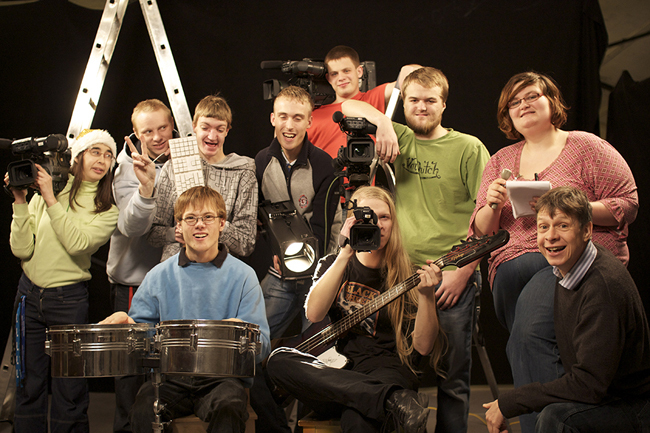
Great television steadily loses the viewer. Small television channels, on the contrary, are gaining momentum, there are more and more of them. The monolithic television audience breaks up into small segments, each give something of their own, here television requires a narrow specialization, and uniqueness is sometimes more important than universality. While the traditional TV is looking for exits from its protracted crisis, rare outlandish flowers bloom on the roadsides of telemainstream. Cable, satellite and Internet television facilitates the creation of television channels for any audience, for every taste.
Tv-glad. For alternatively gifted
The world's first television that people with mental and mental disabilities do. They try not to keep them in Denmark in hospitals, they are socialized in every possible way. TV-GLAD arose in Copenhagen in the summer of 1999-now it is not only TV, but also radio, production studio, animation workshop, training center and branches in different cities. The broadcast of TV-Glad from 30 to 60 minutes a day-city television channels are allocated. Recently, a children's cyclic gear , which TV-GLAD produces in conjunction with DR , the main national television radio holding, has started. People with “mental” diagnoses themselves have interviewed the heroes of their reports, from passers -by to officials (in particular, the queen of the Danish Margreta), they themselves remove, mount, draw graphics - teachers and professional television people only help. TV-Glad branded dish-for which he periodically receives festival awards-animation:
Justice TV Network. For places not so remote
Telezet "Justice" broadcasts special television programs for British prisons. Channels are provided for personnel, security, visitors and convicts themselves - of course, they pay more attention. For Sidelski, they create short, two-three-minute programs in order to motivate them to change their lives, to help rehabilitation and socialization after release. Not such a new practice for Britain, where since 2006 there is a National Association of Prison Radio Station, not to mention numerous organizations and funds in support of prisoners.
DogTV. For dogs
The world's first television for dogs appeared in the United States last year. First, on the Internet, then DogTV began to broadcast satellite and cable television. The channel is paid, the subscription price does not exceed $ 10 per month - a little for such a unique content. DOGTV software director of the University of Tafts Nicholas Dodman, animal behavior specialist, and his employees, including veterinarians and trainers, create Dogooriented channel. The grid comprises three types of transmission: relaxing, stimulating and training. A special pace, thoughtful angles, the specifics of the camera and color solutions, not to mention the Full HD format - everything is intended for the dog, everything does the channel, according to the creators, an ideal nanny if your best friend remains at home alone. But you can watch DogTV and together, dog programs, as you can see , are great for human meditation. The concept is successful - last spring, dog television broadcasting was launched in Israel.
You cut the garlic and simultaneously find out what is in common with the "guitan" with Egypt.
Cheesstv. For thinking
The first Russian online telekanal about chess started last year, and at the beginning of the present, having enlisted the support of FIDE and personally Kirsan Ilyumzhinov, became round-the-clock. The chief editor of the Canal Mark Glukhovsky is the editor-in-chief of the oldest chess magazine 64 in Russia. The main thing on the channel is direct broadcasts, in this area, in fact, the Digicast company, which founded the channel, specializes. Chessstv comments on chess tournaments simultaneously in several languages - this is done by grandmasters, among which, in particular, Peng ZhaoCin , Vladimir Kramnik , Robert Fontaine . In addition, competitions are being discussed here, parties are dismantled and interviewed at chess stars. Where in our time you will see on TV - albeit a network - an interview with unreliable Harry Kasparov - albeit about chess? It is piquant, given that Digicast is the brainchild of a trustworthy telemarker , who was entrusted with the monitoring of the latest presidential elections and in customers whose administration and management of the Presidential Affairs, the Government of the Russian Federation and the Organizing Committee of Sochi-2014.
GIPSY TV. For free -loving
The Romanian Internet telekanal about gypsies sees its mission in full support of the national minority. In the channel news, a vast geography - Gipsy talks about gypsy life not only in Romania, but also in Hungary, Poland, the Czech Republic and Slovakia. Toratically, everything is not so diverse - by one cyclic program about gypsy culture, travel and cooking. But the colorful presenter seasons national dishes with excursions into history and comparative linguistics. You cut the garlic and simultaneously find out what the “guitan” has in common with Egypt:
RLTV. For pensioners
If you decipher and transfer, the channel is called "Life on Retires" - this will be stronger than gypsy television. In a marked America obsessed in his youth, at a time when the TV around the world is chasing an active audience of 25 to 45 and awkwardly flirting with the young spectator, to take and make the channel “for those for 50”. This is so neatly formulated, in fact, we are talking about older audience. The slogan of the channel - "Experience matters." The idea is that if a person is over 50, then he grew up on a TV, but the current broadcasting is not intended for him. RLTV speaks with his respectable audience about what is interesting to her: health, social protection, relationships with children and grandchildren. But besides - about traveling, about how to start a new business in old age and radically change the lifestyle. And also offers her a reality show “Another chance to start a novel” , a program about extreme rest and other options for an restless old age. The founding and head of RLTV John Erickson is now 69. Having taken up in 2006 for a pensioner television, he was not mistaken: the channel is successful, he has several national telepresses and a good audience-the number of elderly people in the United States, like everywhere, is growing, and they are watching the TV more often and more. In 2006, it was not so obvious, and now large American televisions follow the example of RLTV , creating programs for the age audience.
In principle, after all, our federal television channels do about the same. Programs for Negumanoids. Programs for those who are at rest - and for those who are on eternal peace. It’s just that our television channels do not always recognize this and never admit it.