
Translated material
Ring -2013 in Bayroit
“Do you need? Take it, we have it, we have it all! " - The lady from the neighboring row held out a package with plastic whistles and puffs, which are usually used at the stadium. Evening toilet, thoroughbred profile and hate -burning eyes. It was after the premiere of Twilight of the Gods - the last opera from the cycle “Nibelung Ring”. The scene is FestShpilhaus in Bayroit, where the famous Wagnerogy has just been set by the notorious Berlin director Frank Castorf.
The director, who was not shown on the stage after the first three evenings (which, in principle, in tradition), gave the initiative Munich faction in Bayroit time and a reason to prepare a real obstruction. "Castorf, at ... Xia in Berlin!" - chanted men in tailcoats. "Disgrace!" - the ladies squealed in chorus. "Bo-oh!" - Hang the hall. Castorf, dressed up in a light linen costume of the bourgeois on vacation and new white sneakers, clearly acquired for this solemn occasion, surrounded by his “forces of operational response” (scenographer Alexandar Denich, costume artist Adrian Braga, Perezer-Rainer Kasper) eleven and a half minutes bathed in the waves of this “ _stand__i__ng Boovation __ _, how a colleague from New York Times described this is the expressing of feelings by analogy with Standing Ovation . We winked at each other and shouted “bravo!” In chorus. And what was to do in such a situation? Moreover, the curtain has already risen and behind Castorf discovered the entire 200-headed ensemble-soloists, choir and orchestra, led by conductor Kirill Petrenko. “Bravo, Bravo Petrenko! Down with Castorf! " - screamed the demonstrators.
If we take into account the aura and the cult nature of the Bayroit festival, the significance of Wagner for the minds of the Germans and the presence of the first persons of the state on all the premieres, each new production in Bayroit becomes an event of almost national significance. Moreover, the production of a new “ring” (tetralogy is put at the festival on average once a decade), especially in the year of the two hundredth anniversary of Wagner. This was one of the reasons why finding a director for a new “ring” was extremely difficult .
Castorf was the only one of the lights of the German spirit who agreed to work. “I, you know, grew up in the GDR, and it was customary to buy bananas from us when they appeared in stores,” commented on the boss of the Berlin Volksbühne his decision to make an offer from the green hill, despite the lack of opera experience and modest knowledge in the field of music.
On the eve of the premiere, Castorf was clearly nervous, said stupid things (in particular, actively flirted with his East German socialization, many in Germany have such a protective reflex) and complained that in Bayroit he had to work in a very short time (for which he reasonably noticed that he did not even exhaust the reheetization time).
In a word, there were all the reasons to expect the most shameful failure of directing. He definitely did not happen. What exactly happened - it becomes clear only gradually, as the incident comprehend.
 © Enrico Nawrath / Bayreuther Festspiele
Castorf is not even trying to pretend that he puts the opera and even more so Wagner. It is difficult to say if he heard the music before the beginning of the orchestral rehearsals. I read the libretto, and carefully. He also read Wagner’s biography, isolating approximately such a set of supporting words: art as a revolution, criticism of capitalism and world domination of money, friendship with Bakunin, “children, create a new one”.
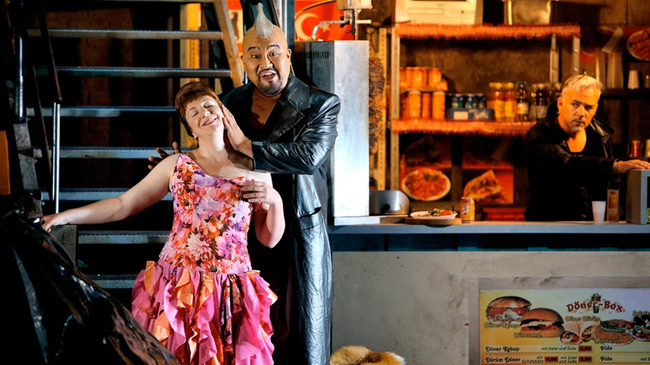
Having easily coffee the Gold of the Rhine with oil, the director sketched four situations for sketches on a conditionally near -reflecting theme. As a result, four absolutely independent performances were obtained, no common thought or a temporary canvas united, but sometimes quite entertaining.
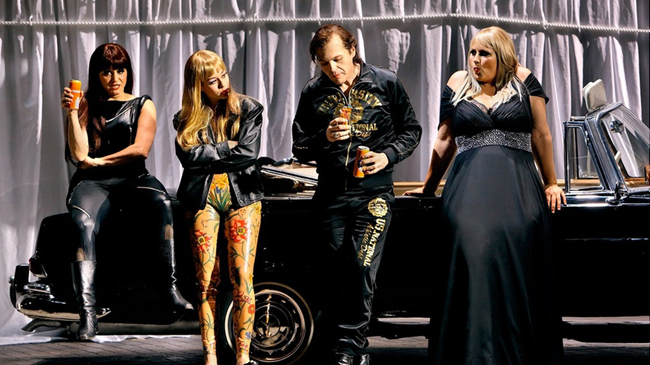
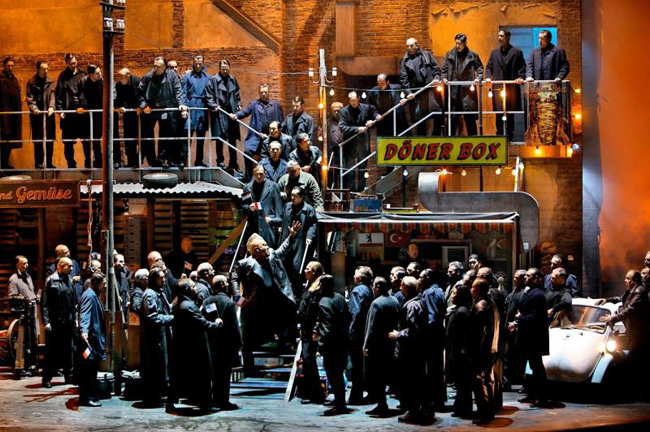
The first (“Rhine Gold”) talks about the difficult relations of the old mafiosi and pimp Votan with his clan and business partners. The case takes place on a gas station in Texas in the conditional 70s. The second - “Valkyrie” - transfers us to Baku at the end of the XIX - early XX centuries, where, as written in Wikipedia, the history of oil production begins. Castorf’s acquaintance with Eisenstein’s films and the Cyrillic alphabet was used, so I had to translate colleagues (not possessing the experience of life in the GDR) slogans such as “shock pace, full stroke” or “more oil and gas for their beloved homeland”. Nepman Votan turns out to be the owner of the oil refining factory.
In the first act of Siegfried, we are at the foot of a sort of communist rashmor with the heads of Marx & _co_, then the action leads us to the backyards of Berlin, first of the eastern, and then, in Twilight, and the Western. In Berlin, as in Baku, the interests of two oil superpowers - the Soviet Union and the USA are faced, explains the director in the booklet. In the final, there is also a portal of the New York Stock Exchange, where, presumably, the threads of world domination converge.
A seditious thought creeps up: how much the theater does music need? And what?
Castorf, as well as the deceased Christoph Shlingenzif who worked in Bayroit, and is going to do this Jonathan Mezie (by the way, all three were or are friends), belongs to the flank of German culture, where it is customary not to analyze, but to campaign and shaman, and others. Intuition is a good thing for art, and some of the scenes placed by Castorf are quite successful: for example, it turned out to be a strikingly touching second scene of Twilight, where the descending pimp, Votan meets with the old whore of Erda, to talk about the fate not so much of the world as the common child, the daughter of Brungilds. Probably, a scene of forging a sword would also look spectacular if Siegfried (Lensa Ryen) managed to train to assemble a Kalashnikov assault rifle (in which the director with some reason sees a modern notung), laying pieces of iron to the beat of music. But Ryien, unlike Castorf, did not serve in the East German army and does not know how to assemble a machine gun with his eyes closed. So he had to give him in addition to the machine, a well -deserved sword from the Bayroitsky props.
There is almost constantly a camera on the stage, on the screens provided for by the scenographer Alexandar Denich in a variety of places, there is a live broadcast from the visible and invisible corners of the stage, the video is mixed live. Video on the stage is Castorf's company technique, but one cannot fail to note the virtuoso work of the team of operators, director and widget (led by the faithful ally of Castorf Andreas Dainerot).
Ah yes: at the end of Siegfried, two charming crocodiles crawl out onto the stage, one of which, to the joy of Brungild, devours a forest bird in a suit of a samba dancer, who had previously had One Night Stand with Siegfried. Crocodiles are their favorite pets of the German scene, for example, in Pina Bausch they crawled among dancers back in 1979, symbolizing the danger of eroticism.
 © Enrico Nawrath / Bayreuther Festspiele
The leitmotif of Votan's lust is quite primitive, although it is appropriate. Norne and mermaids in the role of cheap whores have to endure. Reading the image of Siegfried as a depressed killer prone to sadism, of course, explains his reprisal not only against the Fafner (another pimp), but also over Mime, who had a cold -blooded one, is cold -blooded with three knife blows into the stomach. Castorf does not have positive characters, with the exception of, perhaps, Brungilds, and even that comes to their senses only to the end of the last part of the tetralogy, already approving the custom -made murder of a loved one.
Logic and structure in the play are absent, the only message is the complete absence of any message. The story of the confrontation between systems and the “bloody path of oil”, which Castorf voices in an interview is nothing more than an attempt to “cover the shameful places”. If you do not read the booklet of the performance, the notorious “black gold” can not be noticed at all - you never know what black mud is smeared with each other from time to time the heroes. No through idea, no attempt to interpret the Wagnerian myth. The king is absolutely naked, this is a fact.
Perhaps Castorf wants to say: the problem is not in the system, the problem is in a person. This, of course, is so. But if a person is not complicated and contradictory, like Wagner, if he is only ontologically mean and a bastard, it is not clear why this vegetable garden is fraudulent.
And, as usual, it is in this deliberate helplessness that force is. Having discouraged and indignant at the viewer, Castorf leads him into the dense forest of hemispers and senselessness and throws him to be eaten by individual demons. In 16 hours of the play, the director pours on your head so many finely chopped associations and analogies, which at some point gets everyone.
Of course, Castorf Pig. It rummages in the discharges of our consciousness, in the “visual memory of several generations”, as one of the German colleagues correctly remarked, and tears away any divorce there, which falls in front of your nose with appetite. It is painful and very German. After a couple of days, you begin to think that it was probably useful. And in a week you understand that you do not remember the scene from the last three “rings” viewed in Vienna, Munich and some Mannheim, but you can retell the Castorfovsky opus with a high degree of detail.
The question arises of the ratio of all this business with music. Since Kirill Petrenko, the new young god Bayroit, held an educational conversation with Kastorf, asking him very much, God forbid, not touch the score and not interfere with the life of music at all, this does not happen. The singers said that the director was extremely respectful, to any remark on their part, readily provided them with complete freedom of action. As a result, large conversational scenes are set extremely static, more precisely, not set in any way.
 © Enrico Nawrath / Bayreuther Festspiele
On the other hand: we all think and write as if a directorial opera, which is only a few decades, is the only language and the path of development of the musical theater. But maybe this path has already passed to the end? In Bayroit, the LoEngrin is the Patriarch of the director’s opera and its actual creator Hans Neoenfels and until the last year walked the Parsifal Stefan Herhaim. Virtuino, more witty, more professional in this channel is simply impossible to do anything. Naturally, you need to look for new ways. A seditious thought creeps up: how much the theater does music need? And what?
Kirill Petrenko, conductor, who was in advance by the discovery and sensation and the post -fact, was praised beyond measure, devotedly serves the music of Wagner. He is not as enchantingly perfect as the main bear in the Bayroitsky den Christian Tileman, but more experimental and expressionist. In his read, the desire to get to the very essence is felt. Sven Friedrich, director of the Wagner Museum and the Wagner archive at Villa Vanfrid, was giving up that Petrenko spent many hours over the original scores, which was heard. The conductor is not worried about the individuality of his own handwriting, but by the hidden and obvious meanings and beauty of the score. In this, Petrenko, of course, is the anti -to -Castorf.
The crisis of Wagnerian vocals did not bypass the anniversary Bayroit. There are approximately two worthy Siegfrieds on the global vocal market: Robert Dean Smith and Lens Ryen. Ryien is also a good actor and has convincing external data. But in Bayroit the Canadian singer managed to sing his eleventh Siegfried over the past five to six years, which is not good for the voice. Excellent singer Katherine Forster is also in the timbre, too bright, not perfect Brungild. Votan Wolfgang Koch is the best actor than a singer. Burkhard Ulrich fell in love with everyone in his stunningly expressive vocal and acting mime and was probably the only singer in the ensemble, to which there were no complaints.
In general, for the anniversary Bayroit, the leaders of the festival, the combined sisters and great-granddaughters of the composer Eve Wagner-Pasquezier and Katarina Wagner, it is worth putting a solid five. They managed to shake everyone with a new “ring”, update the festival team and find a new pillar in Kirill Petrenko and the statement of Wagnerian truth. You leave your favorite Bayroit with the charge of vital energy and an unbearable desire to return to this divine Francon province as soon as possible, where the idea of a triumph of art over the meanness of life is brought to the maximum.