
Translated material
"Today, the candle box is the central place in the temple ..."
Unfinished interview with about. Pavel Adeelheim
On August 8, Pskov was buried in Pskov, brutally killed in his own house, the 75-year-old priest Pavel Adeelheim. Deacon Andrei Kuraev called him "the last free priest of the Moscow Patriarchate." In memory of this remarkable Orthodox shepherd The New Times publishes an unfinished interview with him

We met Father Paul in September last year at the conference "Reformation: the fate of the Russian Church in the 21st century." It was organized by the public movement "Russia for all." Different clergymen were invited to speak. Only Father Pavel Adelheim was not afraid to come. I heard about him as a wonderful, wise, active priest, but mainly - the passionate criticism of the “vertical of power” built by Patriarch Kirill in the church. They said that Father Paul has been fighting against church reform for many years, which made ordinary priests absolutely disenfranchised, reduced to a minimum the role of laity in parish life and focused all power over parishes in the hands of hierarchs.
During the break between reports at the conference, I tried to talk with Father Paul about the most important thing about what many worried a year ago: what was happening with the Russian Orthodox Church. We, as it seemed to me then, the conversation only began and agreed that we would definitely continue it. Father Pavel invited Pskov. I promised to come. How often happens - I did not have time ...
Anti -Soviet
You are probably the only priest in a modern Russian Orthodox Church who was in prison as an anti -Soviet. Why were you arrested?
I was ordained in 1959. And they planted ten years later, in 1969. True, I did not even receive the primary Zekov education, I spent only three years under the usual article for that time: the Brezhnev article 190 (“Storage and distribution of slanderous materials that defeat the Soviet Constitutional system”).
What did you find?
I found quite a few poems of the poets of the Silver Age: Akhmatova, Tsvetaeva, Mandelstam, Voloshin. The funny thing is that the court decided that I myself wrote all these works, and attributed them to famous poets.
"
“In the church, there is an intransibility of positions on the understanding of church life, which has not yet been decorated. But if a leader appears who wants to lead people, then the split will become a reality. "
"
Where did you serve the deadline?
| *Kyzyl-Tepa village in Uzbekistan. |
I served in Bukhara, and when I was arrested, the investigation led Tashkent KGB, and during the year I sat in an internal prison. Then I was sent to the camp on the territory of my parish - the camp was located in the Kyzylkum*desert*.
How then did you end up in the Pskov diocese?
In the camp after an accident, I lost my leg and then, having been released, returned to my Tashkent diocese. They gave me a parish in Central Asia in Ferghana. Then I had some clashes with a local religion authorized person and a local curator from the KGB, and I was transferred to Krasnovodsk. There it was difficult for me to serve because of the next intrigues by the local KGB, and I decided to leave for Russia. It so happened that, due to disability, I had to move to Pskov. True, at first there were many difficulties, I was driven from one parish in another, they were “planted” all the time on the rector’s head, but then, finally, they gave the parish in the village next to Pskov. And there I started stormy activities and an interesting life - to create a temple and in parallel on the creation of the community. In the late 80s, social work appeared, and then in the city we received the temple, it lay in ruins. This was the first temple in the Pskov region, given to the believers. Our Temple of Fatherland Wives.
Envy
Where are you serving now?
Yes. I have been there since 1988, and in 2008 the ruling bishop (Metropolitan Eusebius.-The New Times) shifted me from the post of rector. Before that, the bishop drove me out of all other temples where I served. I also built a temple in the regional psychiatric hospital at my own expense. The bishop did not help us, but when the temple was finished, he told me: “He went out of here!”
Why did he drive you away? Took this temple for myself?
No, he does not need this temple. This man is not a villain. He lives only with his ambitions. You can talk to it humanly sometimes. But at the same time, this is a person who spoke with me affectionately for ten years, but expelled me from everywhere.
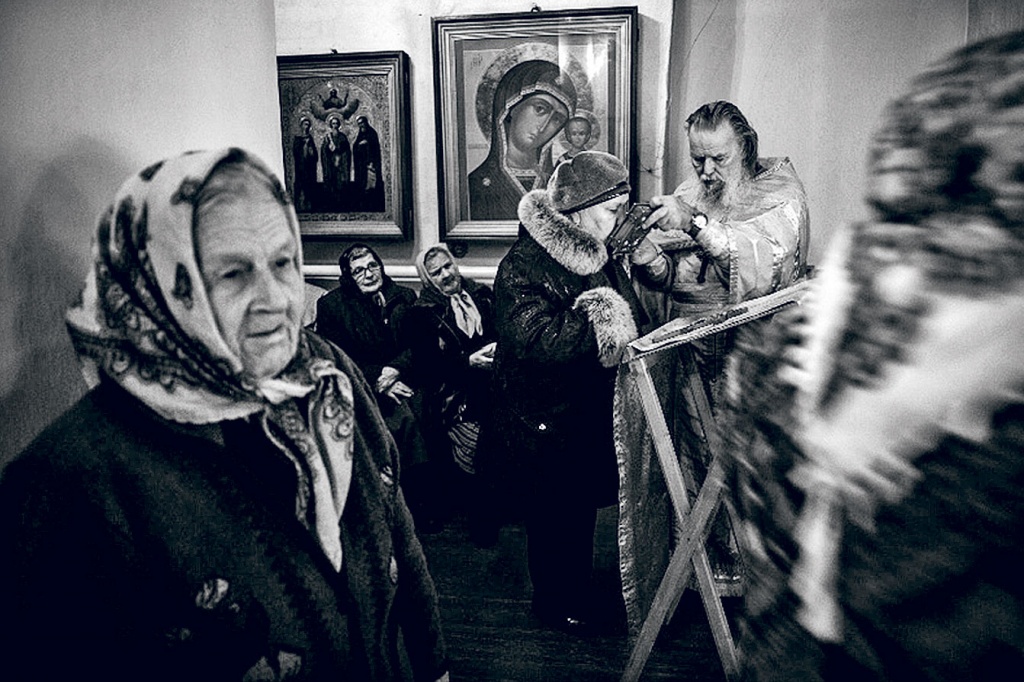
Father Pavel in confession
Why did he dislike you so much? Is it because you envied your power, your authority, which you acquired from believers?
What power? What can a priest against the bishop?
Why are you expelled, as soon as you rebuild the temple, unfold social activities, arrange a parish?
I think that he has some strange envy for me. Everything that I have been doing in recent years, even when we have already completely stopped communicating, he begins to repeat. Since I celebrated my 70th anniversary, for example, it repeats the same. He is a year younger than me. And he repeats, but he gets a parody. It turns out to me involuntarily due to the fact that I am surrounded by smart people who know how and what to do right. And he is surrounded by uneducated and stupid people who give him unsuccessful advice.
Split
If you distract from your conflict with the bishop and return to the problems of the Russian Orthodox Church: is there a split in the church today or is it fiction of journalists?
There are two completely different views on the church and church life. The split in this sense exists: the intransigence of positions on the understanding of church life, which has not yet been decorated. But if a leader appears who wants to lead people, then the split will become a reality.
What do you mean?
There are quite a lot of priests who want the spiritual revival of the church. After all, the whole question is what: we say about the revival of the church, but in fact we are talking about the decomposition of the church. And there are a lot of priests, priests of the young, who are also looking for the revival of the church, but not Kirillovsky (Patriarch Kirill. - The New Times), but the revival of Christianity, not the revival of the distorted image of Orthodoxy, which is now being created, but the revival of the Christian spirit. That is, they want to restore the service as it should be, and besides worship, there is also the spiritual life of a Christian, which takes place in communication, and in education, and in social work. In our church, the Patriarchate now declares both catechization and missionary, but in fact nothing is done, only a lot of commissions are created. And under the patriarchy and under the diocese. I don’t know what is being done under the patriarchy, but I know what is being done in our diocese: we have 15 commissions - for public relations, healthcare and so on and so on. Each of these commissions is headed by some priest who has no idea what this commission should do. He just does nothing about this. But if the reports are required, then these reports are sent to him, and in each report he puts checks. In fact, this is a linden. Ordinary Soviet window dressing.
Candle box
And what are those priests who think not like you and your like -minded people do?
They do the same as in secular society: they think where to get money. Everyone is worried about money, money, money. Now the candle box is the central place in the temple, around which all passions boil. And the altar is somehow on the outskirts and, in principle, no one needs.
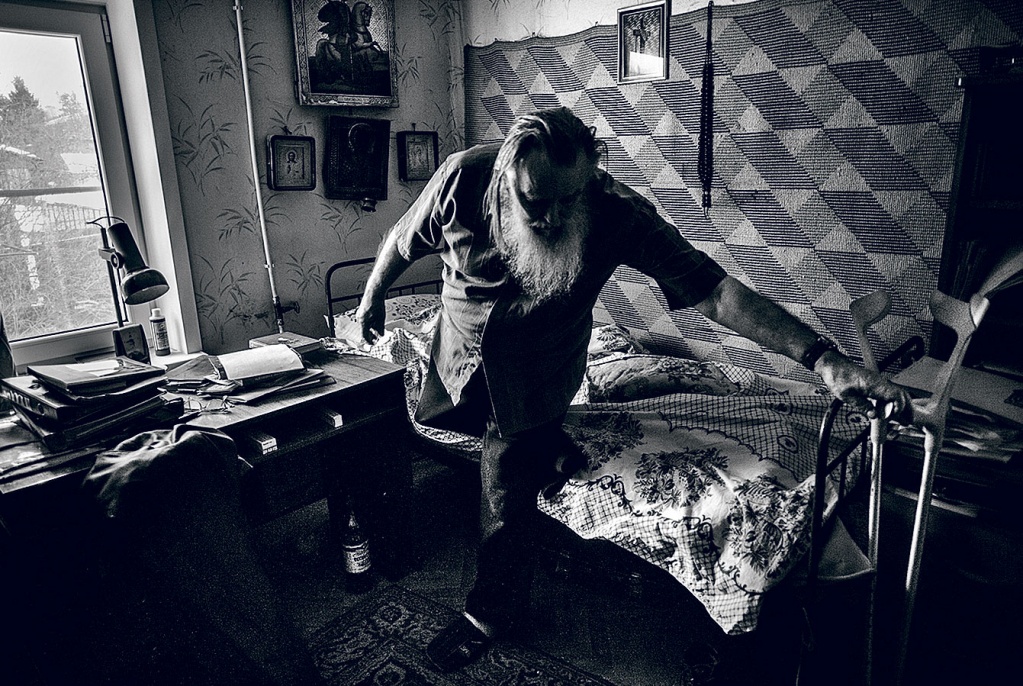
Father Pavel Adeelheim at home in Pskov. 2012
Do these priests need money for themselves or to restore the church?
Of course, for yourself. They somehow saw this money among themselves, both outside the church and in the church. As for our church authorities, it seems that they do not create a church of Christ, but some kind of financial and political empire, that is, in the first place are issues not of spiritual life, not the spiritual education of the people, but property, capital, politicians.
Why?
There are three types of leaders. There are those who are ready to make personal interests for the organization that they create. These are rare leaders, sacrificial people. There are those who are guided by both personal interests and state ones. This again is not so often found, since these interests do not always coincide. Finally, there are leaders who are guided by personal interests and who use the structure that they lead to satisfy their personal ambitions, their career growth.
The Providence of God
| From the autobiography of Father Pavel Adeelheim, my grandfather Adelheim Pavel Bernardovich, born in 1878, from Russian Germans, received an education in Belgium, owned the estate Glukhovtsy and Turbovo near Kiev, built a kaolin, sugar and horse factories. After the revolution, the estates and factories were nationalized, and his grandfather was invited to Vinnitsa, he built a kaolin factory there and was its director until 1938. He was arrested and shot in Kyiv on April 29, 1938. Father Adelheim Anatoly Pavlovich, born on May 16, 1989, born in 1911 - Artist, poet. Shot on September 26, 1942 rehabilitated on October 17, 1962 by another grandfather, Dylaev Nikanor Grigoryevich, - colonel of the tsarist army. Fate after the revolution is unknown. Mother District Tatyana Nikanorovna, born in 1912, was arrested and convicted in 1946, from the places of imprisonment of Soslan to the village of Ak-Tau of the Kazakh SSR. I was rehabilitated in 1962. I was born on August 1, 1938 after my mother was arrested, lived in an orphanage, then, together with my mother, was at a forced settlement in Kazakhstan, and later was a novice in the Kiev Pechersk Lavra. From there in 1956 he entered the Kyiv Theological Seminary. Excluded by Abbot Filaret (Denisenko) for political reasons in 1959 and was ordained Archbishop Ermogen (Golubev) to the deacon for the Tashkent Cathedral. He graduated from the Moscow Theological Academy, appointed in the city of Kagan of the Uzbek SSR the priest in 1964. In 1969 he built a new temple, arrested, convicted under Art. 190-1 (slander for Soviet power), sentenced to three years in prison. In 1971, in connection with the unrest in ITU, Kyzyl-Tepa lost his right leg. He was released from the imprisonment of a disabled person in 1972. He served in Ferghana and Krasnovodsk. Since 1976 I have been serving in the Pskov diocese. Married, three children, six grandchildren. One of my two parishes in Pskov is called the Temple of the Holy Fatherland wives. Since 1992, the temple has opened the parish educational Orthodox school of regents. My other parish in the name of the Holy Apostle Matthew is in the village of Piskovichi. At the Church of the Holy Apostle Matthew since 1993, there is a shelter for orphanages. "Continent" No. 115, 2003 |
How do you assess the role of Patriarch Kirill in the life of the Church?
I think Patriarch Kirill is a source of church evil. Under the Patriarch of Alexia, Kirill had a very large weight, but still Alexy held him back, crushed him a little. All documents, all new charters published by the Church, all this is Cyril's business.
Does he exist in alliance with the authorities or leads his own game?
Of course, he is in the symphony with the authorities, but he has a personal interest. He made a brilliant career, received huge funds, and he, of course, builds his personal well -being and personal prestige. His ambitions are very great. But in civilian society, he is Zhupel. Of course, he belongs to some specific clan in the Kremlin that supports him.
And from the point of view of the Church, is it useful or harmful?
God chose very different prophets to Himself, sometimes he demanded from them such things that seem to us not even moral. Here, for example, Pussy Riot - did they do badly or well? In terms of purely human, I think that dancing in not very decent clothing on the lounges is not good, but I’m afraid to condemn them for it, because sometimes the Providence of God does not act as we used to understand this correctly.
And how do you assess the reaction of the church to the Pussy Riot action itself?
A terrible, of course, reaction, non -Christian reaction. Just ordinary revenge. The desire to take revenge on the fact that the church was offended.
Now some parishioners of the Russian Orthodox Church say that they are ready to leave the church in protest. How do you look at this?
I came to this church. I came after it already included people worthy of the highest respect, who are undoubtedly the leaders of spiritual life. I was ordained Vladyka Yermogen (spent eight years in the Stalinist camps, served in Tashkent. - The New Times), which was ordained by Patriarch Tikhon. So I have such direct roots. It was not me who changed, my views that were from the beginning remained like that. But around me, the whole environment began to change very much. People appeared with completely different views, and we no longer understand each other. Patriarch Kirill is a representative of a completely new spiritual position in the church.
You are one of the few employees of priests who stood up for Pussy Riot. Are you not afraid that you will be sent for the state?
I can expect this, but I'm not afraid of it. They will send and send. And once it will be necessary to die. Well, now I am afraid of death? ..
September 17, 2012
Photos: Vasily Popov