
Translated material
Solzhenitsyn of our time
A year ago, on August 17, a sentence was announced to the Pussy Riot punk group punk groups
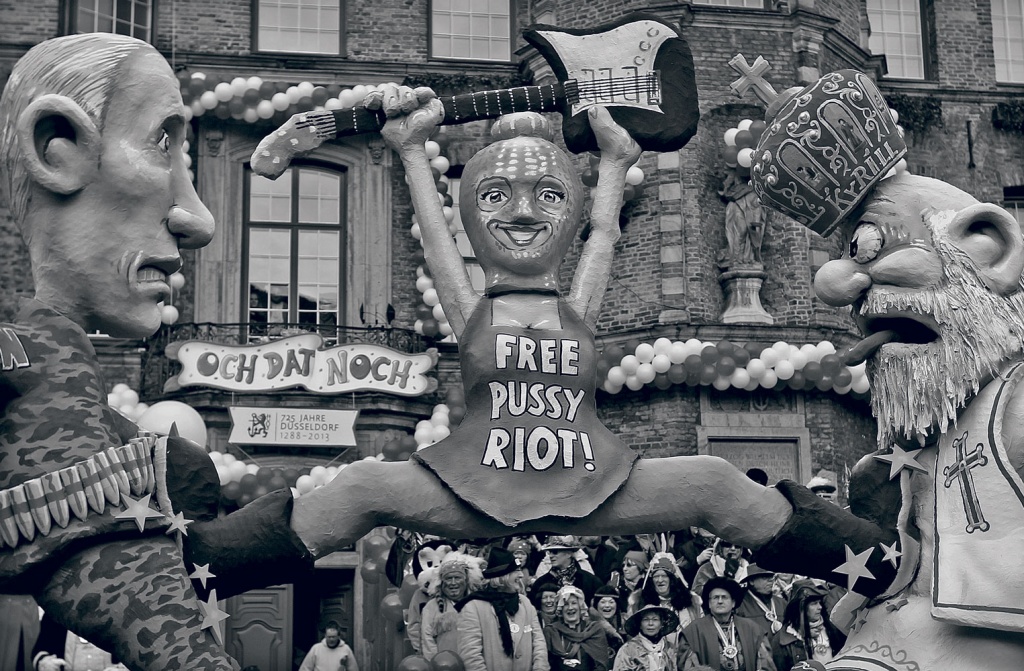
Carnival in Dusseldorf. 11 February 2013
In Moscow, the day of the sentence has already come, and in New York there was still an evening. The Fashion Hall of Ace Hotel was crowded to crowds and stuffiness, and there was still three hundred people on the street: and there was a crowd in summer stuffiness. A full house at the charity evening of readings in the second half of August is even something beyond the New York standards. And the fact that the program included the main names of the New York undergrand, you can’t explain the full house: they, as a rule, do not collect such crowds for their own performances. And here they read rather uneven texts - translations of poems demanded too long explanations, which, however, did not give, and speech sounded like good, of course, the speeches of young progressive Western politicians, but in the year of OCCUPY WALL STRET this good - good, and sometimes brilliant political speeches - was in bulk.
Listening to the translations of the defendants’s speeches at the Pussy Riot process, in particular the speech of Nadezhda Tolokonnikova, it was difficult to get rid of the feeling that here, in New York, performed by Levakian poets and artists, they sounded much more organic than in Russian in the cage of the Hamovnic Court. This is one of the secrets of the success of Pussy Riot: having spoke in a language understandable for the Western public, the group members gave them the opportunity to identify with themselves. The readers on that evening - the artists Karen Finley and Justin Bond, the poet Ailin Miles - were like that 25 years ago. They - Finley, for example, for hooliganism in art were deprived of the grants of the State Art Fund, there was a huge scandal, and it came to the Supreme Court (Finley lost). And the Pussy Riot after a quarter of a century was arrested for the same thing, hitting in handcuffs, judged in a cage, sentenced to imprisonment.
Having giving the Western audience the opportunity to identify themselves with them, Pussy Riot committed in relation to Putin what Alexander Solzhenitsyn made in relation to the Soviet regime, publishing the Gulag Archipelago in the 70s. They turned the attitude of the West to the regime established on one sixth of the land.
That New York evening had another feature, which I noticed almost by accident. The organizers sent me the script in advance and offered to choose a piece for reading. I knew that I would choose: Tolokonnikova dialogs with the victims. But they were not in the script. As there were no speeches of the victims and the prosecutor. The point is not that the organizers of the evening did not consider it necessary to imagine the point of view of the opposite side - they are not a newspaper, in the end, to create the appearance of balance. The fact is that those parts of the trial, which seemed to me the brightest, most egregious, were simply uninteresting to them. The court himself was only interested in the inscription-scrap involuntarily granted the rostrum to the participants of the punk group. With the opposite side, everything is clear: it is an unconditional evil. The Putin regime in the eyes of the Western leftist, that is, the representative of the most politically active (and as a rule, the least involved in foreign policy) part of society, is an unconditional evil. Gray, banal, not deserve to close attention evil. And this is the achievement of Pussy Riot.
Not their only major achievement, by the way. It’s just that large works of art have many unexpected consequences.
Photo: Ina Fassbender/Reuters