
Translated material
Goodbay, America?
Why Putin disliked the United States
US President Barack Obama defiantly refused to meet with Russian President Vladimir Putin in September in Moscow. There will be no personal meeting of the two presidents in the G20 fields in St. Petersburg. There was no such cooling even during the time of Reagan, who declared the USSR the "Empire of Evil", but from meetings with Gorbachev, who did not refuse. Experts recall that the last time something similar happened during the time of Nikita Khrushchev. Why did Putin so disliked America that he moves him? The New Times turned to experts on both sides of the ocean
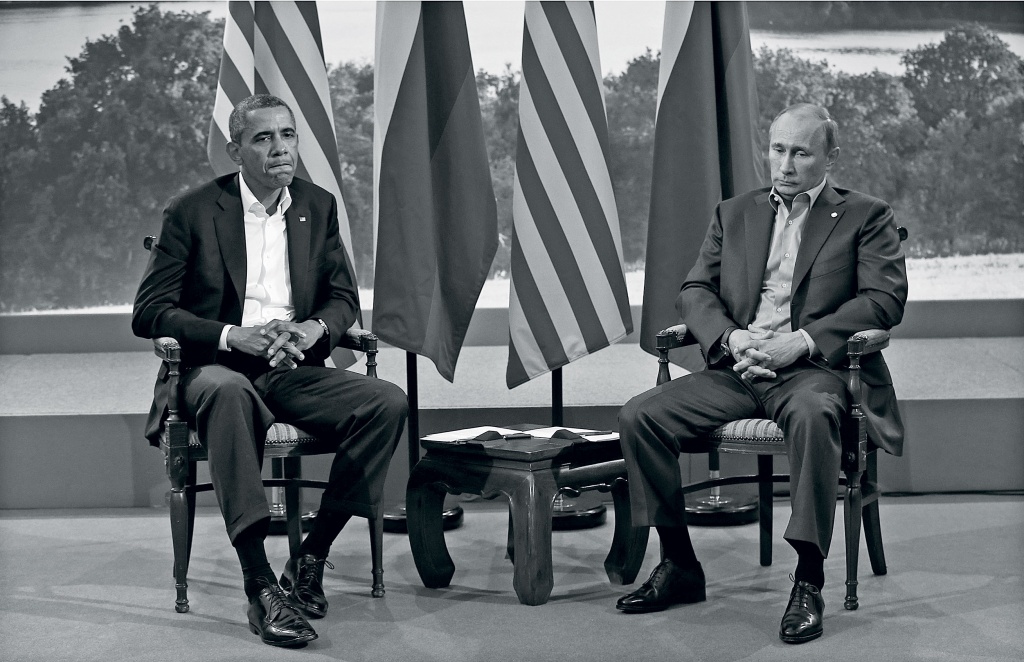
Already at the meeting at the G8 summit in Northern Ireland on June 17, 2013 it was obvious that Obama and Putin had nothing to say about
Dmitry Train, Director of the Moscow Center of Carnegie*
| *The text is based on the publication in the network edition of Tablet Magazine. |
In the first years of Putin’s reign, his relationship with the United States was distinguished by relative harmony. He began by talking about strengthening ties with NATO, was the first to call President Bush after the tragedy on September 11 and provided quite practical assistance during the American operation in Afghanistan. The shift began after the “color revolutions” in Ukraine, in Georgia and Kyrgyzstan, which Putin regarded as the desire of the Americans to oust Russia from the zone of its interests. The result was his Munich speech. The arrival of the new president, Barack Obama, in the White House Putin-although he was not formally president at that moment, but still controlled everything-he took as an opportunity to “reload” relations with the United States and improve the mistakes of the previous administration. The result was dual: on the one hand, Obama demonstrated that he had no interest in the post -Soviet space, and adjusted the US plans in relation to the about in Europe - it was good, on the other hand, Libya's bombing in order to change the regime there - it was definitely bad.
Disappointment
Returning to the Kremlin, Putin accused the United States of getting into the internal affairs of Russia, the State Department was that he finances protests and fell upon those whom he christened with “foreign agents”. Official anti -Americanism became the main feature of his new presidential term. It can be stated that over 12 years of his location in power, Putin lost any kind feelings for the United States that he had at the very beginning of his reign, as well as sympathy for Europe. /.../
From the very beginning of the Arab Spring, Vladimir Putin considered American politics in the Middle East the wrong, unprincipled and dangerous, and all the US attempts to calculate the situation or intervene in it were, from his point of view, monstrous. / .../ For example, convincing the public of the readiness of the Egyptians to accept the democratic rules of the game, the United States was mainly preoccupied with the protection of its geopolitical interests, including the world between Egypt and Israel and navigation through the Suez Canal. Even the military coup on July 3, 2013, Washington refused to recognize the coup so that it could be hypocritical to circumvent American legislation, which prohibits in such cases to provide (foreign country) military assistance, a key tool for the influence of the United States. / .../ In Libya Barack Obama, he decided on military intervention contrary to the advice of his own military - this was done in order to keep his face before the elections in America, as well as support allies in Europe and the Arab world. / .../ According to Putin, as a result, Libya ceased to exist as a state.
But in the most obvious way, the failures of American foreign policy manifested themselves for Putin in Syria. The United States was not guided by the desire to create democratic Syria - they made an attempt to take Iran the most important ally in the region. Democracy was only a means of achieving this goal. And to establish democracy in Syria, America spoke in alliance with one of the most authoritarian states in the world - Saudi Arabia and Qatar. For Putin, the principles of national sovereignty and non -interference are above all. “Do not forget Libya,” he instructed Russian diplomats at the UN, urging them not to pay attention to the preparation of the next humanitarian “Crusade”.
It is unlikely that Bashar Assad is among Putin's close friends: “He often visited Paris and London than Moscow,” Putin once remarked sarcastically. From his point of view, the armed Syrian opposition, unlike its weak political wing, is controlled by al-Qaeda. Help to these forces in the seizure of power in the most important Arab country will lead to its transformation into a bridgehead for terrorist operations in the region and beyond. In Mali, Putin noted, the West fights against the same groups that helps in Syria.
In May, Putin was ready to stop the Syrian war with the United States. For the Russian leader, however, there was no question of shifting Assad from the USA from the presidential post with the United States. Its recipe was simple: Moscow and Washington work hand in hand and on equal terms, they organize a peaceful conference for representatives of the regime and opposition forces, they grant the Syrians the right to choose the future for their country and the details of the change of power. But the USA did not like Putin's proposals. Putin, for his part, did not agree with the decisions of Washington. Do not be surprised that the Geneva-2 conference will not take place. At least in the near future.
"
Putin believes that the United States has lost their way, and the European Union did not find one at all. He sees America and Russia with cultural antagonists
"
Syria is a indicative example of relations between the United States and Russia. Snowden's business thickened the paint even more. Putin's firm position: no extradition of a fugitive in the United States. / .../ The Kremlin immediately recalled the Russians serving terms in the American prison (pilot Konstantin Yaroshenko and entrepreneur Viktor But. - The New Times) for controversial charges, as well as the former Chechen militants, whom Russia accuses of terrorist activities and to whom the United States provided political asylum.
Putin believes that the United States has lost their way, and the European Union did not find one at all. He sees America and Russia with cultural antagonists, and from the point of view of basic values, Russia is more than a European country for him than today's European Union. /.../
One against all
Compared to the heads of most leading states, especially in democratic countries, Putin, with his royal in volume and experience in world politics, looks like an impressive political figure. It is sometimes attributed to him qualities that none of the modern Western leaders possess: strategic thinking, historical memory and determination. Putin is often represented by a grandmaster that exceeds other players, even if the position on the board is not in his favor.
Indeed, Putin only benefits from comparison. Modern Western leaders in America and Europe are often very mediocre. His personal merits, especially in comparison with past Russian leaders, whether in the days of the USSR or the Russian Empire, make it a real figure. Putin managed to preserve Russia one, and so far he managed to prevail over his rivals; He successfully disposed of oil money and believes that he found the formula for managing the country: authoritarianism with the silent consent of the population; In the end, he put an end to the post -Soviet dependence of Russia from the West.
However, the problems facing Russia are only complicated by both within the country and in the international arena. To cope with them, he chose the path of conservatism, even traditionalism, which could be a wrong bet in a rapidly changing world. It’s one thing to quarrel with Washington against the backdrop of an oil money flow, another to restrain the growing hegemony of China ... Putin once noticed sarcastically that after the death of Gandhi, they say, and there is no one to talk to. In every joke there is only a share of a joke. Tsar Vladimir believes in his God this mission and no longer walks next to ordinary mortals. /.../
Strogub Talbott, President of the Brukings Institute (Washington), Deputy Secretary of State in 1994-2001.
Western countries, including the United States, are certainly experiencing a crisis of management system. People cease to trust not only state, but also private institutions, banks, and the press. The system that showed its effectiveness during the Cold War today is called into question not only by citizens of the Western countries - in many cases it cannot be an example for the rest of the world.
Putin understood this. He uses a new reality to protect his own system, which I call Putinism. After all, it is much easier to protect the principles of vertical power, sovereign democracy, when an alternative system - in the West - ceases to be attractive.
We pass through a certain step in the development of mankind, when all large countries are experiencing difficult times. About 200 thousand speeches against the authorities are registered annually in China. We see how the situation is developing in the Middle East - in Egypt, Syria. Even Türkiye, which a few months ago was an example for the Islamic world, today entered the period of instability due to the authoritarian manners of Erdogan.
Rupture of values
But Russia also has nothing to brag about. By the way, Bill Clinton, after in the summer of 2000 he met with the newly elected President Putin, in a private conversation told Boris Yeltsin that Putin had "no democracy in his heart." Yeltsin answered him that he hopes that this was not so, and he would do everything in his power. But Clinton turned out to be right: if earlier it seemed that Putin was just a screen for different clans - security forces, oligarchs, today it became clear: everything is spinning around his personal power, the most important decisions in the country are made in the same office. This model of the country is one of the reasons why Russian-American relations are going back today.
"
*This is absurd to think that the main threats of Russia are from the West. In fact, the most serious dangers for Russia in the east, in the south and ... in the mirror*
"
America is the state of ideas. Our values are spelled out in the Constitution and in the Declaration of Independence. And we will project these values to international policy, we want to share with our partners not only common interests, but also of common values. Today, these common values with Russia are becoming less and less.
It often seems that Putin is simply gloating. He likes when others have trouble, he enjoys it. The problem is that if the West is experiencing a crisis, trying to find ways of further development, then Putin’s Russia confidently walks back, including in foreign policy. This is absurd - to think that the main threats of Russia are from the West, but there is no worse enemy than NATO. In fact, the most serious dangers for Russia in the east, in the south and ... in the mirror.
In the east - China: with a population of 1.4 billion people, this country with lust looks at the unassembled lands in the north and at the natural resources, which it acutely needs. Classic geopolitical recipe for conflict.
In the south - radical Islam. But the conflict can happen inside the Russian borders - this is to the issue of the mirror: it was more difficult for me to present the collapse of the Union in 1988 than the branch of the North Caucasus today.
Not Snowden one
As for Snowden and the abolition of the Russian-American summit, I am sure that Snowden is not the main reason at all. Yes, both countries broke a lot of firewood in this matter: the Americans scattered too much, the Russians got into, not wanting it themselves, and now they don’t know what to do with it. But the summites are not canceled due to such things.
Meetings at the highest level are held in order to achieve results and to send certain signals to the world. True, the owners send them. But the guest should be comfortable from the signals that are sent in his presence.
It was clear to Obama that for any of the key problems - namely trade and investment, Syria (and this is a very big problem), nuclear security (START Treaty) - it would not be possible to agree with Putin. So why should he lose his time and sacrifice prestige for the sake of a meeting that will not bring positive results?
Photo: Kevin Lamarque/Reuters