
Translated material
Zarnitsa Soviet education
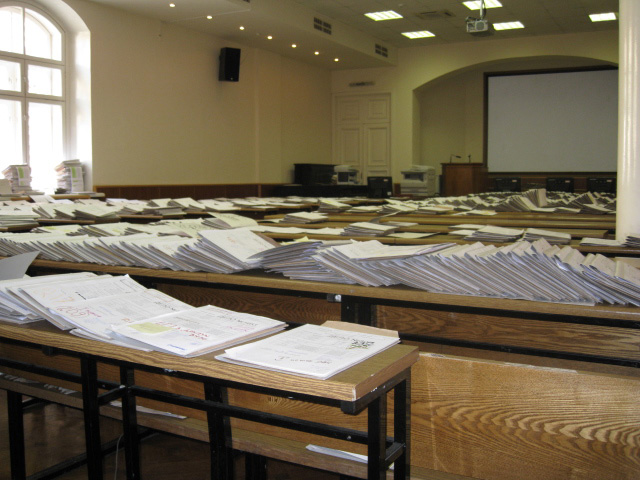
The revival of the Soviet school has become one of the iconic events of the past school year, among those that can affect the development of Russian education in the near future. In total, four such events at the Summer Seminar at the Higher School were called four: the development of preschool education, the “dissertation scandal”, the assessment of the effectiveness of universities and the movement “For the Soviet School”.
The latter, uniting several initiatives of Vladimir Putin at once: the introduction of the school uniform, the norms of the TRP and a single history textbook caused the most active response among experts.
Isaac Frumin, Head of the Institute of Education of the Higher School of Economics :
It seems to me that the last academic year can be characterized as the year of the victory of Soviet education. True, this is not a Kursk battle, which completed the defeat, but, apparently, Stalingrad, but the flashes of the ranges are already clearly visible.
I would not politicize this plot, remove all its classification to the left or to the extreme conservatives. Because we all, both teachers and managers, feel the need to solve complex problems related to education, with knowledge of history, with physical development, finally, but we do not know how to solve them. And here a fork is formed, which is not an ideological, but an intellectual character.
Will we look for new and difficult ways or go to a trusted road, because - I quote the political leadership - “there were a lot of good”? This question, from my point of view, is a serious challenge, since the trouble is not that the Communists or extreme conservatives broke through, but that our research community did not provide effective mechanisms for solving these problems. And when Madame Yarovaya says: “There is such a crafty reasoning that diversity is better than uniformity” - her position is clear to me. It is really crafty for her, because diversity is more complicated than monotony, and whether Russian pedagogical thought can deal with complex moves without relying on a single program, but building some mechanisms of collective agreements, forming a professional community, this is an open question . This is my interpretation of this event.
Tatyana Kovaleva, leading researcher at the Department of Research and Development of the Institute of Education of the Higher School of Education :
This is an illusion that a variety was implemented in the Russian school. Because talking about its implementation should be at least at three levels. The first is household consciousness when such a trend becomes popular, fashionable. The second is a pedagogical environment that is specially created for this. And the third level is management.
What do we see today? Among the community of advanced parents there is a fashion to choose a family, home education for a child, and this trend is growing. On the other hand, now almost any school has many circles and electives, that is, pedagogically, we are ready for diversity. But at the level of managerial culture of this attitude, there is no. And in this regard , you should not talk about the return of the Soviet school, since we did not leave it anywhere.
Igor Remorenko, Deputy Minister of Education and Science of the Russian Federation :
What has really changed during this time is that mechanisms appeared, however, not market relations, but competitive ones. The competition, unlike market competition, involves a certain ratio of proposals. And different regions gave different proposals, they were compared with each other, who has better. On the other hand, there were proposals, but demand was not articulated, and this is fundamentally important.
Today, the “dissertation scandal”, for example, is actively discussed, but no one wonders why the dissertations are needed in the current conditions, what kind of social institution it is. That is, we notice changes, but we do not think about the main thing - why does society need it .
Anatoly Kasprzhak, Director of the Leadership Development Center in the ESCE Education :
I do not have such an optimistic attitude to existing trends. If the 90s could be called a parade of sovereignty, now we should talk about the parade of uniformity. The point here is not only in school uniforms and not even in a single history textbook.
Look: it seems that the absolutely liberal mechanism of distribution of funds in schools was introduced, and how did it end? Complete stagnation of species diversity! In other words, everything that we did 20 years ago, having formed schools of different types, ended today. The gymnasium remained only as a name, as well as a lyceum, and everything else.
What is the current attack on the exam? It has long been clear to everyone that no children are photographed in the exam. This attack is a reaction to the need to change the long -established Soviet single feudal style of relations between a student and a teacher . Well, and finally, the introduction of the TRP complex is an attempt to make people make obvious stupidity, that is, think the same way, and at the same time to say in chorus how important it is. In this sense, it seems to me that the formation of the next counter -revolution, counter -reform is taking place.
Evgeny Bunimovich, Commissioner for Child Rights in Moscow :
Of course, we have a counter -revolution in education, only it sounds quite funny here "in education." In the current context, it is completely normal and the TRP, and a single history textbook, and the school unit, and, by the way, the total unification of schools, when everyone is aligned. But salvation from all this is very simple, it is that, as it seems to me, the word "culture" becomes a key word. There are many people who do not care about it, but there are some people who broadcast this culture. They did this before, they do it today, regardless of the market and contests. At school, you just need not to lie, keep your own dignity, tell the truth and, in general, to do very simple things. I think that in this way it is possible to transform education today, and not with the help of systemic, decisions lowered from above.
Vladimir Livshits, Secretary of the Central Committee of the Trade Union of Public Education and Science of the Russian Federation :
Those who want to move towards the Soviet school are clearly mistaken. Because at first it was necessary to move away from her. There are two things that should be changed, and above all, mentality. The system, artificially removed from a state of balance, will return there after the cessation of external influence . But in Russia it did not particularly change, because we are large masters of imitation.
If we talk now about autonomy, about new budget organizations, in fact, all this was simulated. Of course, in Russia there are islands where something is being done, but there are very few of them. And the same can be said about quality, about the exam - as they were written off earlier, so they write off now. Other people have money, other mechanisms work, but the process is the same.
Efim Rachevsky, Director of the Center for Education "Tsaritsyno :
I remember the visit of inspector Rono in the early 90s, who asked me a question as a school principal: "What do you have unconventional at school?" Today, the word "non -traditional" has gained a slightly different tonality, but I express the fears of all my Russian colleagues that the modern word "innovation" has become euphemism. And on this occasion one should calm down, remembering the words of foreign colleagues who came to a very innovative school and asked the director the question: "And when do you manage to teach children?"
Whatever we say, those who brought their children to our school, parents have changed. This is the same generation that someone called is the first blanket. I will not give him a characteristic, but for them the health of my own child is more important than the health of the governor, this is absolutely for sure. And if everything is as terrible as we predict, then the parents will send us far and forever . Some of the children will go to home schooling, and someone will leave for Geneva, who has any resources.
Counterrevolution in Education: Trends and Prospects
Based on the materials of the Summer Seminar "Results of the Year in Education"
Four main events: the development of preschool education, the “dissertation scandal”, the assessment of the effectiveness of universities and the movement “For the Soviet School”, as well as system shifts and spontaneous initiatives in the “Cool hour of freedom” comment:
Victor Viktor Bolotov , Vice President of the Russian Academy of Education, Director of the Department of State Policy in the field of higher education of the Ministry of Education and Science Alexander Sobolev , Director of the Institute for Education of the Higher Superior Irina Abankina and the supervisor of the Institute of Education Isaac Frumin .
The program will also sound the opinions of the editor -in -chief of the magazine "Director of the School" Konstantin Ushakov , the rector of the Institute of Educational Policy "Eureka" Alexander Adamsky , the Director of the Center for Leadership Development in the Education of the Higher Superior Anatoly Kasprzhak , the Commissioner for the Rights of the Child in Moscow, Evgeny Bunimovich , the Secretary of the Central Committee of the People's Education and Science of the Russian Federation, Vladimir Livshitsa , the Director of the Education Center "Tsaritsyno" Efima Rachevsky , Deputy Minister of Education and Science Igor Remorenko and others.
Tamara Lyalenkova is conducting the program.