
Translated material
A person who needs more
Stereotype
Recently, it seems that such a stereotype has developed that the curator is a person who does not have a permanent place of work, free from office routine and engaged in various exhibition projects - mainly in the field of actual art. There is a feeling that this is some new phenomenon, a new professional niche. And this is not entirely true.
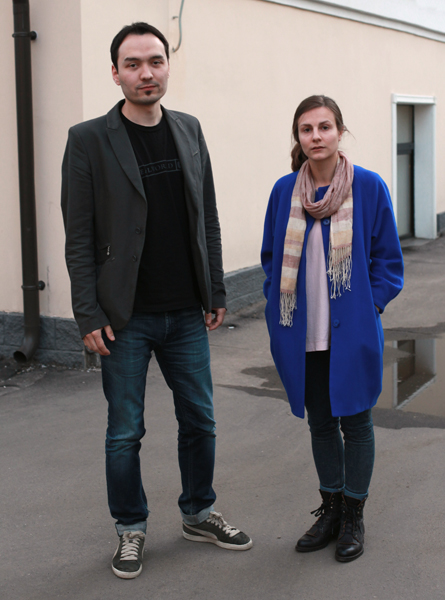 © Yulia Ryzhenko / Colta.ru Andrey Egorov and Anna Harutyunyan, MMOMA researchers and curators of the museum exposition “Dreams for those who are awake”
The history of the issue
If you start from etymology, the term itself is quite old, if not ancient: it has a Latin root and is associated with the word Curare , which literally means "to take care, treat, carry out guardianship." We recently learned that in ancient Rome the curator called a person responsible for maintaining aqueducts, in other words, the head of the ancient Roman housing and communal services. Then, in the Middle Ages, in Europe this word was assigned to people who controlled strange houses and orphaned shelters - literally cared for the disadvantaged. And in Soviet times, after all, there were also their “curators” in the state security organs. In the context familiar to us, that is, in relation to those who have been responsible for the collections of art and other rarities, the term has been used since the 17th century. And although since then he periodically had competitors (like an “inspector”), this term has taken root and today has even managed to fill up many.
Careful employee
According to tradition, the full -time position of the curator exists in many European and American museums (and not only artistic ones), and sometimes in archives, libraries and even botanical gardens. This refers to a specialist who is responsible for a certain collection (or some part of it), explores and replenishes it, and also, which is important, represents through exhibitions, catalogs, guidebooks.
In Russia, the museum nomenclature is historically different. Since Soviet times, people who, in fact, have performed the functions of “curators” in the museum, are called scientists ; In this case, there is also a separate position of the Guardian. They work in the same team, but the first lies the duty, suppose, to develop exhibition concepts and write catalog articles, and on the second - concern for the preservation of exhibits and issuing them to the exhibitions. By and large, the museum, “institutional”, the curator is not some kind of specific branch of curators, but perhaps the most natural, historically rooted form of this activity. And let it not be the most free (primarily in the bureaucratic plan), it has an important advantage - you know your “your” collection is better than a freelancer.
Profession?
Suddenly, it became very fashionable to be a curator, to consider it a profession. Now there are many schools and courses that specially prepare people for this path - including in the genre "become a curator for the semester." This is fine, but it is clear that with this approach a person will still need a fundamental base - a serious fuel in the field of history and the theory of art. Curators are still not a profession, but only one of the possible ways to apply special knowledge and skills, if you like, the area of responsibility; The profession, we want it or not, is still an art critic.
Office instruction
If you think about it, the perfect curator should be only umo Universale . Starting with the fact that he needs to be “in the subject”, constantly improve his erudition, read in foreign languages, travel and watch a lot in order to be at the forefront of exhibition decisions - because he must make a relevant, strong concept of the exhibition project. Then - you need to be able to competently and clearly express your intricate ideas (to write slimly, speaking, arguing reasonably). Finally, to possess remarkable organizational abilities, to be diplomatic when communicating with artists, colleagues, workers, sponsors, leadership and at the same time be calm and confident - to radiate wisdom and authority. And to everything else, after a sleepless week of installation at the opening of the exhibition in the light of the television cameras, the curator should look presentable and fresh. It is quite difficult to combine all these virtues in the correct proportion, and even in another person. Therefore, we work together.
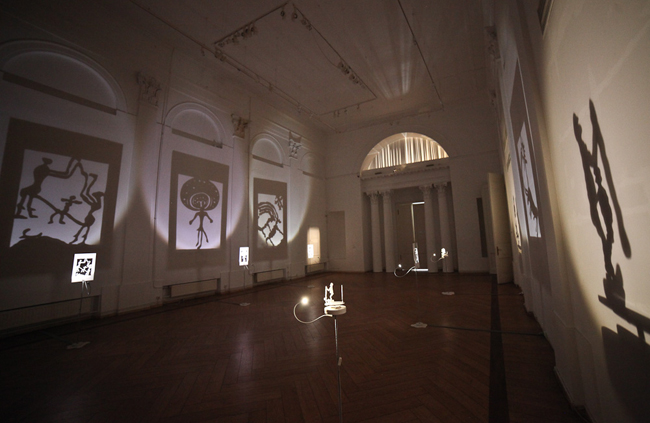 "Dreams for those who are awake"
One for all
When you make a large project in the museum, the main difficulty is synergy. Obviously, all services- the department of funds, PR and exhibition departments, installers, restorers, all up to accounting staff- must operate in the team, motivated and harmonious. Everyone who worked in the team, when a large number of people are involved in the final product, understands that this is already a considerable problem. Inevitably, a conflict of interests arises, both personal ambitions (which is normal) and different ideas about responsibility (which is worse) manifest. The curator in such a situation turns out to be a person who is “the most necessary”. At all stages of work, it is extremely important to maintain dignity and respectful tone - this is a tool for proper communication. In the end, due to problems in communication, the exhibition suffers and the pleasure of the process, which should still complement “Protestant ethics”, is reduced. Seriously discussing communities and communications, we ourselves must try to translate these conversations into a practical direction.
High Finish
With a competent organization of the process, to live, of course, is much easier. True, in our country everything related to managerial and coordinator functions is still at the stage of formation. This is always seen in the quality of the final product. And the point here is not in the steepness of the concept and not even in the seriousness of the texts, but in whether the label corner bends on your exposition or not. In English, this is called High Finish , and it is in this "premise" that the coherence of teamwork is manifested. Unfortunately, in Russian institutions this indicator is not yet at a 100 % level. But there is something to strive for.
Snobbery
In a small curator/art history community, there really is such a problem. And you have come across her since the student years. And if in the “workshop” environment this can be treated stoically (as the cost of the profession), then with regard to the viewer, arrogance is completely unacceptable - given the significance of the exhibition as a public event. In the field of contemporary art, in particular, everything is closed into a vicious circle: on the one hand, professionals owe that this art is not popularized, the abyss of misunderstanding and rejection is growing, and on the other hand, they themselves create exhibitions in which they do not give it difficult to overcome this distance. Of course, there are very interesting and influential examples of emphasized elite, non -adaptive projects, but they are rather appropriate in a special context - in some galleries, exhibition spaces, but definitely not in the museum.
Intellectual tolerance
It is believed that if you, for example, have not quoted in your text of the slurry or do not grieve at the death of the "modernist project", you automatically profaning modern art. That is, an excuse in the “progressive” art community has only left-wing projects covered with protest political pathos. With all the obvious sympathy for democratic ideas and civil values, the feeling does not leave that the art in such projects often serves as a pretext for the polemic, which, perhaps, could be more effective in a newspaper or a popular blog. Is it necessary to refuse the works of artists in visual, plastic power? After all, this is precisely in this, their genuine rhetorical persuasiveness is also concluded. If the left is utopian intention - to create a society of justice, then justice should be in the fact that exhibitions may be different and should not be reduced to agitprope. In this sense, there should be some kind of intellectual tolerance.
Work for a wide audience
The most different public goes to the museum, so the installation of museum curators on a wide viewer and an attempt to make a popular project in a good way is to overcome their own snobbery and the desire for social understanding. It is clear, for example, that it makes no sense to write a text in a parody bird language, which is difficult to read even interested spectators. Colleagues who abuse professional jargon, in fact, preach the converts - their texts are able to digest only those who no longer need to convince anything. The cognitive degree of such projects is quite low. At the same time, adapted explications cannot, of course, be reduced to cute, easily readable cliches. Of course, the audience varies the level of erudition, but you can never underestimate their intelligence - these are not synonyms. There should not be this: "We all know and now we will tell you all how it is actually." Indeed, in the process of developing the topic, you yourself learn so many things and open that you have to raise questions and look for solutions with an imaginary viewer.
Prepared by Julia Ryzhenko