
Translated material
Return to innocence

The withered singer in black clothes, black scarves, black glasses and a black hat was surprised by the performance. He spoke more than sang, ”he complained about a frustrated guitar and drove memorized tales, but a crowd of Norwegian youth enthusiastically accepted everything that came from his graying head, planted in the old neck: fake notes and causeless pauses. And there were a lot of them, grateful listeners - more than in many other young and fashionable groups that performed with the singer at this festival. Perhaps Sizt Rodriguez nicknamed Jizus, a 70-year-old bard from Detroit, is already used to the fact that those who are suitable for his grandchildren gather for his concerts and wait for him to drag out his most famous song “ Sugar Man ” - that very, about the drug dealer. But this lasts only the last couple of years, and “ Sugar Man ” He recorded more than 40 years ago.
Light in the attic
The amazing story of oblivion and gaining Rodriguez is told in the prizes marked by the documentary " Searching for Sugar Man ” (2012), who made him a great international advertisement. In the 1970s, the restless bard, which was the obvious influence of Dylan, recorded two albums that no one noticed in his native states, but suddenly fell in love and remembered forever in South Africa, where his songs became a symbol of racism and apartheid. In the early 2000s, Rodriguez's intelligible songs, a sag of a memorable high voice, was re-discovered by Europe and America-almost simultaneously “ Sugar Man ” was presented to his audience with two such dissimilar musicians as Irish DJ David Holmes and the American rapper NAS . In 2009 on the Sith Libe Light in The Attic was reprinted by Rodriguez's first album “With OLD Fact ” - 39 years after its release. To date, this reprint has been sold in the United States with a circulation of 140 thousand copies.
For Light in The Attic , which is engaged in the reprints of the albums, which its owners are really looking for in the attics, “with OLD Fact ” has become a lottery ticket that allows you to recoup a dozen more archival releases with carefully restored sound, circumstant booklets and rare photographs. Oddly enough, in the zero, which passed under the sign of the deepest crisis of sales of music on physical media, labels engaged in the return to the cultural turnover of lost audioralvy (sometimes, however, dubious value) appeared a lot. As a rule, these are tiny amateur firms opened by collectors, owners of record-shops or DJs, and they are interested in the rarest, strange and deprived of attention of the music of the area in which they registered, such as gypsy popes from the Yugoslav time of Broz Tito. For example, Madrid Vampisoul , which inspired Light creators in The Attic on its own label, digs out a variety of latin-radiations-a sixtieth psychedelic rock from Peru or jazz from the reign of Franco, and a Wesome Tapes from Africa , founded by a European, reprints music circulating on cassettes in Western Africa. There are those who dig one, but a wide topic, for example, Finders Keepers , interested in both the vanguard and the obscene East European music, or minimal Wave Veronika Vasitski, who is engaged in the cultivation of an artificially created white style “minimal synt”, which in reality never existed.
They are interested in the most rare, strange and deprived of attention to the music of the area in which they registered.
Among these labels there are very serious, suitable for Reissues , that is, reprints, with the systematic and depth of study of the topic appropriate to scientific institutions, like the London Sul J Azzz , richly printing immigrant-colonial reggae, ruggiton and disco, as well as a mutant New Weive and postpank, which has bore on these Branches, and Chicago N Umero G Roup , meticulously reprinting local American music, which was distributed in the unintentional cities of the United States, or even in the same club of some hinterland, are a kind of musical maps of history and areas made both specifically for the library of the Smithson Institute. For such firms that the humanitarian potential of their records put above commercial, in English there is a noble term Salvage Label - that it can be approximately translated into Russian as "Label of Salvation."
The first “Labels of Salvation” appeared not in the zero, but much earlier. In the book of the famous British musicalist Simon Reynolds , Retromania , who is closely analyzing all the signs of the last decade, is not jesting the retro, it is reported that the forerunner of such private initiatives to preserve the disappearing UHCA , opened in the early 1930s, Milthee Gaibler, the owner of a shop with records in the records in the records New York. He began with a reprint of the jazz classics that came out of the circulation, and then began to search and release unknown works of pioneers of jazz. In the same place, in New York, in 1961, the Times label became a household name Square , which supplied the collectors of the Du-Uopa 7-inch with all sorts of oddities and rares of the genre.
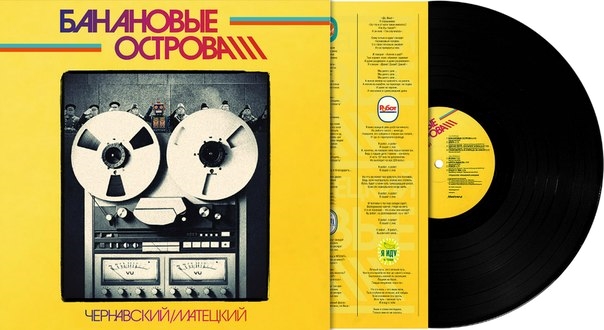 © "Mirumir"
Enhanced nostalgia
If the “Labbes of Salvation” is the same antiquity as the songs that they publish, then why are we writing about them only now? Finally, we got to the info-provoking this article-in 2013, the reprints of the “historical heritage”, “Huritege”, as the youth says, finally appeared in Russia. In our country, another, albeit low, civilization barrier has been taken.
One of our first records in the Lost genre GEMS (that is, “Lost masterpieces”), which is quite officially, a separate box or shelf, exists in many European music shops, was the reprint of the magneto-album Yuri Chernavsky and Vladimir Matetskiy “Banana Islands”, carried out by the Miromir label to the 30th anniversary of this sign. About the “banana islands”, one of the first and strange exercises in the “New Wave” in Russian, and its authors can be read in the book of Alexander Kushnir “100 magneto -albums of Soviet rock” or articles by Artemy Troitsky. We will only say that the most hitty song from this wonderful album, which spread in Soviet times only in the “cassette” samizdat, you probably heard in the film “Assa”. Moreover, she, “Hello, Boy Bananan,” gave the name to the chief hero of this generation film. Having reprinted the album of Chernavsky- Matetskiy in Vinil, Mirumir filled one of many gaps with which the history of the Soviet and post-Soviet pop and rock music was dotted. The utopian "Melomaniac islands", where the lyrical hero of the "bananas" actually sought in the title song, was loomed with a small point on the horizon.
Following the “banana islands” , two more plates of Yuri Chernavsky appeared in the Miromir catalog, who in the early 1980s caught up with the fashionable western sound, trying to make it no worse in the home studio than Telex or Yello . The “automatic kit”, even more wonderful continuation of the “bananas”, was available only to those interested only in the form of home digitization of a collector who spread over the Internet. For a vinyl reprint, Yuri Chernavsky personally made remastering in his Los Angeles studio from his preserved workshop. The final plate in the anthology of Chernavsky, initiated by Miromir, was published by a collection of songs by Alla Pugacheva, composed and produced by the inventor of the word “pops”. The most famous of them, the long-term hit of the “morning mail” “Belaya Panama”, according to the composer’s memoirs, was repeatedly published in the Soviet Union on vinyl collections from demo-records given for television broadcasting. On the freshly printed vinyl, “White Panama” sounds like the author would like to hear her, and in addition, there is previously accessible only in bad quality on YouTube The duet of Pugacheva and Chernavsky, about whom, as a lost brooch, recalls the Grand Dame of the Soviet stage itself. Approaching the reprint of the records with the scrupulousness of archaeologists, Miromir is trying to comply with the Code, established by Western “Labbes of Salvation”, which are controlled by enthusiasts devoted to music.
These records could appear in Moscow back in 1972.
Just “Mirumir” announced the release of Eduard Artemyev’s two separate vinyls to the famous films of Andrei Tarkovsky “Solaris”, “Stalker” and “Mirror” - and this news slightly excited both Russian and Western collectors. In Russia, these sound paths did not go out on Vinil, despite the fact that among the “vinyl maniacs” there are legends about “Solaris”, supposedly printed in the seventies “Melody”, since the music for the film was recorded at the All -Union Studio of the Film, which was part of the company. But, as far as is known, for some reason this plate never came out. But she appeared in Japan under the license of “Melody”, and even later, in the 1990s, in Holland. Japanese and Dutch records have already become a collection rarity-at Internet surges, the rates on them start at $ 150. Retraining from the blessing of the classic of Soviet synthesizing music, his exemplary work, “Miromir”, on the one hand, makes a successful commercial move, and on the other hand, restores historical justice, because these records could appear in Moscow back in 1972.
“Miromir” began its activities in 2011 with the anniversary album “Chaif” “25 years of endurance” made by order of the group. Now in his catalog, not only the re-release of the albums of the heroes of Russian rock, which are guaranteed to be sold by a circulation of 1000 copies (and for which a competition is being conducted between similar Russian labels), but also the substantial notes-stadium rock stars of the 1980s “Dynamics”, where young Vladimir Kuzmin, the Alpha group Sergey Sarychev, a “civilian” concert. Defense ”in Novosibirsk. The immediate plans: “Drack files”-the first album “Zero” in the original “pencil” cover and two records of the Siberian punk group “Black Lukich”, brothers in the cartridges of “Civil Defense”. By the way, not only “Miromir” is engaged in the reconstruction of musical and historical justice in Russia-for example, the Moscow Libe “Geometry”, who recently celebrated the 10th anniversary, released the full version of the forgotten art-car-master “Noem” . But the efforts of even two labels to restore a well -deformed audio storage of our country are clearly not enough.
What drives people who, creating their own salvage Labels , return the music of the past from non -existence and sometimes, as in the case of Jizus Rodriguez, its creators? And what drives people who eagerly buy these records? The excitement of the treasure hunter? Missionary complex? A heightened sense of justice? One of dozens of possible answers is Forced Nostalgia , “enhanced nostalgia”: by the way, it is called the Belgian label, which reprints wild punk and no less wild electronics, which came out with piece circulations in the 90s on home-made cassettes.
Nostalgia is an escape from reality to the world of phantom memories of its own or alien childhood. Return to innocence as a means of psychological therapy. There is, of course, something in a scanned naive and charming one in how musical enthusiasts from the “salvation labels” are trying to correct our collective audio asd, repaying the delayed honors of the next missed talent and his creation, arranging a stellar punk group or the failed James Braun from the god of the forgotten American town. They boldly create an alternative story that is too incredible even for science fiction writers with the richest imagination: well, imagine that in the center of the line of the members of the CPSU Central Committee on the Mausoleum, which you saw on TV, the robot shining with light bulbs crept up. And he crept and waves your hand from the brand new envelope of the “banana islands”.
5 labels involved in reprints.
The choice of Danil Maslovsky ("Miromir")
The incredibly interesting label of Jen Makneay with a huge number of sabers, on which the most diverse music comes out, from the "rare earth" punk to the American Musak. Mostly on CD , but in recent years the number of vinyl releases has increased.
Libel oriented to Vinil, reprinting the material of the 60-70s. A lot of interesting, previously unrelated positions on senf, bat, psychedelia.
The French musicians of the 50-80s are very high-quality. Recently they realized my dream, releasing the “complete collected works” of Clotilds on CD and Vinil.
For those who cut in good sound. In the catalog - world names of the first magnitude, the quality of the records is excellent.
I have been engaged in this label since its founding (to be precise, even a little longer). We try to release not only one hundred percent commercially successful artists, but also just interesting little -known music, paying maximum attention to design and sound.