
Translated material
Thus-swa-on-ss-si-oco-su | Colta.ru
The centenary of the “Spring of the Holy” (a rare anniversary of the work, not the author) is celebrated in 2013 along with the composer anniversaries of Wagner - Verdi - Britten. In Russia, more attention was paid to the ballet side of the matter: the festival and the book “Century of the Spring of the Holy” - Age of Modernism ”in the Bolshoi Theater; Nizhinsky ballet and a new production of Sasha Waltz in Mariinsky.
In the American Bard College, New York, at the annual summer festival, they presented the Stravinsky and its world program. A huge amount of music, behind each concert concept, many rare works. You listen and think: here it is, a festival dedicated to the Stravinsky’s music itself, which Russia is so lacking in a series of anniversary events. But suddenly it turns out that “spring” has nothing to do with it! As explains the President of the Bard College and the music director of the festival, conductor Leon Botstin, the anniversaries in Bard are ignored. “But you can’t come to New York and pass by the Empire-promot-book”-that is, past Stravinsky. At first, Bottstin did not even want to include “spring” in the program, and the “firebird” and “parsley” did not turn on-and they are often executed.
The main hall of the festival - Sosnoff Theater with 900 seats - is located in the center of the arts of Richard Fisher; The center was built by the famous Frank Gary, among the works of the Guggenheim Museum in Bilbao and the concert hall of Walt Disney in Los Angeles. The acoustics of the hall is phenomenal - all orchestral groups sound clearly and distinctly, as if cleansed of impurities.
A super-saturated program is a business card of the festival, which this year is held for the 24th time. Two or three concerts per day for more than two hours each. Not every professional can withstand such a marathon, but the trained festival audience listens tiredly. And the Bard public is just mostly unprofessional, to the joy of maestro Bottstayna, who states that his best listener is an interested fan.
Enlightenment in Bard is engaged very competently and, one might say, with passion: the program along with Botstin is made up of famous scientists, some of them are members of the editor -in -arms of the leading American magazine Musical Quarterly (and Bottstyn - chief editor). An expert detachment is invited to each festival (this year was Stephen Walsh, the author of the two -volume biography of Stravinsky, the expert in the Diaghilean seasons, Lynn Garathol, Millisent Holeson and Kenneth Archer, who reconstructed the “sacred” Nizhinsky “Spring”), but not scientific reports are required from them, but public lectures, and at the same time at the front ends modern musicology. A book is published for each festival. A booklet in 80 pages is also a solid edition with rare photos.
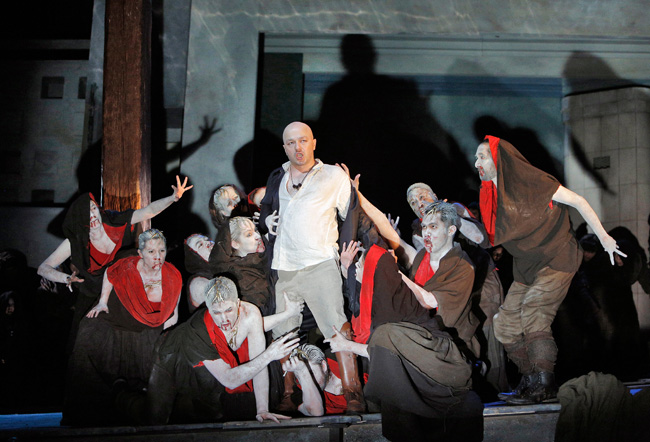 © Bard Music Festival Mikhail Vekua - Oreste in Sergey Taneyev’s opera “Orestei”, Sosnoff Theater. July 24, 2013
The day in Bard is painted by the clock, as in a pioneer camp: an early rise to catch a lecture at 10 in the morning, lunch at 12:00, at 13:00 - a lecture again, a concert at 13:30 - and so on. At the same time, there are no ends from those who wish: tickets for concerts are sold out, in open lectures there is also a full hall.
Two weekend is filled with music-Stravinskaya and near Stravinskaya. In each program there is a plot, and not one; For their sake, they are freely treated by chronology, pushing early and late works, although in general the festival develops according to biography and geography: from Russia - through France - to the United States.
In the Russian part, not only Rimsky-Korsakov play, but also Glinka, Glazunov, Lyadov and quite rarity: “Metamorphoses” by Maximilian Steinberg (also a student of Rimsky-Korsakov and in this status-the rival of Stravinsky), ballets of the same 1913 as “Spring”. “Mechanistic aesthetics” are demonstrated using Bartok, Vrasing and Anteille. “Stravinsky in Paris” is surrounded by Arthur Lurie, Alexander Tansman, Boguslav Martin-those who came here in the early 1920s. Another angle of the French 1920s is in the program "Gazy and Sound: from abstraction to surrealism." Neither Jean Cocteau, nor Pablo Picasso, nor the “six” are missed here.
Botstin is convinced: the more diverse music, the easier it is to keep the public's attention. The Brass-Duet (pipe and thrombone) may come out in front of the chamber orchestra, and after that the duo is a piano duet; The plays and vocal cycles of the first department are not only the music of ballets (“newlyweds with the Eiffel Tower” - the collective composition of the composers of the “six” - and “parade” of Sati), but also the whole chamber opera - the “Moor of Stravinsky, which the Americans performed very frivolously and charming.
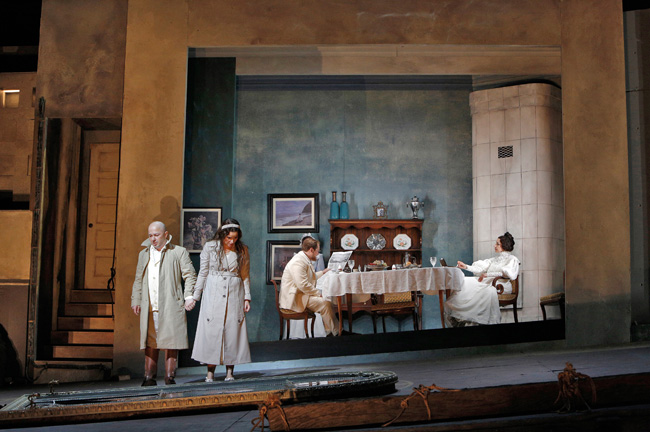 © Bard Music Festival Mikhail Vekua - Oresta, Olga Tolkmit - Elektra, Andrey Borisenko - Egist, Lyuba Sokolova - Clytemestra in Sergey Taneyev’s opera “Orestei”, Sosnoff Theater. July 24, 2013
Sometimes because of the curatorial gluttony, the program grows so that you want to suck it-for the purity of the concept. “Modernist dialogs” is a great idea, a concert in which Arnold Schounberg’s vocal cycles (“Moon Pierrot”), Maurice Ravel (“Three Poems by Stefan Mallarm”) and Stravinsky (“Three Poems from Japanese Lyrics”), written in a row - a chain composer reaction to the Shenberg innovations are reduced. But besides the cycle of Maurice Delyazh, which fits into this series, the program includes the plays of de Fali, Ravel, Sati and Stravinsky, dedicated to Debussy’s memory, and this new plot, logically explained in theory (annotation), sins with variegated and interferes with the elegant verification of the plan.
The record holder for saturation was the program “Emigrants in America”, which seemed to have three full concerts with a mass of contrasting works. Swanings - like on the American hill: Bottstin wanted to fulfill what the emigrants of Stravinsky and Schounberg in California wrote, far from the European catastrophe. And they wrote very differently. The anthem “Star-striped banner” in the arrangement of Stravinsky (Bottstin asked the audience three times not to sing along-in order to better hear the branded “skewed” harmonization) followed by the oscillation of Schonberg “ Kol Nidrei ” , after which the Orchestra Oda Stravinsky and his ballet“ Game of Cards ”sounded too lightweight. It was just the first compartment. After the intermission - two more opus of Stravinsky: a military symphony in three parts and the late "Requiem Canticals" .
But Bottsta did not stop there even and completed the program with the music of Hans Aisler to the film by Alena Rene “Night and Fog” (1955). And not only music. He showed the documentary of Rene on the Holocaust himself. Before the concert, and then, before the film himself, Bottstyin announced that the listeners were free to leave the hall. However, he also thanked the remaining - which, perhaps, he proved the doubters. Such an extravagant and bold gesture would hardly be possible in any other American hall. Obviously, Bottstyin relied on the authority of the festival and many years of affection for his listeners when he decided to break their habit of coming to the concert for entertainment. He achieved his goal, but the price of this act has yet to be realized. After the film, a pause hung in the hall - after Auschwitz, there can be no applause.
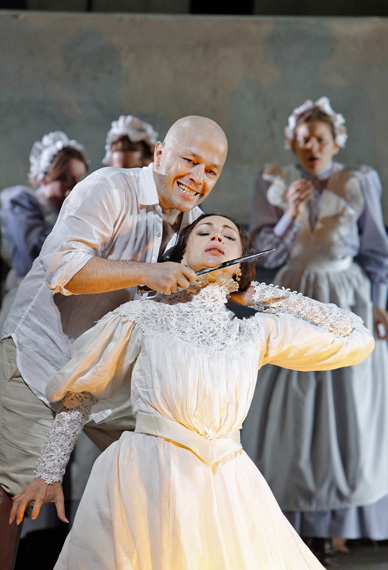 © Bard Music Festival Mikhail Vekua - Orest, Lyuba Sokolova - Clytemnesta in Sergey Taneyev’s opera “Orestei”, Sosnoff Theater. July 24, 2013
The American Symphony Orchestra, which Bottstyin leads for 20 years, and the festival choir work in the summer without respite. The lion's share of the program is learned from scratch. “We have to rehearse three times a day,” the orchestrants report. There are sometimes enough time at rehearsals, only to complete the essay from beginning to end. The Stravinsky’s “Wedding” in this mode was not easy to cope. The choir carefully mints: "Thus-su-on-sta-ss-no-ku-su." Botstin stops, corrects the pronunciation (in Russian he reads and says), asks to sing and easier and goes on. After several comments, he turns to the choir: "Do you even know what this music is about?"
Almost all the instrumentalists engaged in the festival are musicians from the American Symphony Orchestra, and the vocalists invited. In the first weekend, the strongest impression was made by Soprano Kira Duffy and Bariton John Hankok. Hankock was equally convincing in the "Abraham and Isaac" of Stravinsky and the vocal cycle of Pulenka. Listening to the clear, piercing and plastic voice of Duffy in the “Wedding”, it was impossible to imagine that in a day she would perform the highest piloting of a completely different kind in the “Moon -Pierrot” Schoenberg. Two Russian vocalists participated in the “Wedding” - tenor Mikhail Vekua and Bariton Andrei Borisenko. The folklore melodies “Wedding”, calmly placed by Stravinsky “under the glass”, they sang gambling and chopping - thanks to them, a riot of a sucking wedding sometimes broke on the stage.
The “wedding” of century and Borisenko came straight from Orestea Sergei Taneyev, whose American premiere took place before the festival. Since the premiere in 1895, in the Mariinsky Theater of Orestei, they put a few times and in reduction: a complex score, replete with polyphony, remembered arias a little (but what choral numbers!). Director Tadeusz Strassberger and the scenographer Madel Boyd managed to wit and intelligibly tell the story composed of immediately from the three tragedies of Aeschylus, and even do without bills (the performance was four hours). Times and era on the stage were replaced rapidly: the Greek chiton was adjacent to the dress of the 19th century, and the Electrre was served by serfs.
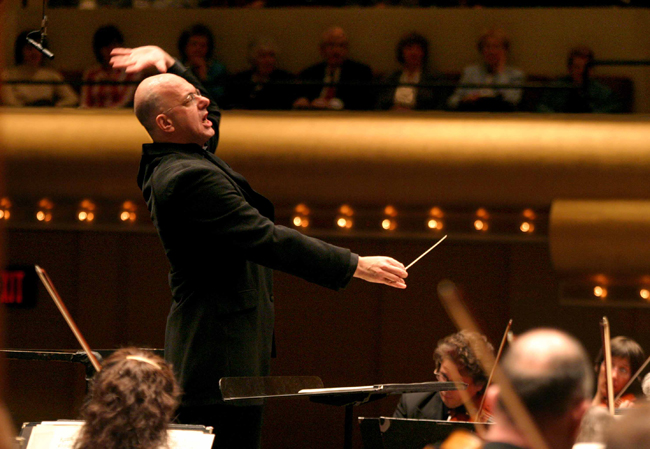 © Bard Music Festival Leon Botstayn conducts the American Symphony Orchestra, Sosnoff Theater
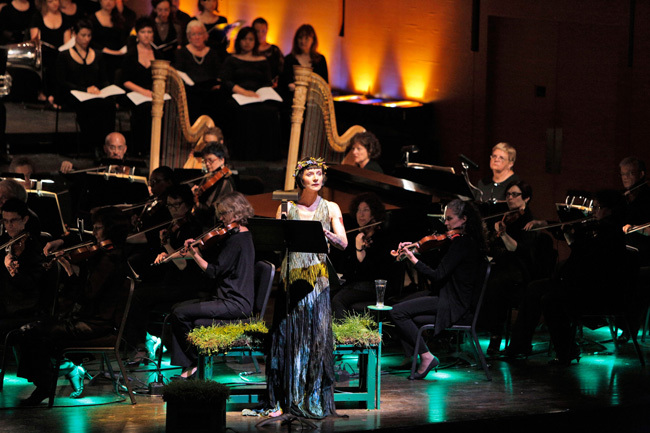
The ancient arch to Orestei was transferred in the last program of the festival, which became its climax. The fragile, weightless music of the Melodrama of Persephone coexisted in it with a powerful, expressive opera-Opera King Oedipus. Almost no scenery is only a throne covered with live grass, on which Persephone (a chita Jin Stilvel) was sitting on. Suprates have become a scenographic element, turning into a minimalistic video sequence with a text that resembles a cloud of tags.
The main character of the evening was tenor Gordon Gits - a impulsive, touchingly vulnerable and deeply human Oedipus. He was shaded by the unperturbed Creon (monumental bass bariton John RELEA) and the truly royal IOKAST (Jennifer Larmore). The orchestra seemed to have saved his strength for two weeks (this is with his schedule!) And gave out the best that he was capable of.
Over a quarter of a century, the heroes of the bard festival were Brahms and Shuman, Wagner and Maler, Tchaikovsky and Sibelius, Prokofiev and Shostakovich, Berg and Schounberg, Ives and Yanachk. The theme of the festival of the next year-“Schubert and its world” is a natural choice for a bard college, in which Schubert specialist Christopher Gibbz works. The 2015 theme is more amazing: Carlos Chavez. But before, in June 2014, Leon Botstain is lucky for the European tour, a student orchestra and will perform with him in Moscow and St. Petersburg. In the programs - Shostakovich, Copland, Stravinsky, Lutoslavsky. You can wait for surprises.