
Translated material
Sochi: Special Olympiad
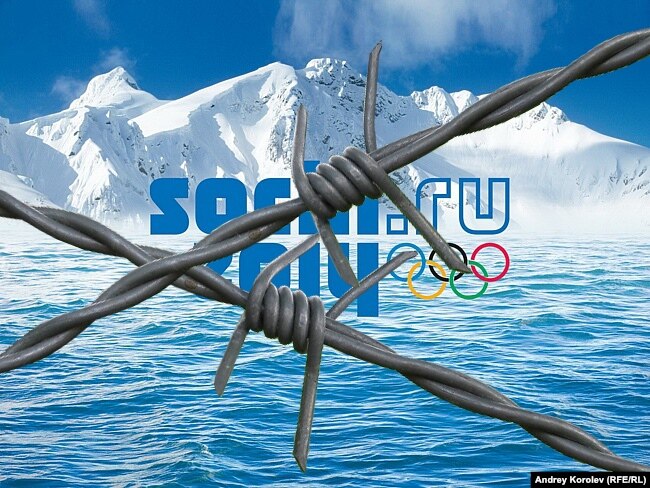
Putin’s decree on special security measures during the Olympics unleashes hands with corporations
The fact that Sochi will be introduced in the “specially protected zone” mode for a long time. Back in March last year, the Governor of the Krasnodar Territory Alexander Tkachev warned residents and guests of the "Olympic" city about the need to maintain personal documents in order. Over the past years, Sochi has become the territory of the smallest favor for journalists, human rights activists and environmentalists.A visit to any Olympic object is strictly regulated by hundreds of vowels and unspoken orders. Any forehead can indicate to you if he suspects a civil activist in you or, God forbid, a reporter. To penetrate the "construction of the century", dozens of certificates, approvals and credentials are required.
But from January 7, 2014, the closeness of the "Olympic" capital has acquired ominous outlines: the Decree of President Putin "On the features of the use of enhanced security measures during the XXII Olympic Winter Games and the XI Paralympic Winter Games of 2014 in Sochi" actually establishes the regime of counter -terrorist operation and emergency.
A month before the opening of the Olympiad and until March 21, the entry of nonresident private vehicles will be limited to the entry of non -residents, any public events, including rallies, meetings of citizens and even single pickets, are prohibited. Border guards will block the state border with neighboring Abkhazia. Moreover, the so -called “forbidden” and “controlled zones” will be installed inside the “blockade” city itself.
As you can understand from the Putin Decree, the “controlled zone”, where it will be possible to get only if there is a special accreditation or registration card of the guest of the Olympics, will be installed around the objects of mountain and coastal clusters. In the zone itself, the stay of citizens and vehicles "without official or production necessity" will be banned.
But Sochi human rights activists are not even so prohibitive as the scale of the territory on which the “special regime” will operate. As experts of the environmental shift in the North Caucasus calculated, not only the city of Sochi, but also the southern part of the Mostovsky district, as well as a small area in Karachay-Cherkessia fall under the “ban”.
The border of the "zone" will stretch along the Black Sea from the border with Abkhazia, then it will pass along the Mzymta River towards Krasnaya Polyana, from the cordon the Psevo will go west (before the merger of the Shahe and Bzych rivers) and north - up to the village of Nikitino in the Mostovsky district. After that, along the rivers Malaya Laba and Tsakhvoa "Forbidden Zone" will invade "again" within the limits of Karachay-Cherkessia and along the border of the republic, the Krasnodar Territory and Abkhazia will again go down to the Black Sea.
For what "security" it was necessary to declare a "forbidden" vast territory in two constituent entities of the federation is completely incomprehensible, ecologists say. The only thing that is clear with all certainty: not only random tourists, but also residents of more than two dozen settlements along the border of the zone will actually be in the role of potential “terrorists” with all possible consequences - up to physical liquidation on the spot.
The human rights activists and the terms of "emergency" in Sochi from January 7 to March 21 are perplexed. Obviously, experts suggest, the meaning of the Putin decree during the month after the completion of the Olympics is not at all due to the mythical “terrorist threat”, but by the interest of a number of higher officials and companies close to them to completely prohibit the access of “strangers” to the territory of the Caucasian Reserve and the Sochi National Park.
Behind the "smoke curtain" of the Olympics after February 2014 in Sochi, the implementation of environmentally hazardous projects may begin - with the complete impossibility of legal control by the public, says the Ekovakhta coordinator Dmitry Shevchenko.
For example, Gazprom OJSC is developing plans for the construction of ski infrastructure on the Pseashho glaciers in the central part of the Caucasus Reserve, for which the company is preparing a bridgehead in the Fishy Polyana tract in the buffer zone of the reserve.
It is possible that Vladimir Putin signed his “Olympic” decree, including in the interests of Gazprom: a month after the Olympiad, the “prohibitive” regime will still be in, it is possible to organize the transfer of equipment and building materials to the reserve. It is noteworthy that the shelter is cold in the Caucasus Reserve, where Gazprom plans to stretch the cable lifts, will also fall into the boundaries of the “forbidden zone”.
At the same time, the “Olympic” decree of Putin caused an extremely negative reaction of human rights organizations and due to the fact that it violates the basic constitutional norms, in fact, suspending the effect of the Constitution of the Russian Federation in the city of Sochi. Human rights activists believe that the president exceeded his powers by replacing the State Duma, since restrictions on freedom of assembly can be introduced by federal law, and not by the presidential decree.
"The Olympic adventure in Sochi is approaching its culmination. For seven years, while preparing for the games has been conducted, the legislation and rights of citizens have been systematically violated, irreparable environmental damage was caused, huge budgetary funds were stolen despite the fact that the Olympic objects themselves did not have time to build for the deadline. The authorities are now ready to get out of the skin, just to prevent protesting events in The time of the games and to protect the contacts of foreigners with the arbitrariness of the “prohibitive” decree after the Olympiad is clearly linked by the developers of the surroundings of the Krasnaya Polyana, who are interested in the “cleansing” of the Caucasus Reserves and the Sochi National Park. The coordinator of the ecological shift Andrey Rudomakh.