
Translated material
Chemical weapons. The return of the monster
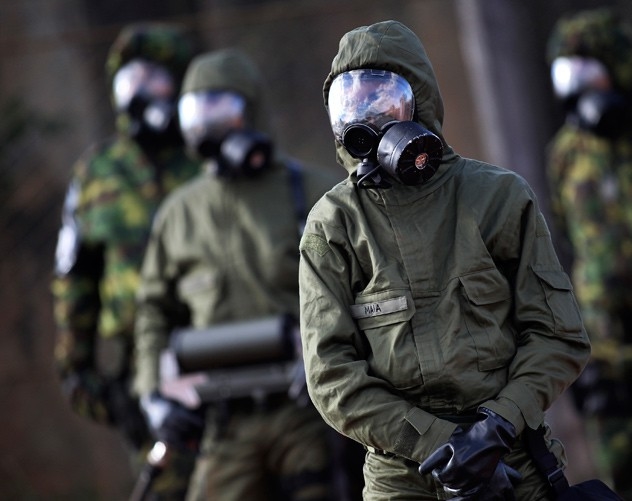
Events in Syria, regardless of their further scenario, again attracted attention to the danger of the use of chemical weapons. It doesn’t even matter who used it, why and how. Because there is every reason to believe that this is only the beginning of the new stage of the world asymmetric war.
Chemical weapons are not a novelty today, as you know. The First World War was gloomily famous for its massive use by all large warring parties. Although the first experiments were conducted earlier, and in 1907 he was even banned at the Hague Conference - as if advance. Moreover, at the beginning of the World War there were still some doubts-it is enough to recall that the wife of the great German chemist Fritz Gaber shot himself in protest against her husband’s actions to develop chemical weapons. But soon doubts disappeared, because “what morality can be after the World War” (A. Tolstoy).
The chemical weapon called a “atomic bomb” always caused a certain disgust not only among the general public, but even among the military. And distrust of him. But the farther, the more attention is paid to all kinds of terrorists and global provocateurs. Therefore, the conversation about the "Syrian precedent" should start from the very beginning, namely with its production and properties.
Bomb in the garden
Chemistry is everywhere today. Even our food products are pretty flavored with chemist development. Her victorious march began at the end of the 19th century. Then chemists made discoveries one after another, and technologies grew like yeast. The Fritz Gaber I mentioned did not immediately become a murderer - he first worked on the creation of antidotes for various chemical agents for the needs of the German civilian industry. There is no violation of logic in this - the fact is that even then they encountered an unpleasant phenomenon: many chemicals that are useful in industry are either explosive or terribly poisonous.
On the network and so full of any devilry, so I will not decorate my post with detailed descriptions of chemical reactions. But it is worth recalling that the famous picrinic acid, known as explosives under the names of shimosis, melinite or TNF, is obtained from ordinary phenol and serves as a beautiful yellow paint for silk and wool. Dinitrophenol was used to impregnate wood as the basis for dyes, as well as as explosives, while extremely poisonous. Chlorpicrin, which is the basis for fumigative mixtures in agriculture, is not only poisonous itself, but when heated, it turns into a notorious phosgen noted into the First World Fosgen. But even now it is extremely common, since it is an important raw material for the production of various dyes and plastics: polycarbonates. All of the mentioned substances are made from each other on the basis of raw materials from coal resin and ordinary salt.
If you have some deja vu when reading this paragraph, then this is explainable: a chemistry lecture is very similar to a very described in Alexei Tolstoy’s novel “Hyperboloid Engineer Garin”. Here is what the American chemical magnate Rolling told his girlfriend, Russian adventurer Zoe Monros in reduction:
“... to prepare a pyramidon from a coal resin, which, say, heal your headache, you need to go a long row of steps ... on the way from stone coal to a pyramidon, or to a bottle of perfume, or to an ordinary photographic drug - there are such devilish things as TNT and picrinic acid, such magnificent pieces as brombenzilzilzilzilzilian, or brombenisyanide. chlorpicrin, diphenylchlorarsin, and so on, and so on, that is, combat gases from which they sneeze, cry, tear off the protective masks, suffocate, tear with blood, are covered with nashthars, rot alive ... "
In the 20s of the twentieth century, it became obvious that chemical weapons are an extremely profitable way of conducting both the total destruction of the enemy and temporary or long-term disabled with the aim of weighing the enemy’s economy. Why kill everyone when you can kill a part, and the majority to turn into disabled people who will be horrified by the experienced world? In the brochures of that time, exceptional benefits were described from the use of chemical weapons. And Fritz Gaber received the Nobel Prize in 1918.
One of the advantages of combat chemistry is just that it can be produced in any chemical production, more precisely, many products may have a dual purpose. By the way, the same Zarin, who was supposed to be used in Syria, was invented in Germany in the 30s, in the process of developing insecticides. It’s already where everything is intertwined - phosphoruscids , insecticides and defoliants are very toxic, and, in fact, fertilizers are the native brothers of phosphorus -Rorganic poisonous substances - in any case, they have one mechanism of action and very close manifestations when exposed to a living organism.
All this should be remembered by speaking of the possibilities of a chemical attack - in the world a full of chemists who for a fee organize a small production of poison that you can use at your discretion. It remains only to choose a weapon - after all, toxic gas or liquid itself is not as it is not an explosive weapon. Need a carrier.
Illusions lost and acquired
When the Germans first used chlorine on April 22, 1915, they generally did without weapons as such - they began to let it out of the cylinders using a suitable wind. Clubs of green-yellow smoke began to rise above the neutral strip. When the cloud sailed to French positions, people began to die in terrible torment. And the cloud all sailed into the rear of the French troops. The panic was terrible. Then they calculated that more than five thousand people died, and several times more poisoned.
Later they began to use bromine and its connections, pumped into shells. But there was a problem - the shell could burst in the gun barrel, so special mortars were created that shot large -caliber chemical mines, gas machines, as well as high hopes for aviation. It is important to take into account that, for example, the same Zarin, Zoman, herd, VX and other poisoning substances of neuro-paralytic are not gases-Zarina has a boiling temperature +150 ° C-and they need to be sprayed to the state of aerosol, which is just more convenient to do either from the aircraft or when the rocket falls.
True, the large spray height is not suitable, the aerosol quickly mixes with the air, and its concentration will fall to the relatively safe. The high flight speed is also undesirable. So, you need to fly low and slowly, that is, to become a target for the enemy. That's just, knocking off such a plane or helicopter, the enemy himself will bring down the whole charge on his head, which will turn into an aerosol during the explosion, and ... the task will be partially, but completed.
As you can see, the number of introductory for the successful use of HO grows. We have not yet entered the details of gas and aerosol behavior in air flows, and this is an amazing thing. Even in World War I, the soldiers found that the wave of chlorine literally bounces from a fire or a long fire. Since the chlorine is well noticeable from the side, it was clear how the movement of this gas is changing even in open areas, depending on the wind or vertical air circulation.
In cities, air flows become generally inexpensive. Along the heated walls, their ascending jets of air form, which interact with those descending in shaded courtyards. The wind can have its own direction in each quarter, and drafts carry gas to the deepest places of buildings, with incredible ways.
If the task is to poison as many people as possible, then this is good. Here, even a fall in concentration does not matter - since even mild poisoning causes instinctive panic in a person. But if the task is to poison the armed enemy, in conditions of close combat contact, then this task turns into something impossible in principle. The fact is that the armed enemy in the vast majority of cases is also an adversary who can have a gas mask and a protective cloak, or an anti -chemical costume. He is taught how to act in the case of a chemical attack. And the poison acts on its soldier with the same success as the strangers.
By the way, the civilian population was not always completely defenseless. In the 1920s, systematic work on civil defense began around the world. Remember the famous “Golden Calf” - the moment when Koreiko eludes Bender during exercises with imitation of a chemical attack. Events of 1930. By the beginning of World War II, all Europe with young nails knew where your gas mask lies, they were developed and produced for men, women, children, horses and dogs ... Everyone was sure that the next war would be chemical.
However, this did not happen. And the point is not about the pacifism of the Nazi regime-in their rear, the prisoners of the camps were killed by the Cyclone-B gas (active reagent-synical acid) and ordinary carbon monoxide. At the front, chemical weapons were extremely inconvenient in use. What was good for the position of positional, when tens of thousands of soldiers literally grown into the ground in their trenches, was unacceptable in the conditions of the tank war, when the army moved quickly. Even against large cities with a developed civil defense, the attack would not have been guaranteed success, but a response blow could greatly hit the economy of the Reich.
After Hiroshima and Nagasaki, an atomic, and then thermonuclear weapon came out for an advance. And chemical weapons began to gradually leave practical arsenals. The war as a continuation of politics did not need mass victims among civilians, and with the collapse of the USSR and the transition of China to the rails of a market economy and ideology ceased to be a stumbling block. True, not always and not everywhere, but this is another chapter ...
The ideal weapon of the terrorist
So what is chemical weapons today? It as it was, remained weapons of the mass defeat of the defenseless civilian population. The army, having suffered the first minor losses, will simply put on gas masks and begin to use a long time ago.
It kills people, but leaves material values - buildings, cars - and other weapons. This is not important and often unacceptable from the point of view of developed countries (including because consumers are more important than rusty iron and stones), but it is important for those who are fighting for the territory, and the population professes another ideology or faith.
It can be done in artisanal conditions, if you mean a small production by this. It is not difficult to find chemists who worked with phosphoruscorganic insecticides, for example, against locusts. And in practice, we see that it is quite possible to organize the production of the same Zarin - for example, in early June there was a news about the discovery of three underground industries in Iraq, where poisonous substances were produced , including Zarin and mustard gas, aka Iprit.
The Air Force also reported that she organized the production of Al-Qaeda, which already has practice in a chemical war: it owns 16 cases of the use of chlorine from October 2006 to June 2007 in Iraq. It is important that the carriers of poisonous substances were also discovered: remotely controlled models of aircraft that could bring a portion of combat substance at a distance of one and a half kilometers from the drone operator, which would be safe for him.
This opens up new opportunities for the use of the same Zarin. It is enough to recall the technology of Zarin’s attack in the Tokyo metro station on March 20, 1995, committed by members of the Aum Sinrikyo sect. Then they quietly laid on the floor liter bags with Zarin (liquid, as we recall, in normal conditions) and pierced them, leaving the car. 13 people received fatal poisoning, 5500 people had poisoning of varying severity. The poisoning was caused by the vapor of Zarin: if the terrorists managed to spray him - the number of victims would be immeasurably larger.
Therefore, even a toy aircraft carrier with a zarin is already a dangerous weapon. In fact, we become witnesses to the appearance of a new danger when poison can deliver completely without a trace right to your window.
All this opens up new opportunities for the use of chemical weapons for all kinds of provocations. Fantasies here can be limitless. Equipped ammunition is a glass siphon with a transparent liquid, nothing special. The radio -controlled drone will deliver him to the right place, sits down, release its poisonous contents, or maybe just drop it on the stones and fly away to perish in the flame of a fire or fire. Here, as the late Osama Ben Laden wrote in his letter (his words gives the Air Force in a report about chemical laboratories), it is important to evaluate all the consequences of such a step, including political and media.
Events in Syria could occur according to the most difficult scenario, which does not exclude the participation of the third force, which may be interested in drawing as many parties as possible. Perhaps this explains the fact that the UN experts, as the Reuters Agency reported, could not determine which of the parties used chemical weapons in May of this year. Both government troops and the opposition troops could be tied in this game. But he pays in this game in full a peaceful population. And this is another vile property of chemical weapons, but this has already been mentioned.