
Translated material
Winter will come - at home they will be covered with goosebumps
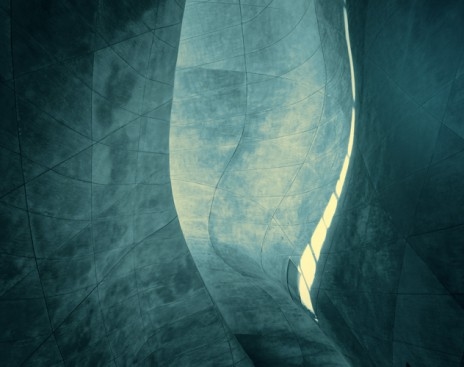
The architect and senior teacher of the University of South California Doris Kim Sung talked about how to unite disciplines distant from each other - biology and architecture. In the lecture “New Skin of Architecture”, she explained how to minimize the influence of civilization on the environment and at the same time bring the living conditions to the ideal. Slon publishes an abbreviated version of the lecture.
The ideas of my projects are based on biomimics. I thought about creating surfaces that would serve as conductors between the external environment and the premises. Such a conductor is, for example, human skin, and I set myself the task of bringing the “skin” of buildings to it as much as possible. In my opinion, soon the architecture will switch to a new level, and everything that we now see in cities will change beyond recognition.
It all started with thick skin
At first, before the air conditioning system appeared, the “skin” of the buildings was thick, I mean, the walls of the houses were made very thick. Such a “leather” supported the coolness inside in the summer, and in winter did not allow the heat to go out. The windows were small, and it also worked on thermal insulation of structures.
Then, in the thirties of the twentieth century, with the improvement of technology and the emergence of mass production, the windows became huge. They already occupied almost the entire surface of the wall of the building. Such windows passed so much solar heat that the rooms overheated. Mechanical air conditioning systems appeared to cool the premises overhewsticks. Over time, the buildings themselves became more and more, so in order to be in them, the air conditioning system had to improve. Massive attitudes consuming a huge amount of energy and throwing a large amount of heat into the atmosphere have appeared, and with them what we call the effect of the “thermal island”: the temperature in the cities became several degrees higher than in the regions adjacent to them.
All these were motionless systems. But in the eighties, attempts are made to conduct active, opening and closing mechanisms designed to regulate the number of sunlight penetrating inside buildings. However, such mechanisms from the very beginning did not work properly.
Third leather, biology hurries to the rescue
Comprehending all this, I thought about the question, why do we need architecture at all? What if the buildings become another skin for us? Human skin is an organ that regulates body temperature, as well as performing the role of a protective and water -repellent layer. There are pores and hairs on the skin, they form an effective system of protection and regulation. The skin is not static: when we are cold, we are covered with goosebumps, and the hairs rise. A person has two skin: the first is the skin itself, the second is clothing, it changes its shape and moves with the body. I suggested that the house can become the third skin of a person if it can respond to changes in environmental temperature.
I began to look for biological systems that could serve as a prototype for creating the “skin” of architecture, and drew attention to the protective mechanism of porcupine. There are needles on his body, they rise if the animal feels danger. When the porcupine is calm, the needles are pressed to the body.The first experiment was conducted over the trailer - the principle of porcupine applied to it: the needles attached to the trailer rose according to the principle of hammers of the piano. |
I was also interested in the BMW Gina project. This is a machine, which is covered with a fabric, so that its appearance can change. What if we teach and move the architecture, change the form in accordance with what happens both inside and outside?
Material is wanted: beautiful, but smart
I was looking for a material that could help in this, but I wanted to move away from control and energy consumption. And I discovered a very simple and “smart” - thermogometal. This is a metal material consisting of two layers of various alloys, the coefficients of thermal expansion of which are significantly different from each other. Since the coefficients vary, one side reacts to the temperature faster than the other. When heated, the edges of the plate rise, and a slight twisting occurs, and when cooling, the bimetall is straightened again. The material reacts quickly even to a slight increase in temperature.
But bimetal is not on free sale, and it was not easy to get it. I asked the factory to give me waste from production. I had to wait a long time, since only a few companies are engaged in the production of bimetall.
When I finally received a small amount, I wanted to use it as efficiently as possible. I also tried to keep as much material as possible, because in the process of giving it a lot of scraps and waste formed. Thus, we came to a form resembling a triangle. We make surfaces from many small pieces.
One of our first projects, more precisely, its result, is in New Orleans. The installation center is placed in the artificial lighting source. The result is a kind of heater: when the light turns on, the bimetall is heated, the “gates” are opened on the surface, and the heat comes out.
A couple of years ago, in Los Angeles, we built an art installation called “ Bloom ” (“Flowering”). At that time, the factories were already interested in our experiments, and we could get more bimetal. It was a huge step, since for the first time we could place the open -air structure and see how the real sun, and not artificial light, will affect metal. We erected the model in a very limited space. The process itself was very unusual - they began from above and gradually moved down, until the construction touched the ground. In the process of constructing “flowering”, a lot of inconvenience had to be experienced: we sorted the elements in the morning, when it was cool enough, but after the afternoon it became hot, and the bimetall was folded.
“Flowering” consists of fourteen thousand pieces, while there are not even two exactly the same - each has its own shape. When the sun enters the surface of the structure, the bimetal controls the penetration of the rays, opening and closing the holes. It is also a ventilation system - when necessary, the air penetrates inside or goes outside.
Also in the afternoon, open plates will provide a greater overview, while their closure at night is solitude and comfort. No curtains, blinds or other devices will need to close the windows. |
Bimetall, in my opinion, is very practical. Buildings from this material are easy to repair, since large surfaces are made up of small pieces, so in case of damage, it is enough to replace a small fragment, not a whole layer.
Grasshopper as a model
The prototype of the project, which I am currently working on, has become a grasshopper. There are special narrow slots on his body - breathing holes. The circulation of oxygen inside the body of the grasshopper is ensured by a reduction in its diaphragm. If we create a wall system that looks like a grasshopper breathing system, we can easily cool and heat the rooms. Using this principle, you can create a mechanism for attracting wind from the outside into the building.
The next project is patented, so I cannot tell a lot about it. I can only say that this is something like a double leather system. We will try to place bimetall between two layers of window glass. The principle is slightly different - such windows should be closed completely when it becomes too hot and sunny.The facades of buildings, thus, are especially high, will change - they will cease to be static, their appearance will constantly be different. |
Today the facade looks like this - tomorrow the weather has changed, and it looks completely different.
Other Bimetall capabilities
But we are able to make bimetall not change the shape during the day. This is another idea that work is being done - heat can only be used in the process of erecting the structure. So, if bimetall is bend at a temperature of about 3-5 thousand degrees, he will remember the shape, retain it, and since the ambient temperature in natural conditions will not rise so high, it will never change the shape. The bimetall is very light and easily divided into pieces, and, thus processed, can provide greater surface strength.
Like most metals, bimetall can improve its properties if it is covered with dark paint. Although the bimetal is easily controlled by reducing or increasing the thickness of the plates - the thinner the material, the smaller the temperature is needed to start responding, but if different areas in different colors on the same surface, you can achieve a variety of effects, it all depends on our needs. Perhaps, for example, an interaction with the Super Black coating, which reflects much less rays than any black item.
An interesting effect can be achieved if you combine bimetall with other materials. So we can create something resembling a system of bones, muscles and ligaments. Another "smart metal" is Nitinol. This is a wire, it is difficult to use in architecture, since it does not cover large surfaces, but you can find interesting use of nitinol. Nitinol wire remembers the shape and takes it when placed in hot water.
In general, the bimetall works better in a warm climate than in one as, for example, in Russia. It seems to me that the problem is that these systems need to be “turned off” for the winter. It is like blinds on the windows - they are very effective in the summer, but in winter you can not close them, since in cold weather you will need the sun to heat the room. And here you can use nitinol. In the future, we hope to make systems that regulate the amount of not only heat, but also water, but so far there are small difficulties.
We must go forward. Times of thick walls and small windows have passed. In addition, progress has already caused enormous harm to the environment, and we need to make sure that the situation does not deteriorate. I believe that the new “leather” that we propose will change the architecture and help to solve many problems.