
Translated material
Bakradze: "For the government of the reformers, we lasted a long time"
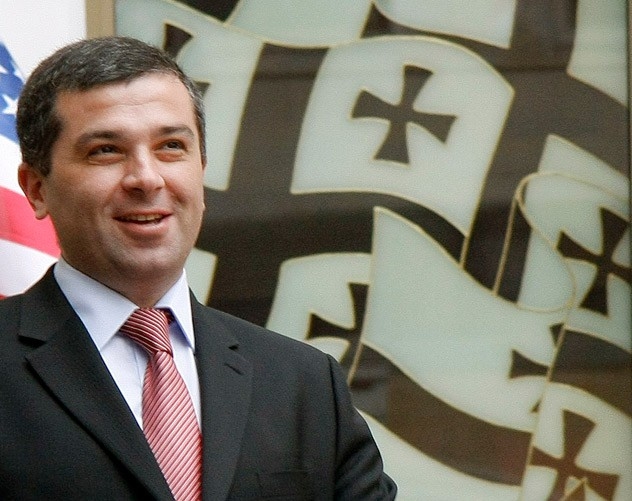
On October 27, the presidential election will be held in Georgia. The current president Mikhail Saakashvili by law cannot run for a third term. One of his most influential associates, Prime Minister Vano Merabishvili, who oversaw the famous police reform, will also not become a presidential candidate: he was arrested in May on suspicion of corruption. As a result, the “national movement” in the elections will be represented by David Bakradze - a former diplomat and Minister of Foreign Affairs, and today - the head of the parliamentary opposition. As a result of the 2012 elections, the majority of the Georgian Parliament received the Georgian Dream coalition, which is headed by businessman Bidzina Ivanishvili, and the Saakashvili party for the first time since 2004 was in the opposition. From the “Georgian Dream”, George Margvelashvili, a philosopher and a university teacher, goes to the elections. Slon He discussed with David Bakradze why he could not hold Georgia in the channel of reforms, for which they arrested Merabishvili, who has any chances in these elections and how soon Georgia will become part of the European Union.
- Your party was in power for eight years. What is the opposition?
- Being a normal opposition is not at all bad - I mean when the opposition has the opportunity to work normally and the deputy from the opposition cannot go to prison only for criticism of the government. I’ll tell you even more, after eight years in the government it is not only normal, but just necessary - to stay in the opposition for a certain time: to look at life from a different point, to understand what cannot be understood from your office, from your personal car. There is an opportunity to rethink everything that you did when you were in the government - what was right, what was wrong. This is useful for both the party and the country. To be in the opposition, when your views directly determine your location - in prison or in the wild, much more specific. Now being in the opposition is very difficult. Political persecution is practically: most of our leaders, former members of the government, are either in conclusion or under a criminal case. Every day I have been traveling through the regions, I meet with our activists, and most of them have visited the prosecutor’s office, either the police, or in the financial police for one simple reason - they remain activists of our party. I do not want to create a wrong impression and complain that Georgia has a full -scale dictatorship. Thank God, no, and I hope she will not be here.
- What has changed in the country from the parliamentary elections?
- Much has changed. It is more difficult to talk about positive changes, and not because I am in opposition, just positive changes, probably much less. But, from my point of view, one positive moment is clearly present: our society passes the vaccination period against unrealistic expectations. The expectations that some rich person will come, the political Santa Claus who will do everything for us, who will give us a salary every month, builds such a beautiful village of Santa Claus from this country, where people live happily, do not work, but only get money and walk. Such a virus, as a rule, has been preserved in all post -Soviet societies, and not only in the post -Soviet, but in all countries of the former Warsaw bloc. The expectation virus that the government should do something for you. Of course, the government should do a lot, but not for you. No government will work for you so that you just sit at home and receive money. Our society, too, was supposed to be immunity against such a virus. The government should work, create conditions, build a country, but people must work themselves, earn their own and build their own lives themselves. A year ago, in this country, expectations reached comic. In October, after the election, people stopped paying in transport - they said that now the transport would become free because Ivanishvili won. People stopped paying for gas, for electricity, stopped paying loans at the bank - after all, Ivanishvili won, he will pay for all loans for us. Now our society is sobering, gaining immunity and understanding that you need to buy a ticket when you get on the bus. I hope that after this our Georgian society will gain a healthy ideological basis, and for me it is a normal market economy.
- But the program of your party in those elections was also unexpectedly populist: raising pensions, helping agriculture, increasing subsidies. Would you do it if you won?
- Yes, they would. We had not only promises - we had a specific calendar, where we literally painted everything that we promised people for a week. It was possible to reveal this calendar for a period of four years and see that at the 15th month after the elections this promise will be fulfilled, on the 25th-another. That is, it was an absolutely specific program. Of course, our branded style has always been a free market. But in Georgia there are still a lot of problems, and poverty, and any government, no matter how right it is, is simply obliged to take certain measures in favor of social justice. In this regard, what we proposed to the people did not come into conflict with the general right -wing beliefs of our government, which focused on minimizing the role of the state in the economy. There was a minimum package of what the government should do for social protection of the population in a country where very many people live behind the poverty line. I think we proposed a compromise option.
- Do you go to the presidential election with the same program?
- The program now, of course, is different. The president’s functions under the new Constitution are much less than the functions of the government, the economy is almost entirely a government field. But the president still has authority, primarily control over the government. In the social sphere, the role of the president is a little limited: the president, as a politician directly chosen by the people, can politically affect the government, but the president no longer defines daily economic policy. I'm not talking about foreign policy, about security - all this is included in the powers of the president. Therefore, now the task is different, and the program is different.
- Last week you proposed a candidate from the Georgian Dream George Margvelashvili Debata one on one, but he refused. Will you succeed in the president with such a relationship to cooperate with the government?
- It is very bad that Mr. Margvelashvili refused the debate. Of course, there are a lot of differences between us, a lot of mutual claims. And the easiest democratic way to solve these contradictions is through debates, when the people have the opportunity to listen and draw their own conclusion, to determine which candidate they like best. That is why I offered him a series of debate on various topics: economics, foreign policy, security. Unfortunately, there was no positive answer. The main function of the president is the control of the government, therefore it is fundamentally important that the president represent another political force. When all political positions are equipped with representatives of the same party, control weakens here, we ourselves passed through it. We ourselves were a political force that dominated all the posts, and now it is clearly visible that if then the opposition was stronger, events could develop differently, we would work better and did more. Politics is like a sport: if you do not feel someone's breathing behind your back, relax, and you will not show a normal result. We again get a picture when all posts will be in the hands of one political force. Over the past nine months, I was able to show as a leader of parliamentary opposition that I can simultaneously criticize and cooperate. We have a very emotional debate in parliament all the time, at the same time we can negotiate on various issues.
- Why did you not manage to hold Georgia in the channel of reforms? What mistakes were made?
- I would not say that it was an unexpected collapse. For the government, which carried out such important and radical reforms, we lasted a long time. Judging by the experience of East European states, as a rule, such governments change in four years, and sometimes earlier. Reforms, of course, were absolutely necessary for the country, but such reforms are always very painful and are often incomprehensible to the people. With some results, people got used to it very quickly, they became part of life, and when something becomes part of life, you no longer notice this. If ten years ago, someone said that in Georgia they would forget about the problem of electric supply, about crime, normal roads will appear, gasification will begin, the pension will increase ten times, everyone would say: if someone does it, we will vote for this party for the rest. From the point of view of macroeconomics, of course, we put the country on our feet, because ten years ago the Georgian economy actually did not exist-it was a set of some wild capitalism and corrupt socialism in the Soviet version. But for this macroeconomics to reach every family, years and years are needed, and we had very difficult periods: there was an economic crisis, there was a war with Russia. People want the changes to take place faster, but it will not work faster. In Batumi, one taxi driver well explained why we lost: “Here, you have built a very beautiful city here, it’s very nice to live here, but now I’m voting for Ivanishvili, I will get money from it and live with money in a beautiful city.” Our priority was large projects and long-term prospects, and people, of course, were expecting specific results tomorrow or the afternoon. Well, then people elementary people want novelty. Even in successful Western European countries, people, as a rule, vote for novelty, even when the government is very successful. It is bad when people can look at the same face for twenty years.
- How do you evaluate your chances? Who are your main competitors?
- The main competitor is, of course, a competitor from the ruling party. Its main advantage is that he represents the Prime Minister Ivanvili, who is popular in our society, and many still associate hopes with him for a better life and trust him. Any candidate whom Ivanivshvili put, would automatically become a favorite in this election. I would say more precisely: the main competitor's name is Bidzina Ivanishvili, not Georgy Margvelashvili. Regarding the chance - let's see, I never like to make forecasts. But if people go to the polls with the understanding that the country needs a strong opposition, our chances are quite large.
- Nino Burjanadze as a serious opponent are you not considering?
- Based on the situation that has developed in the country, the only opposition party is a single national movement. The opposition is not the power that the government wants to call its opposition, but the one that the government does not want to see in the opposition. All those repressions, arrests, the problems that I spoke about only members of a single national movement. Today, if a criminal case has been instituted against you, you just need to leave the party, change the faction in parliament, and the persecution ceases. And many came out like that. If I say that we are the only real opposition today, this does not mean that I do not respect other forces. I hope that the policy in this country will someday become multipolar, but, based on the political balance today, from the one against whom the government is directing its resources, we have one opposition-this is the UND.
- Do you think the case is against Vano Merabishvili political?
“If Vano Merrabishvili, David Bakrarase or someone else did something wrong, the fact that we are politicians should not give us immunity.” But in normal conditions there is a crime, and, investigating it, come to a specific person who committed it. With political persecution there is a person against whom you want to find something, and you are looking for what to punish him. In the case of Merrabishvili, for several months, almost the entire financial police interrogated about 20 thousand people who worked in the program to create jobs that Mebishvili was engaged in last year. When so many resources are spent on investigating a potential business that was not resonant, society is not interested in, it does not lie on the surface in order to at least somehow find evidence against a particular person, serious issues arise. There were such things against Merrabishvili and against many of our other people. As far as I know from lawyers, there is a big chance that on a court examination this case will simply fall apart, as it was in many other cases when the prosecutor's office arrested members of the former government. I do not want to comment on the legal plan before the court. But how this happens, leaves serious questions about political persecution.
- If you lose these elections, how serious for the party this will be?
- Of course, it will be unpleasant, but I would not dramatize. We have potential, brand, image, everyone remembers what we have done in previous years. Ten years ago, I was still a diplomat, and at international courses I myself taught that Georgia is an example of Failed state due to corruption, due to invalid state structures. For eight years from this failed State we built a state, even if the poor and rather weak, which stands on a normal healthy basis. Today it is fashionable to scold the previous government for errors, but this fashion will pass, and the changes will remain. I'm not talking about roads, about electricity - we created institutions: police, army, tax service. Sooner or later, the party, which has such experience and so many international contacts, will return to power.- Who will Mikhail Saakashvili be after the president leaves the post of president?
- It's hard to say, but he will remain in the party, will be one of its leaders. And so, as far as I know, he has his own plans related to education, but it is difficult for me to comment on his personal plans.
- How do you see the foreign policy of Georgia? European integration?
- Western politics is also a brand of our government. Ten years ago, no one in the West seriously considered Georgia as a potential candidate for NATO, and there was no conversation about the European Union at all. When I was a diplomat and finished NATO college, I said there that, perhaps, in one day Georgia would also become part of Europe, and they just laughed at me. And now we have reached a point when in Bucharest we officially confirmed that Georgia will certainly become a member of NATO, we in Vilnius sign the next agreement with the European Union. Georgia simply does not have an alternative: if we want to be normal democracy, we must be part of Europe. Georgia made its historical choice.
- You said that the free market should be the priority, but the European Union is now moving towards increasing the role of the state in the economy. Will Georgia have problems with integration because of this?
-We already had problems because of this. In 2003, I was the chairman of the Parliament Committee on European Integration, and part of my work was just checking the new Georgian legislation for compliance with the Directors of the European Union. Then we had several points, somewhere, the legislation that we wanted to introduce did not coincide with the European one: our regulations were much more liberal than the regulation of the European Union. Then we always tried to find a common language, and we succeeded. I think in the future we will succeed. For all new EU members, the harmonization of legislation was a long and complex process. In our case, he will also be difficult, God forbid, so that it comes to this.
-What will happen to Russian-Georgian relations?
- It is very bad that these relations have entered such a dead end. Of course, we must say. This is very difficult, much more complicated than our government represented a year ago, when it thought that real changes would begin with a change in rhetoric. It turned out that even after the beautiful statements of Russia on one day we can get a creepy occupation when barbed wire moves to the territory of Georgia. The Russian President comes to Abkhazia and once again says that he arrived in an independent country. The problems of Russian-Georgian relations are not only in rhetoric and someone’s personal relationships. By the way, when the government was approved by the Minister of Foreign Affairs, my first call was not in Brussels and not to Washington - my first call was Sergey Lavrov to Moscow. I deliberately made my first call to Moscow because I thought that my most important task was to find a common language and stabilize our relationship. Therefore, I said, when you want, tomorrow, the day after tomorrow, you want, even tonight I fly to Moscow, we sit down, go through the entire list of problems and try to find common points. Unfortunately, this visit did not take place then: Mr. Lavrov said that let's postpone it better, then our deputies met, then the visit was postponed again ... Russia is a very important partner in many things: in economics, in tourism, safe. We have a common problem - the North Caucasus, where we are also interested in stability. Главная проблема, что Россия должна начать воспринимать Грузию как соседа. Мы готовы воспринимать Россию как нашего партнера, но не как нашего хозяина. Подчиненными мы не хотим быть ни у России, ни у кого-то другого. Мы маленькая, но нормальная страна. В России должны привыкнуть к идее, что народ Грузии может выбрать своего президента и премьера, и совершенно необязательно, чтобы тут кого-то посадили из Москвы. Мы готовы стать частью Евросоюза, но это совсем не означает, что мы собрались воевать с Россией. Мы делаем этот выбор не против России, Китая, Новой Зеландии или кого-то еще, а в пользу Грузии. Не надо это воспринимать как антироссийский выбор. Чем успешнее Грузия будет на этом пути, тем быстрее в России на нас начнут смотреть как на соседа. Пример Восточной Европы и Балтийских стран очень важен: двадцать лет назад к ним было такое же отношение, а потом эти страны стали частью Европы, и в России привыкли, что это нормальные соседи, с которыми можно иметь хорошие отношения. Пока мы будем стоять на пересечении дорог, всегда в Москве будет искушение, что, может быть, мы свернем с этого пути.