
Translated material
Investors vote with their feet
Sergey Guriev about the fall of the ruble and the flight of money from Russia
On September 2, the Moscow Ritz-Carleton will host an investors dinner with one of the most famous Russian economists, now political emigrant and professor of the Parisian Science Po Sergey Guriev: he will be present at dinner by video communications. But the candidate for mayor of Moscow Alexei Navalny is in personal quality. “Two things of investors are most interested in: Sberbank and Navalny,” Guriev said on the eve of the meeting. The New Times asked the former rector of Rash about why money is running, which is why the ruble is falling with expensive oil and why Navalny was allowed to election
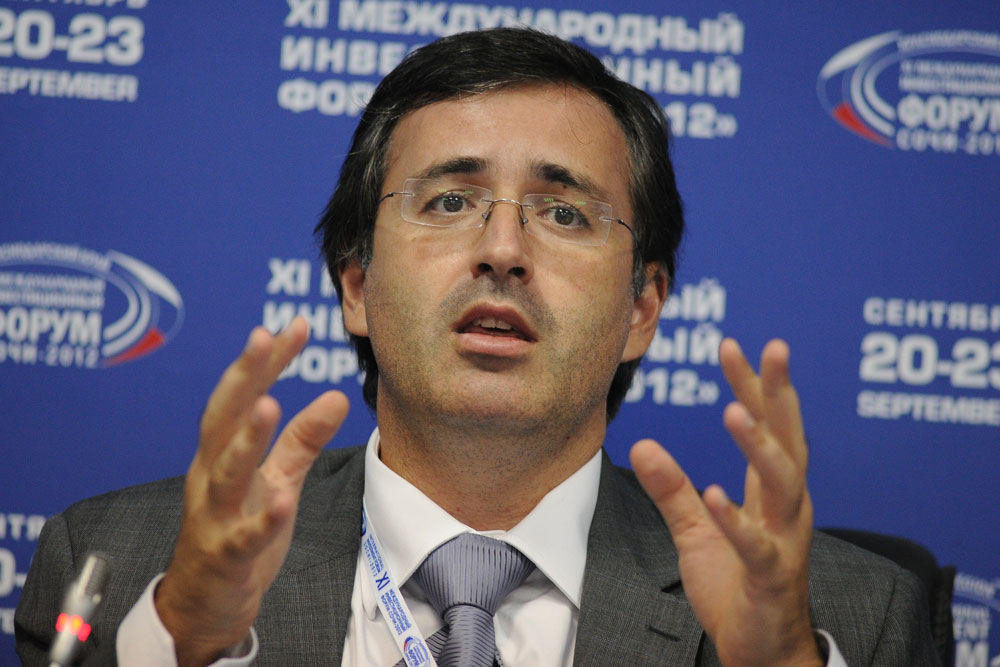 |
| Sergey Guriev at the Sochi-2012 investment forum: three months later he will begin to go for interrogations. However, investors still trust him |
The forecast of the Ministry of Economic Development: In 2013, the outflow of capital from Russia will be $ 70–75 billion. It will remain, according to the forecast of the Deputy Minister of Economic Development Andrei Klepach, and next year. The official reported this last week to reporters. You are constantly meeting with foreign investors. How do they explain their unwillingness to earn money in the Russian market, while before - they wanted?
The problem is as follows: Russian state corporations are deceiving, and private corporations cannot compete with state ones, because the conditions of competition are not equal. Both foreign investors and Russians are tired of hoping that there will be reforms, protection of property rights, a normal investment climate, because for many years the same people have been in power, and the situation, to put it mildly, has not improved. There used to be a slogan - “loot will defeat evil,” that is, everything is bad in the sense of an institutional environment, but the economic growth is so high that you can live, money can be earned. And now, when Russia is growing a pace of 2% per year, or even less, it turns out that there are risks, but there are no income. And promises, investors say, we have already heard. Therefore, they are looking for their happiness in other countries.
However, the latest data indicate that money is running not only from Russia, but also from other BRIC countries - and run, first of all, in the USA. Why?
Absolutely true. Now all the economies of the BRIK countries are slowing down, all to varying degrees and for various reasons, and economic growth in America is the main good news today. This is primarily due to the fact that electricity has sharply fell in the United States - thanks to shale gas. But we see another thing: investors begin to invest in the assets of European countries, including in southern Europe-Spain, Portugal, I think that we will even see investments in Cyprus at some point, although this is not yet. Everything is so bad there, the assets have so much fell in price that investors believe: it's time to buy. In short, investors look at a variety of opportunities to make money. But in Russia they do not yet see such opportunities. They already understand: we can only invest with us with state -owned companies or state -owned companies, and this business is very risky - managers of the state -owned companies of their partners are often deceived. As for other BRIC countries - there are their problems, their economies are growing more slowly than expected, and there are also problems with corruption, the rule of law, and so on. But in Russia, the situation is completely desperate: oil prices are high, there is no budget deficit, but the capital is still running.
This is not clear: oil is now trading at a price of $ 117 per barrel. If there is a war in Syria, the price will be even higher. And for some reason the Russian ruble falls, although earlier players in the foreign exchange market knew: if the oil is expensive, then the ruble is stronger. What's happening?
The ruble is a function of two factors: oil prices and outflow of capital. If there is no outflow of capital or its level is held on a constant value, then the dependence is exactly the following: high oil is a strong ruble. But if the capital is running, the demand for the dollar is growing, respectively, the ruble is getting cheaper.
That is, the ruble will continue to fall?
Yes, if the outflow of capital continues. And if good news will come from Russia, then the money will begin to return.
More weak rubles do more than the problem of the hole in the budget solve the problem?
Yes, and this is normal. But a weak ruble hit the wallet of people and enterprises: import - products, equipment - becomes more expensive. And import in Russia plays an important role.
What do you mean by good news?
| *Organization of economic cooperation and development, headquarters in Paris. |
For example, decrees of President Putin of May 7, 2012 will be made. The fact that there will be an improvement in the business climate will be privatization, the fight against corruption, Russia will join the OECD*.
Is it real?
I would not put my money on it.
The refusal of Barack Obama from a meeting with Putin in Moscow somehow influenced investors?
Investors take into account everything, but this cannot be a real factor. Their task: to invest money in the company's shares or bonds and make a profit. And when other and unexpected bad news are added to bad news - the desire to invest disappears. Everything affects: Obama’s refusal to meet in Moscow, and Snowden, and the war in Syria, and so on. Just for investors, Demarch Obama is an indicator that Putin does not like Washington more than before, and this means that the Western company that invests in Russia will be more difficult to talk with the lobbyists in Washington. But this, of course, is not a decisive factor.
"
In Russia, the situation is completely desperate: oil prices are high, there is no budget deficit, but the capital is still running
"
And you do not think that at today's oil prices, the Russian elite - the one that is close to the ear, the same members of the Lake Cooperative - is just interested in being less western competitors?
This could be mistaken for a hypothesis if it were not for the problem of budget deficit. Putin promised that the economy would grow 5-6%, and it grows by 2%, which means that the authorities are not enough money to pay for the loyalty of the population. With today's appetites of the corrupt elite, there will not be enough money for retirement, for promises to state employees, and this will cause an increase in popular discontent. Therefore, investments are needed. It is no coincidence that Putin recently (at a meeting on the socio-economic development of the Rostov region on August 22, 2013-The New Times) complained that, here, people from Rostov carry money to Greece: “If the investor chooses such a clearly problematic country for their investments and prefers it to the Rostov region, then the question arises: why?” And the answer, apparently, is this: with all the crisis in Greece, investing their money in Russia to Rostovites is even worse. And investments are jobs and potential income of Russians. Despite the entire policy of the elite’s nationalization, it still very much depends on the West.
The report prepared for the 10th anniversary of the Valdai club is more likely to speak the opposite: it is infected with anti-Americanism, does not want democracy in the country and is even ready to strike with weapons in case of some foreign policy problems. You are not afraid, for example, that in the event of a western coalition for Syrian objects, Russia, which almost the only one supports Assad, can somehow intervene? And we will witness the proxy-warriors between Russia and the West, as was the case during the USSR in Korea, in Vietnam, in Afghanistan?
Don't think. The Russian elite will lose its money in Western banks - their assets will simply be frozen. Of course, there are enough crazy people in the Russian elite, but not to the same extent ... In short, Assad will probably supply weapons, but there will be no proxy-waist.
Recently, the First Deputy Head of the Presidential Administration Vyacheslav Volodin at a meeting with political scientists said that opposition candidates would not be removed from the elections that they have been taken a course for the liberalization of the political system. How do you interpret this?
In such political systems, as in Russia, there may be two motives for such statements or actions: the first one - to share responsibility. For example, economic growth is reduced, material problems arise, then you allow the election of governors to say: this is not our problems, that there is not enough money, say, social payments, this is the problem of the governor chosen by you. The second motive: the authorities feels that political discontent is growing related to unlimited corruption or with the adoption of, for example, absurd laws like the law on orphans or the Internet. In this situation, the authorities have a desire to release steam - to avoid mass protest or even an uprising.
You said that at your meetings with investors they are interested in two things - Sberbank and Navalny. Why Sberbank is understandable: the main bank of the country, and why Navalny?
Navalny is the main opposition politician. If he wins the election of the Moscow Mayor, and the normal investor cannot exclude such a probability, then it is important for them to know what will be with Moscow and Russia: the Moscow Mayor has great powers in order to most seriously change the federal policy and the economy. The second question: what will happen if Navalny does not win the election, but gain a large percentage of votes? Probably, this will also affect the state of affairs both within Moscow and in Russia as a whole. Therefore, investors are also interested in what Navalny actually thinks, what is in his head, what are his principles, ideas about the world, whether it is possible to speak the same language with him. For example, I am often asked about Navalny nationalism. I reply that this also worries me, but I never heard anything from him that I would, Ossetian by nationality, made me believe that he treats me as a second -grade person. I talked to him many times on this topic, and Navalny was always amazed that someone could suspect him of such things. It seems to me that Alexei sometimes does not realize how his words or jokes can be perceived.
The President promised that the economy would grow 5-6%, and it grows by 2%, this means that the authorities are not enough money to pay for the loyalty of the population
"
Now many are wondering: why did the authorities allow Navalny to the election, while one of the reasons for the persecution of you is related to his support?
You know, the answer to this lies in the plane of Kremlinology - there was such a field of knowledge during the Cold War, when the alignment of forces at the top of the USSR and possible decisions were determined by how members of the Politburo stood on the rostrum of the mausoleum - these fortune -telling from the same series.
But this is the question of whether there is an elite split or not, there is a vertical of power with Putin upstairs or not, he weakened - and there are constantly rumors about a severe disease of the spine, almost about the sarcoma and that he underwent surgery a couple of months ago - or not?
The decision to first put Navalny, and the next day to release it shows that the model of such a confident, omnipotent, visionary Putin does not exist. Either different people make decisions, or Putin hesitates, or he doesn’t care what will happen to the bulk. Obviously, there is no dictatorial state in which Putin alone makes all decisions. That is, it is quite possible that he makes all decisions, but changes his point of view very quickly.
I can’t help but ask: what is happening with the criminal case, which you are going to a witness, but because of which you had to leave Russia ?
I can only say one thing: for the better, there was no change. And some events of the last months, which I can’t talk about yet, convinced me that then, in May, I made the right decision - to leave.
Photo: Ramil Sitdikov/RIA Novosti