
Translated material
Minks Wound: What happened to Francois Ozone?

Isabelle (Marina Vakt) has just turned seventeen. She blows the candles, kisses his younger brother, reluctantly listens to her mother and stepfather's congratulations, and when the adults are arranged on the veranda with a jamb and pseudo-intellectual conversations, secretly eliminates from home to the beach, where a new familiar, freckled peer-a-nine waiting for her awaits her. Isabelle is seriously configured to lose virginity, which is not at all difficult. Although it’s not that it is pleasant - on the contrary, turning away from the young man who was puffing on her, the girl will even see herself and this scene from the side (Francois Ozone does not find anything better than literally introducing a double of the heroine into the frame). “Nothing special,” she will answer at home a younger brother who meets with questions.
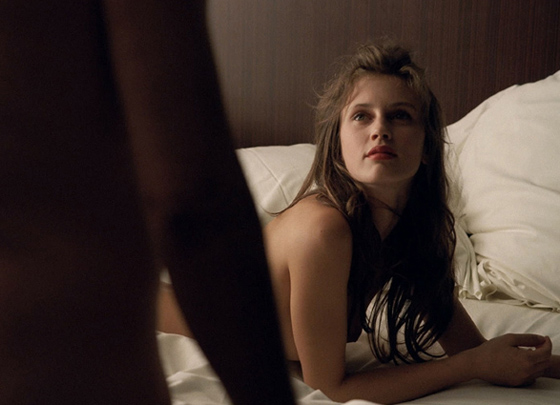
After five minutes of screen time and one song of Francoise Ardi, a freshman Isabelle will already be given to the gray -haired gentleman in the room of the Paris Hotel. For money.
In the new film, Francois Ozon is enough truth, which, in lack of a better word, is characterized by the epithet “sensual”. This truth is opened by the viewer here and there. In the indifference with which Isabelle meets his German friend after defloration. In an exaggerated, "adult" makeup, which she bristles before dating with clients. In that youthful challenge with which she, having come to taste, looks at one of her elderly lovers. In irritation, which for a second, Isabelle flickens on the face at the sight of a boyfriend-one-year-old boy who has fun with her family, after the police reveal the girl’s parents to the double life of her daughter, and after a couple of songs by Francoisa Ardi will indicate a milestone of the milestone of the girl’s transformation into a woman. Finally, in the eyes of Charlotte Rampling, which appears in the final “Young and Beautiful”, to put everything in their places - and to act as a genuine agent of growing up the heroine, a mirror in which she will look to see herself. It seems that some (or all?) Women do not change - and so they carry the same abyss in their eyes: that at seventeen, which is sixty -seven.
 © Mandarin Films
It is in this scene with Rampling, however, the problem of “young and beautiful” is most clearly displayed - and almost all the last works of Francois Ozon. The conductor is a simple, but believable metaphysics of the female soul in the film is not a plot or directing, but selflessly exposed by Marina Vakt (model according to the first profession) in the texture: open eyelashes, swelling of the lips, slightly torn outlines of the nipples. The same with a professional lyceum of Rampling: senile squint, a booster landscape of the landscape once an ideal face. Physiognomy, facial expressions, body plastic - behind all this in the “young and beautiful”, the abysses of meanings, the true beating of life lies. But on one condition - if you look at the heroines through the eyes of a voyeurist, and a voyeurist who does not experience sexual interest in the subject of peeping. Ozon doesn’t seem to hide the nature of his interest in women - he opens the film with a scene of such a peep: the younger brother, who looks like 11-12 years, looks at the topless sister in binoculars. Another thing is that ahead is not only the chemical songs of Ardi and the exhaust, an artificial plot with a secret occupation of prostitution, but also such turns as the death of a client during sex and the final yield of his widow (just rakling).
Artificiality, the far -fetched plot is not a sentence at all. However, it does not turn out to get rid of the sensation that the luxurious texture, which just asks “young and beautiful” over the cheap operation of fake meelodrams (in fact, the nearest analogues of this film are not at all the remarkable “daytime” of Bunuel, but mainstream Europols about the “impenetrable female soul” like a “nympho Diary”), in the given diary). The case works only with a screen for the next Ozonov morality. Pobasenki, which is witty (ozone has a good sense of humor-it is no accident that the best of his films of the last ten to fifteen years, “eight women” and “desperate housewife” were shot in the genre of vaudeville), sometimes hints at the truth of life, but in its essence is infinitely cynical-if only because in every turn of its plot it is unique in its plot. Summarize the heroines, one way or another to reduce to a statement about female nature. It sounds from the lips of the next client: "A whore for an hour is a whore forever." Here mother Isabelle reports that in her youth he herself came off as best she could - although she did not go as far away. Here Rampling is included in the frame in order to report from the height of her experience that every woman from time to time represents a prostitute. Probably, this is true - everyone represents. But Ozone, who in his early films never forgot that what was happening in the frame is precisely that the fantasy that came true (quite in the jig, remember the “rat), and more and more often tries to give out the resulting, genuine order of things.
So the heroine of the “young and beautiful”, shaking out of interesting experience and having received the approval of Charlotte Rampling, safely goes into adulthood - thus surviving not so much a passion for prostitution as a transitional age. So the heroine of another recent Ozonov film, “refuge”, in order to find himself, it was necessary to see the death of a boyfriend from an overdose, give birth and escape, leaving the child a gay brother of the deceased.
We will not deny - peeping after his heroines (and actresses), Ozon imagines for the facades of the bodies an interesting inner world. But you don’t have to be deceived-if someone's inner world is revealed in the Frenchman’s films, then it is himself, and if there is a “young and beautiful” character, who really dreams of engaging in prostitution, moreover, and with tidy elderly gentlemen, then this is an aging Francois in the directorial chair.