
Translated material
Obama and Syria: mistakes and cunning moves
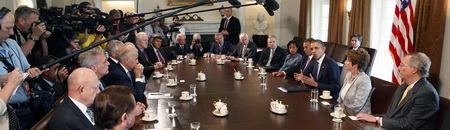
In the story of Syria Obama does not look the best, and this is still mildly said. He is also criticized by those who all their souls for striking Syria, but believes that this had to be done a long time ago, when the crisis has not yet reached the stage of the civil war. And, of course, Obama are extremely dissatisfied with those who are generally against American intervention in the Syrian war. Obama himself said that the Americans were "tired of the war." The foreign policy of the American president does not like not only politicians, but also, in fact, to the US citizens: it approves of only 41 percent, and in connection with Syria, the ratio of approving and not approving is 35 to 44 percent. There is nothing to say about the press. The other day, Farid Zakaria, one of the leading political commentators, called Obama’s actions regarding Syria "as a model of how foreign policy should not be pursued."
But it must be borne in mind that the presidency of Obama is not limited and does not end with the question of Syria. And besides, for the general assessment of the US President, foreign policy - with rare exceptions - plays a less significant role than the internal one.
The president, who is already a second term, is focused on what he will have time to achieve before he leaves the post, what his heritage will be and how much he can strengthen the position of his party. In 2014, re -election of the House of Representatives and a third of the Senate will come, and in 2016 - already without Obama’s participation - another fight for the White House. And therefore, when, having already announced the decision to strike at Syria in the “punishment” for the use of chemical weapons, Obama suddenly appeals to Congress, this is not only a desire to divide responsibility for consequences with legislators. It is also a political step, aimed at improving interaction with legislators - after all, it depends on them whether Obama will be able to fulfill the main goals that he set for himself from the very beginning of his presidency. One of the most important here is the reform of healthcare. For Obama, this reform would become a historical achievement, his presidential heritage, just as the legacy of President Roosevelt was the law on social security of 1935, guaranteed old -age pension, unemployment benefits, support for disabled people and other forms of social protection.
Other, closer domestic political tasks are in the economy. Now economists agree that the situation seems to be established, in particular, unemployment has decreased. But Obama is hanging over the problem associated with the ceiling of public debt. It depends on the congress whether to raise or not raise this ceiling, whether it will be blocked, as last year, the adoption of the budget. These decisions will have a significant impact on how the intermediate elections of 2014 will be held, and no matter how important Syria is, it can be assumed that relations with Congress are more important. Moreover, on the question of Syria, disagreements in the congress look unusual, but that the congressmen do not share on a party basis. In particular, the Republican Party was divided into traditional “hawks”, among which, for example, Senator John McCain. (At a meeting with Obama this week, McCain said that if the Congress does not approve the President’s decision, then this will have catastrophic consequences - a mirror reflection of what the Russian Foreign Minister Sergei Lavrov said, according to which the catastrophic consequences, on the contrary, will have a strike on Syria.) Thus, some of the Republicans will support the initiative of the initiative of Obama. president. Another part of the Republicans is now more isolated and adheres to the policy of non -interference. A bright figure in this camp is a senator from Kentukka Rand Paul, whom many consider to be a probable presidential candidate in the next election. The isolationism of Rand Paul, of course, is dictated not by respect for the sovereignty of Syria, but by internal American interests. The “fatigue” from the war, which Obama spoke about, is primarily connected with the desire to preserve national resources to solve pressing problems within the country, and not to spend them on military operations where and why the same. The idea that the United States has a mission requiring American intervention everywhere, where injustice is being repaired and human rights are violated, it is conflicting that there are more important things at home. And recently, among American voters, "isolationism" is becoming more popular.
Disagreements between supporters of the active position in the international arena up to the use of military force and those who prefer other methods are familiar to the American political tradition (adherents of these two directions are usually called “idealists” and “realists). In some periods, idealists win, for example, during the presidency of Bush Jr., who without hesitation appropriated America's status of a worldwide moral authority, and at the same time the right to invade other countries and contribute to the victory of “good” over the “evil” by the power of American weapons. In this sense, Obama at first occupied a much more “realistic”, careful and pragmatic position - partly in contrast to his predecessor, partly because economic difficulties made him be more careful in the distribution of expenses. It seemed that in this sense it really differs from Bush and at least partially recognizes the limited claims of America for the role of an unconditional moral referee. And in the situation with Syria, he was clearly not eager to solve the issue of a military way. But as a result of unsuccessful political steps and ill -conceived threats, Obama is forced to be in a position when there was no alternative to apply military strikes. Do not hit is to demonstrate that the threats of the powerful power of the world are empty words. But the upcoming missile strikes do not have a clear goal and also threaten destabilization, drawing other countries into conflict, and America itself into another adventure.
Obama’s mistakes associated with Syria, perhaps, cannot be corrected, at least in a foreseeable time. But the decision to transfer the discussion to Congress is a cunning political move. Obama partly protects himself from criticism of legislators for “Syrian mistakes”, partly establish inter -party interaction. The aggravation of contradictions within the republican party, of course, to his hand. Maybe Obama will actually be able to accept the reform of healthcare and make it his historical heritage. Moreover, the situation in Syria itself is still hopeless.