
Translated material
"It is important to know when it's time to stop"
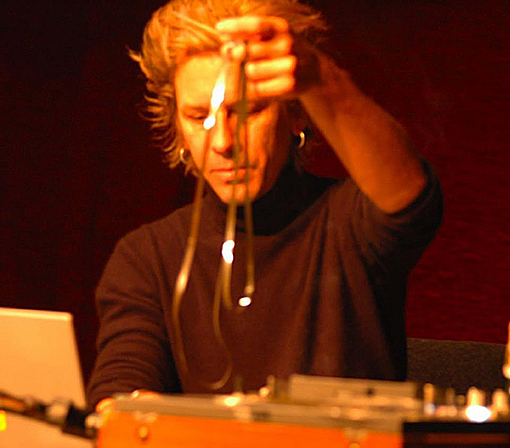
The lord of the film rings, William Basinsky, has already told the story of his famous series of albums “Disintegration Loops” - inseparable, so it turned out, from one of the main American tragedies - that this story, with small changes, repeating from the interview in an interview, as if he had already turned into a magnifying glass that he had to scroll through everyone. Once he communicates with journalists. When I talk about this to William, he laughs and seems to be relieved not to discuss the morning of September 11, 2001. Moreover, there is no need for this - I think that I can tell you this story for it.
On that day, an interview was scheduled for the unemployed bass in one of the towers of the World Trade Center, but when he woke up, he woke up from the sound of the explosion, the world was already different. At that time, Basinsky, along with a couple of friends, lived in Brooklyn, and burning towers were visible from his room. Turning away from the window, he turned on the TV to find out what was happening, but the tantrum that was on the air did not clarify anything. Then he turned off the TV and, in order to somehow calm down, turned on “Disintegration Loops” at full volume-a record, the work on which he finished only the day before; The recording of the "smoldering" of the old film rings, from which pieces of magnetic coating were exfoliated with each turn.
In the evening of this day, he asked his neighbor Peggy, who shot the fire from the roof of their house, fix the camera and leave it on for the night. The next morning, having looked at the shot film, Basinsky realized that he should combine these shots with Disintegration Loops -this will be his elegy to the collapse of the twin towers. Today it is a video in which at first the magnificent motive, turning into a bare rhythmic skeleton by the end, the black smoke of the fire gradually merges with the darkening sky, is in the constant exposition of the national memorial and the museum on September 11.
This reaction of Basinsky to the end of the world outside the window-turning on his music louder-it becomes clearer when he says somewhere at the beginning of our conversation:
- Sometimes I call my music amniotic - you know how a liquid surrounding the fetus in the mother’s womb.
- You mean that she can protect?
- Yes, at least for me it is. The music that I do - I do it for myself. And when there is something perfect in the lupa, something from infinity ... I don’t know how to say it ... When there is neither the beginning nor the end in it, he can seem to support you.
- How water?
- Yes, like water.
-I read that when you lived in New York, in this loft, which you rented with your friends-artists, you sometimes did not turn off some kind of magnifying glass for hours, literally lived in it ...
-You see, when I find something that works, this is like a new environment. Sometimes it’s just difficult to force yourself to stop the film. I create an atmosphere, vibration is the same as the sounds of the sea, the rustling of the wind in the leaves - and I like to settle in this world, breathe.
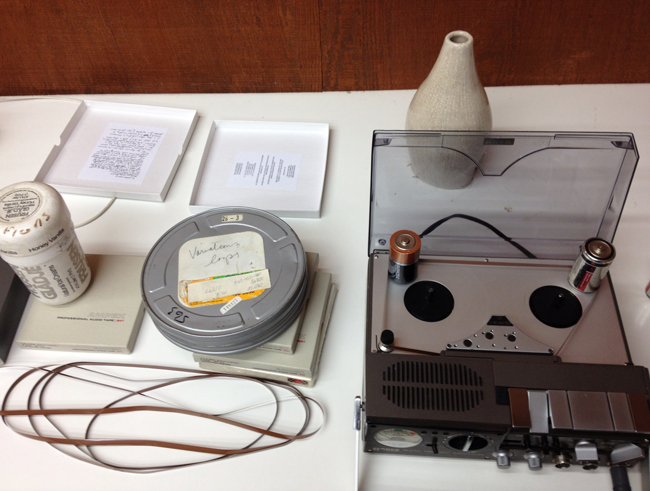 © William Basinski Uher Report 4400-German reporter tape recorder from the 70s. With them, Basinsky travels to tours. D-Batteries on them-a trick for tension of the film
- You did not notice how this influenced you, your friends, or maybe their paintings?
-Of course, this somehow influenced, made his way inside, but it is difficult to say exactly how ... And how does my music affect you?
- Well, I would say that while I carefully listen to her, my attention is aggravated to the details that I usually would not notice. Probably, we can say that the focus is somehow changing.
- You know, I have many fans from among artists, writers - and they all tell me the same thing: my music helps them concentrate. It derives from ordinary time, from these Tik-Tak-Tik-Tak, from daily.
“I’m still what I wanted to ask you.” When you speak in an interview about your last work, “nocturnes” (it will be her Basinsky to represent in Moscow.- Ed. ), You mention that this is an old composition, but you released it only now, because there was some kind of mistake on the film that you could correct only now with the help of a computer. So I wanted to know that in general it could go wrong when you apply one layer of beautiful abstract sounds to another. Is there any risk at all?
- Specifically, with “Nocturnes” this came out: at the end there were two lups, which could be dispensed with. But, of course, I understood this only later - I listened and thought: "That's the devil, well, everything, I ruined everything." It was a shame, because it was a very important project for me, I devoted a lot of time and effort to him. This is really a very early work, I even drew a graphic notation for her, which I usually do not do. She looked like a multitarre in modern computer audio editors: say, this line means such and such a magnifying glass and lasts four centimeters, then interrupted, then appears again and so on. And I liked everything except these two - too cute, or something - Lupov at the end. So it is very important to know when it is time to stop (laughs) .
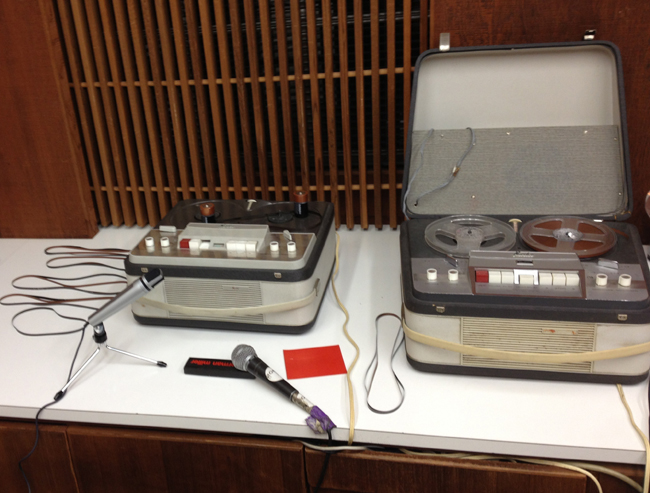 © William Basinski Norelco Philips Continental-exactly he once bought for himself for the first experiments and still uses this model in the studio. But it does not carry tours. Each weighs more than 18 kg
- In general, how many active decision -making in what you are doing? How many of you are in this music? It seemed to me that you are more likely to get me from it.
- Well, obviously, probably that Cage has greatly influenced me. When in my student years I learned about his work, I realized that the process of creating a composition does not necessarily suggest that you should sit with a pencil over a sheet of musical paper: you can try anything. And about the decisions ... In my music, something should happen that I did not specifically plan, otherwise I am bored. Of course, there are also different accidents: sometimes amazing, sometimes uninteresting - so you can’t do without making decisions, active editing and other things. But there are such moments when it is best to just take a step back and allow things to happen on their own.
- In your early works, such as Shortwave Music and The River , as if more events than in albums that you are now released, for example, on Vivian & Ondine .
-Well, when you are young, you want to be able to actively influence what forms the world around you takes, although in fact there is little to change (laughs) . But when you are engaged in art - everything is in your power. Now that I have become older, I like it more to minimally intervene in what is happening in music. For example, in the 80s, when I recorded Shortwave Music and The River , I cut a lot, glued, mixed. I grouped the magnifiers with which I worked, hanging them on a large one, in three girths, probably a dried -up bush in the shape of a brain - I found it across the road from our house and dragged it to my studio. I made notes on these films: how much this magnifying glass should last, when to enter, where to go and so on - when you write a marker on the film, this does not affect the sound. But sometimes I made a new magnifying glass, for example, I recorded some strings from the radio, slowed them down-and suddenly a whole world of sounds opened before me. And it was immediately clear that nothing else needs to be done with this magnifying glass, it is beautiful and amazing on its own - but can I call it my work? Then I was not sure of this, and often these special loops turned out to be hanging on the distant branches of the bush, somewhere away from the rest. As a result, I forgot about many. Six of them came across to me on the day when I decided to digitize my archive - they became Disintegration Loops .
William Basinsky performs on September 7 at the House club.