
Translated material
Sorcerers in Bergen
When the Bergen Assembly was just in the process of creation, many asked Ekaterina Dygot and David Riff: how will it be connected with Soviet experience? After the exhibitions “The Struggle for the Banner” (2008), the curator of which was a tar, and “Drummers of mobile images” (2011), created jointly by tar, riff and space Kostinas, was a lot of expectation of something about the incomplete communist project, which the curators of Triennale were not averse to discussing, but rather in conversations themselves. They were forced to tirelessly emphasize that the exhibition in Bergen was “not about the Research Institute, not about the Soviet Union, not about the Strugatsky” - despite the fact that there are NII, the Soviet Union, and the Strugatsky brothers in fact. This presence is really partly frame , which is quite appropriate, because the name and logic of the exhibition sites are taken from the Strugatsky novel "Monday begins on Saturday." This frame is convenient, as it allows you to partly explain the division of the exhibition into “Institutes” scattered around the city (such as the Institute of Lyrical Sociology or the Institute of Defense Magic) and a selection of work in each of them. However, it is precisely partly - but more on that.
In the first days of Triennale’s work - it officially opened on August 31 - it became clear that the main leitmotif of the exhibition was the host country. Of course, you can see a kind of gesture of gratitude in this. Bergen is the main organizer of the event. Initially, the city proposed to make Biennale (2007), then a conference (2009) was held in the Berggen Kunsthalla, at which the role of regular international exhibitions was discussed, why they are needed and whether it was decided at all, and finally it was decided to hold Triennale. Norway is generally invested a lot in cultural projects, and not so much in the capital as in regional centers, such as Bergen, Tronham, Tromso, Kirkenes. Many artists and curators, performers and conductors from other countries are well aware of this.
For curators, the first Triennale in Bergen Norway became the point on the basis of which you can start a big conversation about today's world. Moreover, to do this is not through general topics, which, when they are seriously affecting them, seem to be abstractions that are not related to our lives: they are not so circumvented, but still the main thing is not the universal scale of the questions raised. It is clear that Norway is a fantasy country, about the same as the United States is still for those who believe in the “American Dream”, which was the USSR for both its citizens and foreigners, friends and enemies, and India for downshifters and seeking enlightenment. But all this is thawed by collective efforts, while the participants of Triennale offer completely personal, dreamy, up to the easy madness of the idea of Norway and the world.
The story of this is either real or mythical Norway is present in several works directly. For the Chinese artist Wong Men Hoy, this is an unexpected perspective for the so -called Scandinavian socialism, which became possible in many ways because two communist parties appeared in Norway, one of which, on the wake of the general left -wing upsurge around the world, became Maoisite aggression against Czechoslovakia and the “cultural revolution” in China. The nameless Hunweiban, exiled to re -educating in the wilderness, literally from the mountains in China gets into the Norwegian fjords, where former Maoists are engaged in various social activities and talk about it lively. On the one hand, this is such a local echo of the World 1968, but on the other, it is a conversation about how ideas that cost several million human lives and so broken destinies in one part of the globe, in the other, played a positive role. A story that makes some frighten, and others - enthusiastically delve into the history of Norway. It is characteristic that in the same building (the site is called the Institute of Pines and Prison Bread), photographs of Alexander Rodchenko, taken by him on the construction of Belomorkanal, and an impressive sound and video installation of the British artist Imozhen Stydorsi, based on the texts of Alexander Solzhenitsyn, which speaks of Sharashka's heroes.
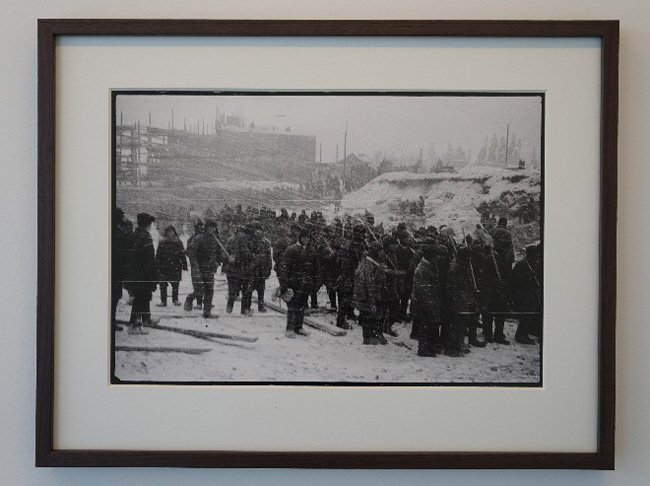 © Archive of Alexander Rodchenko and Varvara Stepanova, Moscow Alexander Rodchenko, Research materials: Construction of the Belomoro-Baltic Canal, 1933. Courtesy of Alexander Lavrentiev
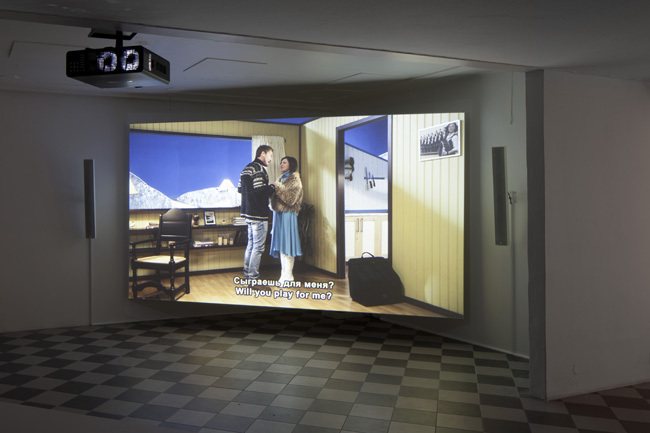
Russian group "What to do?" And the Norwegian-Palestinian duet of Sille Storile and Juman Manna in two films-respectively, “Border Musical” and “Word of Virtue”-showed a clash of the ideal image of the country and reality hiding behind him. Russian artists have a woman who moves with his son from Russia to Norway and, as a result, forced to bring him to another family, recognizing himself a “bad mother”, faces the intervention of society and the state that she considered a “personal life”. In the post -Soviet atomized society, such things definitely cause shock. I have repeatedly heard the sorrowful memories of people who witnessed or survived the study at a meeting in Soviet times-for some kind of retreat from the general line of behavior (similar “debriefing” in the desired form can be observed in such different domestic films as “Afonia” and “Silence”). “You are lucky,” they said, “you will not encounter it.” Leaving west, no one expects to deal with the fact that in Russia it is traditionally considered negative - in fact, from this heritage are in many ways running. The intentionally schematic narrative of the Russian woman, who in the general system of the Norwegians about the re -educating ideal society, is the almost famous final of the Soviet film “Circus”, turned inside out. Society does not return the mother of the child, but takes him from her - however, glee in both cases is universal.
Norway is a fantasy country, approximately the same as the United States is still for those who believe in the “American Dream”, which was the USSR for both its citizens and foreigners, friends and enemies, and India for downshifters and seeking enlightenment.
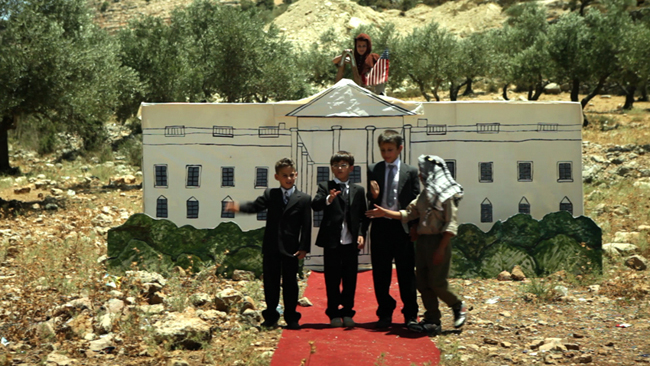 Jumanamanna.com Juman Mann and Sille Storyle, Wanderer mode, 2011-2013
Storyle and Manna show the second version of her film in Bergen, I saw the first on the XI Biennale in Sharje ( 1 , 2 ). It resembles an educational television test with the participation of children. The plot is based on the history of Norway and the decision of its citizens to become an example for the whole world. In particular, in the early 1990s, the country acted as a peacekeeper in the Israeli-Palestinian conflict. The participants and organizers of the then negotiations received the world award, which is mentioned in the film, however, the next frame is graffiti with a wish to be put on trial. In the second version, the film did not change a lot, but it became less about Norway and more about the Middle East, the narrative has become more balanced. As in the case of a “border musical”, a society that considers itself ideal, is called into question - however, without sharp attacks. “The problem is,” Sille told me, “that everything seems to be fine in Norway, the state takes care of everyone and everything.” It is difficult to criticize in such a situation, although necessary. Therefore, “what to do?”, Both Storil and Manna, and the outside look - the view of the Russian immigrant or the inhabitants of Palestine.
This view from outside, many artists beat from another coordinate system. The Laboratory of the City Fauna Laboratory (Alexei Buldakov, Ekaterina Zavyalova, Anastasia Potemkin) creates two cards of the city district: one - human, the other on the basis of other biological species that live here. Keti Chukhrov in her play “Love Machines” comes to the world of people in her play, violate their cynicism, biological and psychological superiority that they attribute to themselves, the course of things is not global, but leaving a mark in people's lives. Austrian artist Joseph Dabernig in the video “Hypercrisis” pushes the same hero with the daily world of the hospital in the mountains - even musical accompaniment changes when attention switches from the protagonist to the rest and vice versa. Roi Rosen (aka Maxim Komar-Moskin) and the group “buried alive”, who declared themselves the heirs of Oberiu and depicting terrorists, capture the hostages that are Israeli intellectuals, including Mikhail Grobman and Irina Vrubel-Golubkin, the most avant-garde, according to their own recognition. The hostages have to read historical jokes - a farce in recognizable scenery of the Islamist underground. At the institute of imaginary states, we are told the reverse history-as an orderly force affects something small and different. Norwegian Lars Kutsner and Mohammed Ali Fadlaby, who moved to Norway from Sudan, recreated the so -called human zoo, telling about fake exotic, designed in Thailand for tourists. Everything would be nothing, but living people are involved in this “production”.
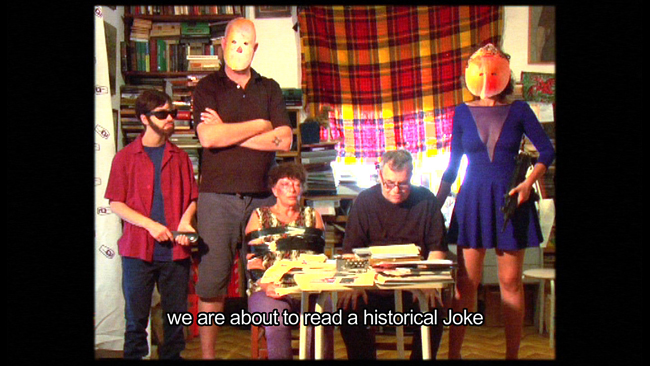 roeerosen.com Roi Rosen, video of the group “Buried alive”: Historical joke #2, with the participation of Mikhail Grobman and Irina Vrubel-Golubkina, 2013
It is curious that such large artists as Ilya and Emilia Kabakov are represented on Triennal quite modestly - they have one small picture here. The point is not so much in legal issues, the difficulties to get and bring certain works - and the curators were faced with these problems - how much more were a little more, they would greatly change the optics of the perception of the Bergen Assembly due to their glory. Media, even the most professional, work: they need “stars”, and the brighter, the better, and everything else is in the fire of this glory. In this sense, the curators, by coincidence or nevertheless, made a movement, the opposite of the one that Kutsner and Fadlaby in their work, in their work, made the exhibition participants from the influence of more eminent neighbors, brought out at least partially-those living people from the power of the inexorable logic of great, systemic interests.
Other “Rock monsters” are built into the exposition in such a way that they do not stand out much and not knock down the overall rhythm of the exhibition. The Slovenian group IRWIN with their voluminous project about obtaining passports of the NSK virtual state was carefully removed into a kind of corral - so as not to interfere with neighbors. And the series of paintings by Pavel Pepperstein, which he showed last year, in the St. Petersburg Museum of Sigmund Freud, was not built into the wall on the wall, but “rolled up” around the column -shaped structure from wooden doors, is practically hidden - no one is visible on no one, the entire series is not visible, a maximum of two paintings.
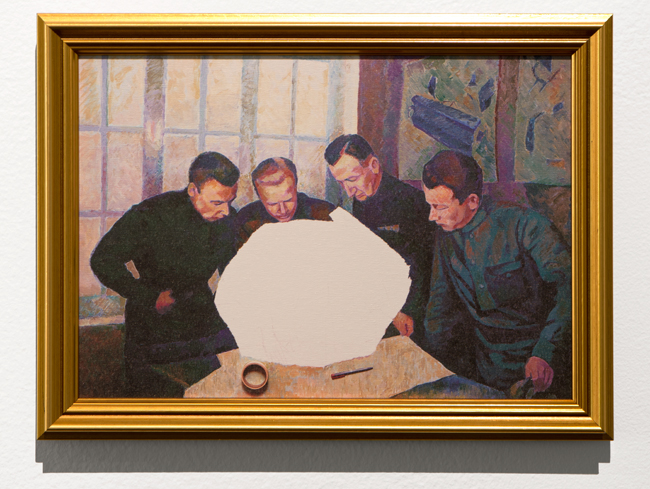 © NILS KLINGER, 2013 Ilya Kabakov, painting #349, Charles Rosental: they discuss a new plan (1930), from the project of Ilya and Emilia Kabakov “Alternative History of Art”, 2008. Courtesy of Ilya and Emilia Kabakov, Long Island
Some projects, on the contrary, received a lot of space, and quite deserved. Inti Herrero actually made his curatorial project inside the exhibition of tar and riffs. His story about “tropical fascism” includes documentation with the infamous exhibition “Degenerative Art” and other materials on the anti -Modernist activities of the Nazis, excerpts from the porn movie and projects of Bruce La Bruce, as well as photographs of those very fascist palaces - almost Indian step -by -stems with the addition of symbolism of the Third Reich. The German artist Anna Oppermann, who died 20 years ago, was given a huge stand filled with objects, paintings, documentation.
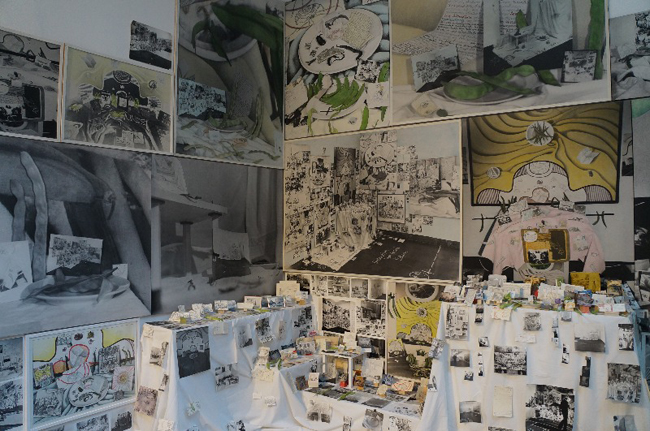 © colta.ru Anna Oppermann, Erzatz Problem on the example of Bobs, 1968-1977. Surtsy of the estate of Anna Oppermann and Galerie Barbara Thumm, Berlin
The most “Strugatskaya” of all works is the “scheme of the organization of art workshops” Peter Subbotin-Permyak. The desire to put everything on the shelves-so that nothing falls out of a strict classification-was characteristic of the creative 1920s. However, in this case, it is important how the artist, constructing his utopian organization, regulated everything extremely. Its scheme is a hybrid of the Kabbalistic Tree of Sephirot and the usual bureaucratic hierarchy - exactly what the reader is faced with the first pages of the story "Monday begins on Saturday." You expect that a strict comrade will appear next to this scheme, who will react to any “step left, step to the right,“ you will stop it! Available? " (In a similar way, Maxim Spivakov commands the museum, using the badges of various Soviet organizations-you do not need to be my little one Eliade or some other mystically configured religious ceremony to see how special signs with symbols arranged here and there are working on a change in the perception of the place.)
As I said above, Strugatsky is only partly a convenient frame. The individual properties of the scientific research institute of sorcery and magic-naturally, in the image and likeness of real research institutes-fuele the energy of art projects brought on Triennal or made specifically for it. The hall with drawings of the Polish artist Mariusz Tarkavian, who gradually, day after day, fills the walls with his graphics - this is the sketches of the museum of the future. Like many other artists, Marium plays this look beyond the horizon, creating his own book of art, like a multi -volume book of fate from the Strugatsky story. Those who have shot the clock film “Like the Sun” Dmitry Wenkov and Antonin Baver, who were specially mixed with might and main, mix magic, achievements of scientific and technological progress and absolutely uncontrolled existential stories (the beautiful role of the artist Nadezhda Grishina). The whole film they get the ingredients to light the second sun over Moscow - a plot worthy of niychavo.
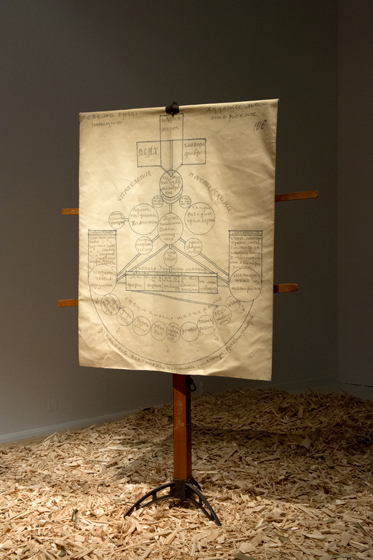 © NILS KLINGER, 2013 Petr Subbotin-Permyak. Scheme of the organization of art workshops, early 1920s. Courtesy of the archive of P.I. Subbotina-Permyaka and Komi-Permyatsky District Museum of Local Lore, Kudymkar
As for the Soviet experience, which all the interviewed Ekaterina Dyghet and David Riff, including me, tried to find them, then there are not so many. Except for the collections of Soviet photography and socialist science fiction cinema, which are even simply exhibited as two ethnographic collections (despite the fact that they have large names, and, as they say, masterpieces, such as the Aelita Potazanov), then Olga Chernysheva and the Gennady Donskoy, Mikhail Roshal, are in fact a matter of the Soviet. Victor Skersis). In both cases, we are talking about a certain sensuality familiar to us by Soviet mass culture - especially the stage, cinema and literature. Everything that is and in the story "Monday begins on Saturday." The picture of “an attempt to see yourself in the past and future” was made by the members of the Gest group in 1977, Chernysheva’s video surveys were made recently, however, there and there the taste of “lyrical comedy” is felt, ease of mixing with longing. We learn from Chernysheva about the “king of homeless people”, in front of which passengers of the metro are parting, we see a fly between the glasses against the backdrop of a motionless apartment building, and the group “Nest” has two twenty -year -olds with blessed faces in the dedicated dance.
You expect that a strict comrade will appear next to this scheme, who will react to any “step left, step to the right,“ you will stop it! Available? "
Two other artists who are also about their kind about Soviet, although in a slightly different aspect, Kiluanzhi Kia Enda from Angola and Carlfredrich Klaus, now the late Marxist from the GDR, who was very voluntary of the creative method and was far from socialist realism. The Angolan artist made photochemensers, introducing a monumental mausoleum built in Luanda and a complex of buildings around it as a rocket and cosmodrome. In this story there is everything required by the canon: heroic construction, languid expectation, successful launch. Photos are attached. As for Claus, his graphic sheets are largely consisted of words, whole liaison sentences. Ekaterina Dygot as a curator brought his work to Moscow as part of the Moscow -Berlin exhibition in 2004. Unfortunately, it is represented on Triennal quite modestly, although he, as a forgotten classics, would not hurt to increase the presence at the exhibition, but the collector, to whom his work belongs, decided differently.
 © NILS KLINGER, 2013 Carlfredrich Klaus, allegorical essay about Albert Viganda: the communist problem of the future: humanity, which becomes part of nature, and humanization of nature, 1979
However, from the Soviet Bergen Assembly it goes to the post -Soviet. The large architectural and documentary installation of the Kyiv association “Group of objects” (Ivan Melnichuk and Alexander Burlaka) tells the standard story of the transformation of the Soviet architect-modernist into the creator of elite real estate. A large -scale project includes a plan of a certain “island”, in fact, the palace complex, where there is a place for a variety of structures - technical and residential, sports and cult, as well as cultural, including the Museum of Modern Art. Участники «Группы предметов», конечно, ничего не выдумывают: таких архитекторов достаточно много — тот же Александр Зусик , в советское время возводивший здания для партийных организаций, а потом переключившийся на запросы нового господствующего класса, который, как потом выяснилось, оказался почти тем же, что был раньше. Как ни странно, недавний наделавший шуму проект Зусика «Грозный-сити-2» с небоскребом «Башня “Ахмат”» посередине напоминает проект выдуманного архитектора, разработавшего «Остров» для Киева.
Алехандра Салинас и Эрон Бергман также совершают заход, скажем так, со стороны архитектуры, однако в центре их внимания — не здание, а памятник, причем абсолютно потерянный. Он стоит в сквере в неблагополучном районе Детройта. Когда-то он был установлен как монумент, посвященный этническим волнениям во время борьбы за гражданские права, и это сделали власти города, чему есть множество свидетельств, однако даже сам создавший его скульптор отрицает связь объекта с событиями конца 1960-х. Немудрено, ведь это абсолютно эластичный, вмещающий в себя любые смыслы, значения и посвящения монумент. Впрочем, случилось то, чего не ожидали ни власти, желавшие похоронить память о событиях, установив этот идеальный модернистский объект, ни скульптор, для которого связи с теми детройтскими бунтами изначально не существовало, — внезапно местные жители поверили в бессмысленный памятник, стали его расписывать, ухаживать за ним. Из саркофага неугодного прошлого монумент превратился в живое напоминание о мгновениях свободы и ощущения творимой истории.
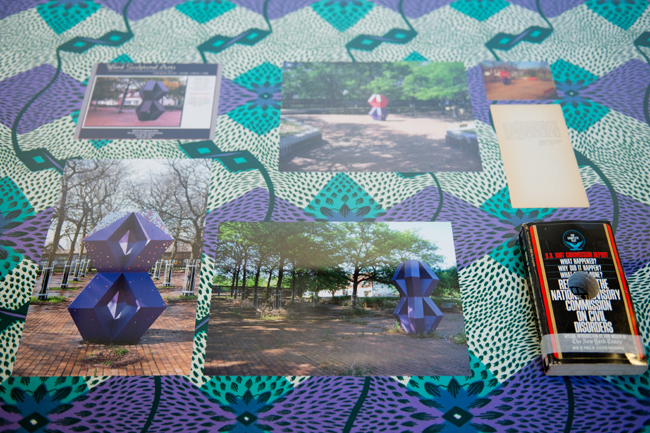 © Nils Klinger, 2013 Эрон Бергман и Алехандра Салинас, Памятник восстанию, 2007-2013
Фильм Кристиана фон Борриса «Я — М» стоит особняком. Другую его работу «Дубай во мне» (2010), которую уже много раз показывали в России, принято считать крайне проницательной. Так оно в общем-то и есть, но тот фильм, если изучить его после просмотра последней работы фон Борриса, вовсе не кажется таким уж связным и стройным. Обе картины являются просто нарезкой путевых заметок с добавлением обязательного критического текста: в случае «Дубая во мне» он больше наговаривается, а в «Я — М» идет печатным текстом, иногда автор предлагает погуглить то или иное важное для сюжета понятие или имя. В последнем фильме показана индустрия визуального: реклама, городское пространство, медийная образность и т.д. Показаны довольные и недовольные этим порядком. Все это сопровождает музыка, завораживающая не меньше «спектакля» из седовласой ситуационистской теории, который то и дело поминается в титрах. Страсть и азарт, овладевающие художником при создании работ, видимо, так сильны, что он немного теряется в том, что делает. Если сравнивать с персонажами Стругацких, то Кристиан фон Боррис — Витька Корнеев. И одеваются, и действуют похоже.
Вообще говорят, что это очень удачно — обозначить художников магами и чародеями. Да и сами художники не против. Ни пролетариями, ни предпринимателями они в равной мере не являются, как ни пытались ими стать. Я — честно — не знаю, хорошо это или плохо. Для искусства, конечно. У Стругацких чародеи хоть и в очень расплывчатой формулировке, но творческие работники, интеллигенция, трудящаяся в НИИ. Кем они могут стать сейчас, сложно сказать: главное, чтобы уши шерстью не заросли.
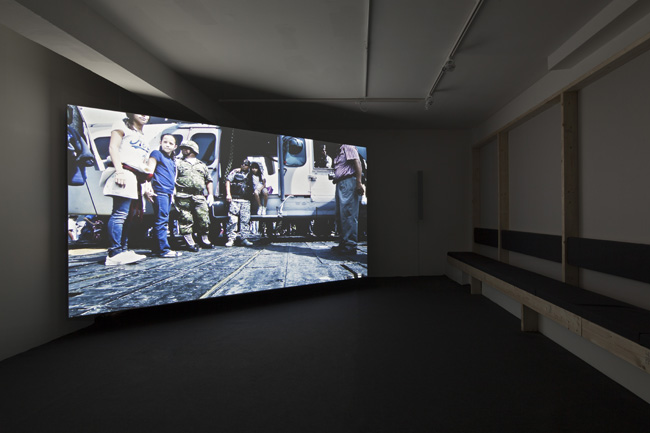 © Liz Eve, 2013 Кристиан фон Боррис, Я - М, 2013