
Translated material
It's time to change the dictionary
During the periods of acute public dysfunction, the pendulum of our reflection constantly sways between the two questions: what will happen next in that external situation in relation to me? And what should I do personally to do? Of course, these questions are always in a hidden form with us, but we begin to articulate them only sometimes. They are interconnected, but at any given moment one of them is usually preferred.
More recently (and it seems - eternity back), Katerina Gordeeva published on Colta.ru the essay “The impossibility of the island” , which caused a storm in reader's hearts. The article articulated the second of the questions against the background of a pessimistic answer to the first. I will not disassemble the reactions, they were all painful, but in people of a different psychological warehouse, different life experience, which are in different everyday situations, a pain reaction manifests itself differently.
I am about the very pain reflection on the current situation that society has encountered over the past year. More precisely, not society, but each individually. The stormy public climb of the winter of 2011-2012 and subsequent several months was experienced as a collective experience, and a reaction maxim gradually piled on society was realized more as a personal failure, as a destruction of the grounds for a positive identification with the country-not as with the space or circle of relatives and friends, but as a place where your own, some kind of life project can unfold. Someone delegated the guilt outside-“the leaders of the opposition protected the protest” and so on, but this was not the consolation either. Feelings of shame, insult, despair usually do not want to discuss, and they were little discussed. Katerina Gordeeva, who verbalized the feeling of despair, received a reaction precisely for the transition of the features from silence to the word.
Against this background, the election campaign of Alexei Navalny, which unfolded in Moscow in the midst of the vacation season, looked at the beginning as an incredible curiosity. It seems that in any scenario of the current drama this was not spelled out. Suddenly there was a hindrance to that concentrated sense of despair, which was already thought out through and suffered. And this interference caused a striking surge in reflection. At first glance, all these hot exchanges of replicas on social networks, in which I had a chance to participate, found some monstrous split that the appearance of Navalny brought into the slender ranks of the reflective part of the “protest”. In fact, these dialogs confirmed what one could guess about, but did not want to: we do not know how to talk about politics and politicians. Our vocabulary is rich, and we can express our attitude to the rulers of thoughts, ethical landmarks, moral freaks, villains and domestic cynics with a large number of shades. So far, Navalny was one of the “leaders of protest”, the proposed semantic paradigm, in principle, remained quite acceptable and sufficient for discussions about it. Having gone to the election of the mayor of Moscow and holding the campaign that he spent, he broke out of his former role finally and will not return there already. The way around him, as if by themselves, dense and very different circles of support are rapidly gathering, speaks simply about one thing: he is a gifted public politician, he wants power, and he will most likely achieve it. Yes, with our help, of course. I'm not talking about the post of mayor of Moscow, if that.
"Russian nationalism" is not terrible and not majestic. He is comic today. There is nothing but words.
So. What are we? That is, those who are more inclined to reflect than exhibit in the elections. “What will happen? And what should we do? " - Returning to the issues indicated at the beginning. In my opinion, we have a lot of reasons for productive reflection, and more diverse than discussions about the moral bankruptcy of the Russian ruling elite (although yes, this is the most) and about the shortcomings or vices of the Political Policy. Well, for example: on what grounds in Russia can public agreement form today? Around what goals and what is the "road map"? We do not like Navalny's “nationalism”, it seems to us a primitive slogan “Do not lie and not steal”. Yes, and the slogan of the opposite side - "Give bicycle paths to every house!" - Also, of course, it does not seem to us an exhaustive agenda. Great! So we know the best. Which?
Of course, the return of the mechanisms of honest competition to different spheres of public life is good. But they return when there is a drive to achieve something with the help of these mechanisms. Nowhere are democratic mechanisms were not introduced for the sake of themselves: so that, they say, everything is like people. More precisely, wherever they were introduced for the sake of themselves, they reborn into an imitation. We lived with her almost the entire twentieth century. So - what's next?
And here it becomes difficult. "Well, what are the goals?" - We can ask to pull time. Well, others had a partly nationalism. Not as a abusive word, but as a rather successful project to introduce the idea of unity in socially heterogeneous communities and to appropriate the value of this unity, called national uniqueness. We will save ourselves because there are no other such. We will become better to win in the competition of peoples. Funny? Ideas that carry away the large masses of people are generally “funny”. Nationalism is a fundamental paradigm of modernity in the cultural zone to which we attribute ourselves. The last two centuries have passed under his sign, and great achievements and monstrous crimes are associated with him. No, there are not different nationalisms (bad and good), but different reflexes of nationalism. Call to “Tajiks”, “Uzbeks” or “Jews”, that is, to consolidate a steady penalative meaning for ethnonyms - a bad tone, a bad reflex of nationalism. To advocate Russia for Russians (for Germany for the Germans, etc.) - criminal paroxysm of nationalism. And to cultivate “love for the native ashes, love for paternal coffins”, to introduce into consciousness along with Newton's laws historical narratives about “our” victories and achievements and positive identification with the “our” cultural matrix as a whole - it seems to be normal. The deconstruction of nationalism always reveals the fictitiousness of the “we” to which it operates. Who are those “we” who unites the sense of pride in the flight of the first person into space? (Yes, and what “we” are in essence, in essence, we have to do with it?) And, by the way, to what extent the previous “we” intersects with the “we” of those who remember the centenary of “Spring Spring” and is proud that it is written by the Russian composer? But “fictitious” does not mean “invalidity” at all. A sense of ownership or belonging is a feeling , and if it manages to form it, it does not decompose through reasoning about the fictitious of its foundations.
When reflective intellectuals with anger show a finger at Navalny's Nationalist, it seems to me a game of a long -lasting war.
Nationalism is truly not fictitious only in its political hypostasis, when it launches the mechanism for involving everyone in the “common” political life of the nation-state. Yes, this is the most: when every citizen, having one voice, with universal and equal electoral law goes to the elections and gives this voice to the one whom he wants to see his “representative” in power and who, in turn, had equal opportunities with other candidates to win the sympathy of this citizen. Representative democracy and universal elections are the basis of political nationalism as a project of social consolidation, a project of superinlusive, if we compare it with the previous models based on the cultivation of elite loyalty to the sovereign or the state as objectivation of the collective mind. So. The project of political nationalism did not take place in Russia. Only the project of its imitation took place, and it is its fruits that we reap it today. No, the point is not only in the ethnocultural heterogeneity of Russia (and before that - the Russian Empire and the USSR): it is this heterogeneity that nationalism “processes” nationalism in its meat grinder. Where it manages to create a myth about the “original” ethnic homogeneity, it can form the basis of nationalism as a political project. Where there is no soil for this, political nationalism constructs unity on other grounds, without referring to the “prehistoric” roots of modern traditions, but creating the narrative of the cultural “community” that it is possible to create. In any case, nationalism is a product of social creativity, supported by the narrative of unity.
The project of political nationalism did not take place in Russia because the Russian state since the beginning of imperial conquests and has still cultivated the principle of “differences” in the methods of managing the population. The difference between the forms of integration of regional elites and maintaining their loyalty to the center, the difference in management and communication algorithms with different groups of the population - this tactic allowed the empire to combine vast territories and manage them quite successfully. The fact that even the shocks of the revolution at the beginning of the twentieth century were only slightly stung, but not destroyed, was the result of the flexibility laid down in the system of relations between the center and the outskirts. However, for the formation of the political nation, this flexibility was one of the main obstacles, for it meant a fundamental refusal to create a single, homogeneous political space. Imital democratic models of involving the population in political life in the USSR could not create a political nation. The “controlled” nation -playing within the framework of the demarcated national republics, on the one hand, continued the imperial policy of raising loyalty among local elites, on the other hand, cultivated local ethnic nationalism as a kind of “harmless” cultural marker “differences”. The logical result of such a policy - on the next revolutionary round - was the collapse of the “Soviet people”, quasinations invented in the Brezhnev period, into a number of countries with more or less formed “mental” nationalisms, but with not yet solved systemic problems associated with the transformation of ethnocultural communities of varying degrees (imaginary) homogeneity into political nations. Russia has come out of this phase of the collapse of the still heterogeneous political education, and the imperial principle of “differences” in regional management continues to be perceived by elites as inevitability. The political nation in such conditions is not formed. That is why the further fall of the outskirts seems inevitable to analysts, and some are the desired perspective. But this is a separate topic.
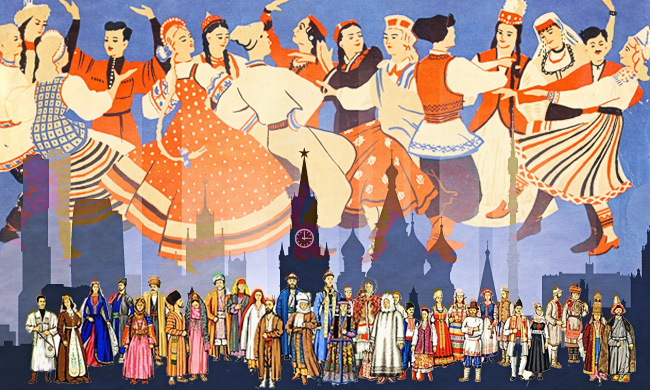
“Russian nationalists”, that is, those who today call themselves so, advocate, however, not at all for the formation of a political nation in Russia. They are a product of that confusion in the minds that was created by more than a hundred -year imitation of the people involving the people in politics in Russia. Since the time of Alexander III, the Russian elites were pleased to offer the masses a hypertrophied version of ethnocentric cultural nationalism - as a replacement for the project of a political nation. In the imperial period, the state priority was Russian cultural nationalism, encouraging which, the dynasty imagined that she solved the problem of the formation of a “nation”. The Soviet Union developed a tradition and put its “multinational project” on the stream: all ethnic groups dangled each “Lezginka”, which embodied both the heyday of national cultural arts and the friendship of peoples on the basis of this prosperity. Cultural nationalisms are a natural and necessary product of national consolidation, but in the Russian Empire, in the USSR, and then in the Russian Federation they also played the function of spectacular camouflage of that gaping void that was located at the site of the political project of nationalism. The fact that at the beginning of the 21st century the ethnocentric “Russian nationalism” still has the illusions of some political prospects for itself is a regrettic consequence of the described specifics of Russian history, in which the political tasks of nationalism were replaced (and not supported) by “chimeras” of ethnic homogeneity or hegemony.
Representative democracy and universal elections are the basis of political nationalism.
Symptomatic, which silently implies the presence of “Russian nationalism” of some political potential and the opposite side, the one that actively condemns it today. In my opinion, we are dealing with fixation on absolutely phantom hope (the “nationalists” themselves) and the phantom fear (their opponents). “Russian nationalism” (the one who is not terrible and not majestic with “Russian marches”). He is comic today. There is nothing but words. (Which, of course, does not mean the impossibility of violence on his soil, but in proportions that are incomparable with violence on the basis of almost the other side of almost the other: alcoholism, domestic quarrels, sexual desires, material needs, etc.) friction inside the multicultural local communities due to non-consuming cultural matrixes-the problem is real, but solved in the current world only within the framework of the political world integration project.
The dispute about whether the latter could take place around the “dominant” culture (that is, Russian) a hundred years ago, we will leave for academic discussion. Today, in a post -industrial society, a model of political consolidation around the “majority”, ethnic or any other, gradually ceases to work, and therefore, someone else's experience of the XIX -XX centuries, I'm afraid, will already help us little. The new type of fragmentation of society, not yet so as to fully evaluate all its consequences, but obviously changing the social reality with which politicians interact, promises some completely different integration project. Therefore, in particular, when reflexive intellectuals with anger show a finger at Navalny's Nationalist, it seems to me a game of a long -lasting war. Navalny himself may well not understand this yet (although I am not sure of this), positioning himself in the usual and pretty parts of his voters of terms. But the way he spent his Moscow campaign speaks completely clearly about much more important: a politician has appeared in Russia who is interested in the sanction of the active part of society, and its very different segments, and not elites and not inert “majority”. To convert this sanction of many active minorities into the electoral majority is a puzzling task, and it is trying to find mechanisms to solve it. This, by the way, is the biggest headache of democracy. This problem could not solve the generation of political reformers of the 1990s: universal and equal suffrage turned out to be that butt, trying to overwhelm which, it opened the gateways for the next round of imitation democracy.
Well, returning to Navalny. The activist and blogger part of his biography is completed. In prison or free, he is already a federal politician - and a federal politician who made himself such in the conditions of the least favors. (Those who consider him to be a “Kremlin project” I can’t help, excuse me generously.) To discuss further his “nationalism” seems meaningless to me. Yes, it is time for him to change the dictionary, but this is not only his task. The dictionary for a politician is not created by himself. This, in fact, is to us, to those who are not put up for elections, but professionally engaged in reflection. To those for whom the questions "what will happen?" And "What should I do?" They are easily separated from each other, while for the current politician - and this is his difference from us - this is, in fact, one question.
None of us will predict an answer to the first question with the decisive accuracy, for which we will then be enrolled in the prophets. But public pronouncing scenarios - good: this, among other things, is cut off completely phantom sagas about last year's snow. No scenario of political integration on the basis of classical nationalism of the XIX -XX centuries will happen in Russia. Any conditional Navalny, that is, the generation of politicians who will replace the current ones, will have to build relationships with a new fragmented society, each active segment of which should see their interest in the proposed political consolidation. Around what? For what? These are really difficult questions. Everything is new. And the dictionary is old. Therefore, Muscovites who are already living in a multicultural metropolitan are in their mental reality “captives” of aliens-migrants who are concerned about concerned about how to not repeat the mistakes of London and Paris-where, however, they go with pleasure to stay, walk along the streets, sweeping away alien, and sit in the cafes opened by them. It is so difficult to get used to the idea that history is for the most part not an epic struggle of good with evil, but changing living conditions for everyone. Yes, we have long divided the common space with those for whom the Fatherland is not a royal village, and so it will continue. We must come from this. And change the dictionary, our own and those politicians whom we choose and who are still able to train.