
Translated material
"Chavez light" goes out
Venezuela first officially questioned the "Bolivarian" economic policy
Six months after the death of Hugo Chavez in Venezuela, for the first time at the official level, a stone was thrown into “Bolivarian socialism”. So far, economic policy has been chosen by target. But, as they say, not evening. Moreover, two -thirds of the countries once again were left without light
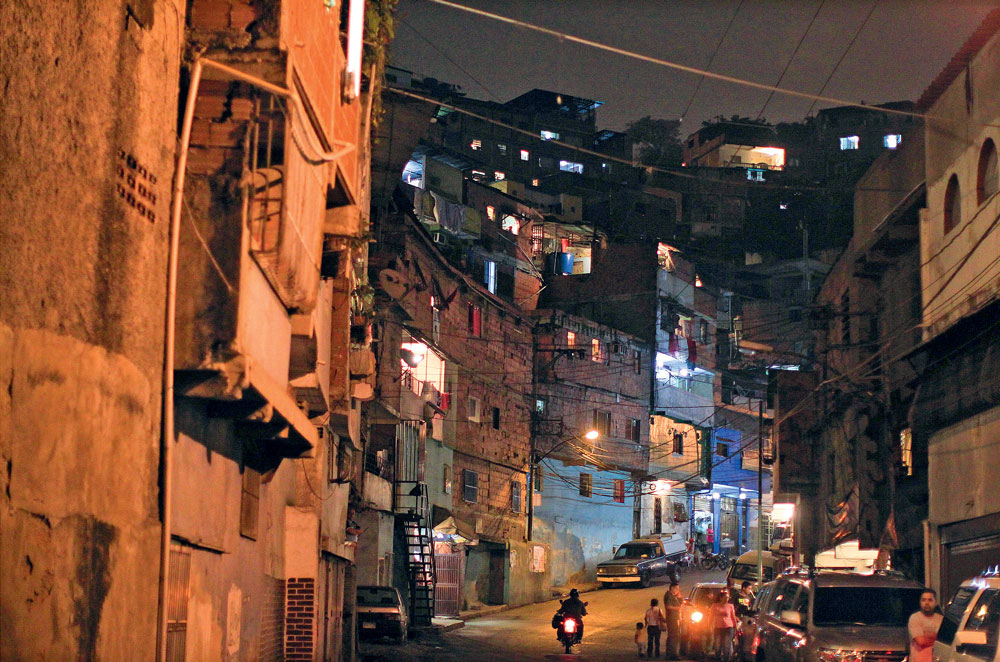
Karakas, September, 2013. After the electricity is turned off, residents of one of the most criminogenic quarters Petara began to go out on the street only with emergency
A resident of Karakas Karolina Salas, a housewife with an average income, has long planned to celebrate her husband’s anniversary at home. Friends called, appointed time. “And then we realized - there was not a single roll of toilet paper left in the house. What 12 people will do, if suddenly ... ”As a result, only two familiar couples were decided to invite, and not home, but to a prestigious restaurant:“ Imported toilet paper is still found in such institutions ... And so it is not to find it with fire in the whole country - this is a terrible deficit now, worse than electricity! ” - Trying to joke Senor Salas.
A country in darkness
| *The US Embassy in Karakas has issued a recommendation to its employees and all American citizens to move in a number of Karakas regions only on armored vehicles. The security services of the embassy allocated three zones in Karakas: in “yellow” you can move in ordinary cars, in “orange” - in armored, and in the “red” zone it is not recommended to appear under any circumstances. Hard security measures are explained by the unprecedented growth of crime in Karakas, which is one of the five most criminal cities in the world. Venezuela in the number of murders per year-55 per 100 thousand inhabitants-takes fifth place in the world after Honduras, Salvador, Cot D'Ivoir and Yamaiki. |
By the way, our interlocutor was still lucky with electricity: the next evening after the anniversary dinner of the Salas spouses in a restaurant, 70% of the country's territory (14 of 23 states), including Karakas, plunged into darkness due to an unexpected shutdown of electricity. The authorities said that the cause of Blackaut was a major accident at the CHP in the Baho-Caroni region, where 60% of all electricity of the country is produced. Turning off the electricity - for several days! - led to a real transport collapse in Karakas and other large cities. Due to non-working traffic lights, motorists have ceased to comply with the rules of the road in general. Trains in the metro stopped, and tens of thousands of people had to be removed in the dark tunnels. Karakas is so far from a safe city, and here are whole quarters, immersed in darkness*... “This year for the seventh time, the light is turned off in all the karakas,” complains the pensioner Jose Ramon Evereria. - They say that you also had this in Russia ... and toilet paper also could not be bought anywhere - right? "
Is it true. Well, we remember: papers, and toothpaste, and washing powder, and soap, and matches, not to mention bras ... Although socialism in the USSR was not “bolivarian”, but simply “developed”, commodity deficiency - one to one.
"
They say that once in Russia there was also no toilet paper anywhere, right?
"
Today, the Venezuela authorities themselves recognize: a deficiency of widespread goods has reached 20%, and this is the highest rate over the past five years. Among the scarce goods are sugar, flour, butter, milk. Very rarely, beef, pork and chicken are “thrown out” for sale. Simultaneously with toilet paper from the shelves, at times, napkins, children's diapers completely disappear, it is very difficult to buy ordinary soap and washing powder.
Recognition from above
The other day, a statement was made in Karakas, which made the effect of an exploding bomb on third -party observers. “The economic policy pursued by the Venezuela authorities is ineffective,” the Minister of Finance of the country Nelson Merentes spoke in an interview with this statement in an interview with this statement. The fact that the country's economy with the largest oil fields in the world was on the verge of bankruptcy is not a sensation. However, for the first time such a high -ranking official admits: such a situation is the fruit of the country's leadership. Moreover, not only the current leader of Nicholas Maduro, who is distinguished by amazing inactivity, but also the “father of the nation” and the founder of “Bolivarian socialism” by Hugo Chavez. Today in Venezuela, according to Merentes, the highest level of inflation in Latin America is 39.65%! Moreover, a year ago, it did not exceed 18%. According to the results of the second quarter of 2013, the indicators of economic growth (2.6%) are half as much than last year, growth in the oil industry - the locomotive of the national economy - amounted to only 1.4%. “Merentes is the most realistically thinking official of the government, but he also gives official calculations, in fact there is no growth for a long time,” the minister’s economic analyst Pablo Huarez corrected the Minister. And he adds:-The government all the time calls the reason for the shutdown of electricity some kind of accident in remote areas. And I suspect, everything is much more banal: the country has been transferred to the regime of rigid saving resources. ”
Moreover, as in a conversation with The New Times, the editor -in -chief of the Venenotic cable television channel Manuel Coo, the authorities have no ideas on how to prevent the inevitable collapse of the economy: “Maduro promised by the end of the year to“ revive the economy ”and put an end to the sharpest shortage of food and astronomical inflation. But no one in the country believes him. ”
Paralysis of the oil industry
 |

Back in early April of this year, on the eve of the extraordinary presidential elections in Venezuela (they passed on April 14. - The New Times), the International Energy Agency (IEA) warned that if Nicholas Maduro was elected by the president, the country's oil industry is threatened with even deeper degradation than under the corner of Chavez. So it happened. Over the 12 years of Chavez's reign, according to the IEA, oil production in the country has decreased from 3.5 million barrels of oil per day to 2.34 million. And in the half months when Maduro costs, the oil production level has decreased to approximately 2 million barrels per day.
The Petroleos de Venezuela (PDVSA) oil company accounts for up to 96% of all foreign exchange earnings. According to the expert in the field of energy Luis Rodriguez Sos, "PDVSA has all the opportunity to cover his expenses and adhere to his obligations to the nation." However, the low efficiency of the company led to the fact that it owed the Central Bank of Venezuela last year $ 26.19 billion. “As a result of the purchase of food and consumer goods, the government simply does not have enough money,” Sosa says.
The fact that PDVSA is now in trouble is now, the expert connects with several factors. Firstly, due to the foreign policy of Chavez, the company turned out to be a hostage to the “Big Geopolitical Game”-the country gives the country for free or for a symbolic fee to its allies in the region for free or for a symbolic fee: only Cuba receives 130 thousand barrels per day from Karakas. Secondly, the authorities forcibly take up a large amount of money for social projects and, thirdly, the government does not want to cancel colossal subsidies for the sale of gasoline in the country, which is one of the cheapest in the world: the gas tank is less than Bigmak in the popular fast food network.
The crisis state of the Venezuelan economy is also evidenced by the figures for the supply of black gold to the United States. In the first quarter of 2013, the trade exchange with the United States decreased by 17%, decreasing from $ 13 billion to $ 11 billion. At the same time, oil exports in the United States decreased by 23% - from $ 9.9 billion to $ 7.5 billion.
In the current position, the Venezuela government may have to go to sell part of their “priceless” oil assets, experts of the Washington Consulting Company Inter American Trends (IAT) believe. “If in the Venezuelan industry the norms and principles of the last ten years will continue to reign, then it will be extremely difficult for it to keep even this relatively low level of oil production and prevent large accidents in oil producing enterprises, which have become more and more often,” the IAT report said.
The situation in the oil industry is also complicated by the fact that after the death of Chavez, China, one of the largest partners of Venezuela, began to review its very generous conditions for the provision of multibillion-dollar loans to Karakas in exchange for the supply of oil-raw.
Fears and ramps
The successor to Chavez Nicolas Maduro finds a single explanation for the dramatic socio-economic situation of the country-the machinations of the “right-wing opposition”, which is led by “puppeteers” from the north, that is, from the United States. So, he recently announced the prevented attempt on him, which the Colombian mercenaries were supposed to be carried out, and the conspiracy, according to him, stood the former US Ambassador to Venezuela Otto Reich, the former president of Colombia Alvaro Urist and the Cuban terrorist, who worked for the CIA, Luis Posada Carles. Maduro, in all seriousness, assured the nation that his murder was supposed to occur at the same time as the beginning of American intervention against Syria.
For the current disconnection of electricity, he also saw the hand of the opposition associated with the United States. On his Twitter, Maduro called Blackout “a rehearsal of a coup, directed against the people,” and entrusted the “fascist right groups”, which “control from the north”.
“Maduro is trying to convince the country of the threat of endless conspiracies, because he has nothing more to justify such miserable results of his reign, and he himself feels extremely uncertainly as the president,” explains the New Times the Venezuela writer Alberto Barrera, the author of the book “Hugo Chavez without a uniform”. - Venezuela is almost in an apocalyptic state, when the news is replaced by exclusively sinister rumors, and the Venezuelans are preparing for the fact that the country will soon break up in the history of the country of disaster. But the nation, because of economic difficulties, is in a state of hysteria: it lost a folk idol, and the one who replaced him does not cause her any trust and respect. ”
 |
| Nicholas Maduro and Minister of Finance Nelson Merentes (right) at a trade summit in Montevideo (Uruguay) |
“Most of the Venezuelae treat Maduro as a temporary worker,” former Senator America Martin notes in a conversation with the magazine. He refers to the latest sociological surveys: Maduro’s rating sank from 51% to 46%: “If extraordinary elections had passed tomorrow, he would guarantee the leader of the opposition of Capricil, who is now 52% of support.”
The other day, a noisy scandal erupted in Venezuela, which was not over all 14 years of Chavez's presidency. The commission of the press was the recording of the conversation, which was carried out by the famous conservative TV presenter Mario Silva with one of the agents of Cuban special services in Karakas. In this conversation, Silva accused the opponents of Maduro inside the ruling Chavist Unified Socialist Party of corruption and attempts to overthrow the president. Moreover, the tip of the attack by Silva, the orthodox Marxist, sent Cabel against Diosdado, chairman of the national assembly of the country, the main competitor of Maduro. Cabinet enjoys the support of representatives of the extreme right -wing general in the Venezuelan army, who look askance at the too close rapprochement of Venezuela with the Castrovskaya Cuba.
The film with the recording of the conversation of an influential TV presenter with the Cuban security officer confirmed the conclusions of experts within Venezuela and beyond: Cuba has a huge impact on the Venezuelan leader, there can be no more doubts about this. On the other hand, it becomes clear: inside the ruling party, there is a deep split - between Maduro’s supporters, closely related to the harbor, and the Cable environment, which protects the interests of large business and army leadership, advocating a policy more independent of Cuba.
The forecasts that the internal discord inside the chavists will get out to the surface after the death of the leader, sounded in Venezuela since the Chavez left the captain's bridge. As well as the fears of the inevitable economic chaos. However, few expected the spiders to overbone so quickly after the death of the "people's commandant".
Photos: Jorge Silva/Reuters, Stringer/Reuters