
Translated material
"The curator is a new profession everywhere"
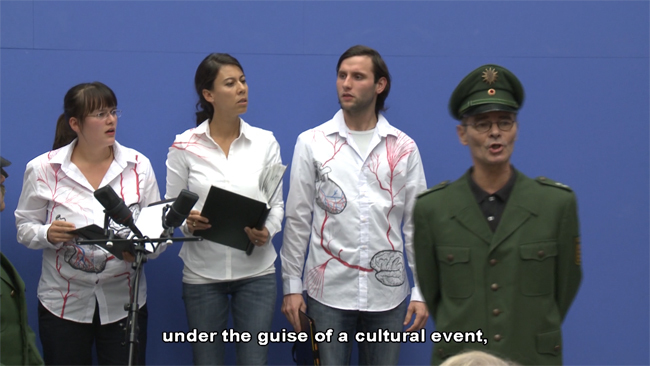
This month, Holland Days in Moscow are held , within the framework of which several exhibitions, theatrical productions, and film plants will be held at different venues. In particular, on September 11, two large projects will start at the Artplay Design Center-the Dutch art science, consisting of three large discussions on the common topic “What curators do we need?”, In which Russian and foreign experts and exhibition “ Spaces of Exception . Extraordinary and plenipotentiaries, uniting more than 20 artists from Holland, Kazakhstan, Russia, Ukraine, the Czech Republic. Elena Sorokina, who is the curator of the art science and the socules along with Yella Bavheis, the exhibition "Extraordinary and Plenipotentiaries" said Colta . Ru about both projects.
- When we talked for the first time, you quite clearly indicated that you do not like in the Russian artistic (and not only artistic) situation: all discussions turn into a sharp confrontation, everyone criticizes each other. In your opinion, what is happening on the Russian stage is unproductive and destructive? What do you plan to contrast such hypercritivity?
- This is a very radical interpretation of my statements. Who can say that everything is unproductive and destructive? In Russia, there are quality institutions with professional communication and there are art strategies aimed just at pedagogical or even educational activities. As for the culture of discussions - indeed, I would like to see a more solid basis, on the basis of which the debate occurs, especially from the museums. What are their narratives, forms of rethinking history, methods of interaction with the public? The Dutch art science that I organize is devoted to these issues-curatorial strategies, exhibition canons and their relevant changes. We will discuss innovations in relations between museums and actual artistic production, changes in the position of curators today, new strategies for presentation of art in the exhibition space and outside it.
And since the development of art is unpredictable, during the artistic decline, the museum will curl up to the desired size, in the time of creative upsurge - to unfold at full power.
- You mentioned quality institutions - what are you putting into this concept? Probably, without the presence of such an exhibition or discussion, worthy of attention, are impossible? What institutions in Russia, in your opinion, are worthy to be called high quality?
-This is an institution-visionary. Turning to the actual vocabulary-similar to the Institute of Defense Magic (this refers to one of the projects within the Bergen Assembly , divided-by analogy with the Research Institute of Winning and Magic from the story of the Strugatsky brothers, which the curators were inspired-to the institutions-"Institutes."- Ed .). It gives artists (and curators) the magical opportunities for the implementation of projects, supports their research, gives them time, then shows them in magical conditions, while creating a defensive context for especially fragile works, it is accessible, but not flatly explaining the design of the artist to the public, the connection of the project with the history of art, as well as with the social, aesthetic, political and other context of its time. The museum that Ligia Clark dreamed of is not an object depository, but a generator of experience, in a building built by Oscar Hansen. In 1964, Hansen created a project of a museum, turning and unfolding in space both vertically and horizontally using hydraulic devices. He rightly reasoned that the Museum of Contemporary Art should be open to the unknown. And since the development of art is unpredictable, during the artistic decline, the museum will curl up to the desired size, in the time of creative upsurge - to unfold at full power.
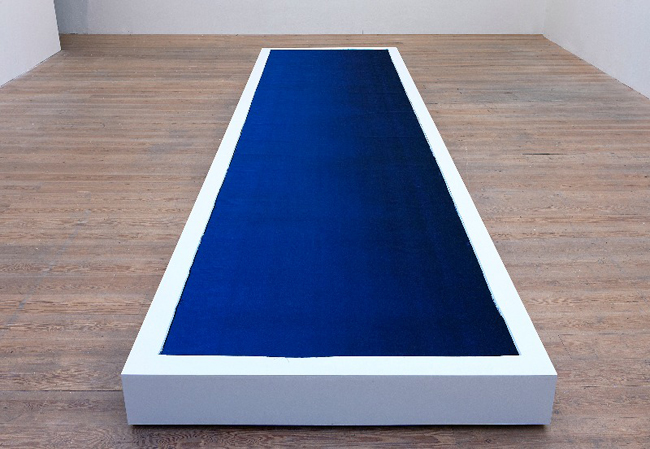 © GJ Van Rooij Willem de Rooij, Blue To Black, 2012
- How do you plan to organize a discussion platform? Without what such an initiative cannot function without today? What is especially important to take into account in Russian conditions - or there is no specificity in Russia?
- What is the exhibition today, who is the curator and what it does - issues that need to be discussed in Russia. After all, the situation is strange: anyone is a curator and any more or less playful combination of objects in space is an exhibition. Museums are planned without concern for their filling, exposition solutions are similar to those in a jewelry store, and more or less famous foreign artists are brought for no apparent reason. Why, for whom and why - is not entirely clear. Therefore, I invited Western curators to talk about projects interesting in the Russian context: Maria Khlavoyov - about the “former West” , a huge project that is completely reviewing the post -communist recent history, Mark Nash and Koyo Kuo with their independent research on African students in the Soviet Union, Hedvig Feyienn - about the “manifesto” and others. The program has already come out and circulates, look!
-It does not seem to you that, despite the wide participation of Russian professionals in the work of the art science, despite the fact that, as you said, things will be discussed “interesting in the Russian context”, the project still remains largely “imported”? I agree that many of the problems that Russian institutions and curators face are resolved in other countries, and therefore have the right to teach us. But can you move away from simple imports and discussion formats, get away from reproducing a standard international project?
- Here you will be radically disagreeing with this. I am surprised by Russian inferiority complexes. Of the solved institutional problems, new ones arise, and everyone has their own problems. In his study on infrastructure, the theoretician Rogoff says that the Western developed network of institutions, the system of classifications, categorizes, traditions, professional education can become - and often becomes a limiting factor. The lack of institutions does not mean the lack of good artists and interesting curatorial projects. The Bergen Assembly of Ekaterina Dygot and David Riff, for example, just a magnificent project. And the format of an invitation of a high guest student has absolutely nothing to do with the Dutch art science. The curator is a new profession everywhere, and right now it began to actively historize it. Why is the history of exhibitions and exhibition strategies in Russia less interesting than Western or, say, Latin American? It just needs to be explored and written. The Assembly will just do this - theory and practice, raising questions, presentation of individual projects ( CASE Studies ) and their discussion.
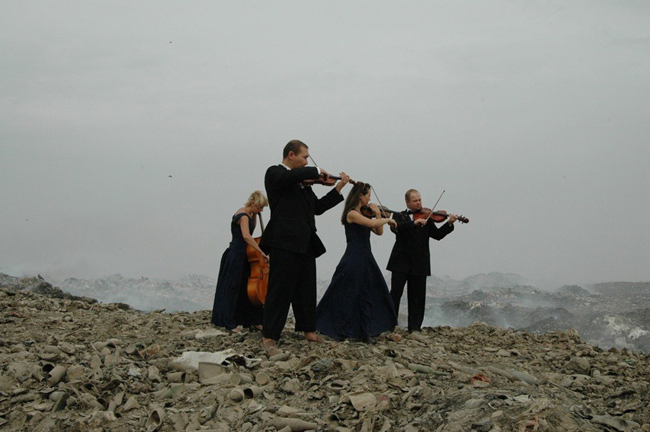 Gulnara Kasmalieva and Muratbek Dzhumaliev, Spring, 2009
-In addition to the actual art scoop, as a curator will make an exhibition, that is, the theoretical part will be supplemented by practical. Or is the discussion platform and exhibition more or less autonomous?
- Relations cannot be avoided! They began as two autonomous projects, but now the assembly takes place at the exhibition and is completely integrated into its space. Yes, and it is impossible to talk about new curatorial strategies, while making a standard exhibition. The exhibition "Extraordinary and Plenipotentiaries", which will be held at the Artplay Design Center, outlines its space as a specific one, where the action of ordinary laws is suspended and their own artists are included. We will hang the work of Kary Young, which concludes a magic pact with the viewer. Her work “Obsidian Contract” gives the viewer - as well as artists participating in the exhibition - the right not to obey the usual norms of behavior in the public space. That is, the exhibition clearly defines its right to a feature.
In addition, it will function as a scene. We cooperate with the choreographer Anna Abalikhina, who will make a production in the exhibition. It seems to me that today it is necessary to experiment with the new ways of exposing art, new models of the exhibition as a genre, and “extraordinary and plenipotentiaries” is just such an experiment. Let's see what happens.
Museums are planned without concern for their filling, exposition solutions are similar to those in a jewelry store, and more or less famous foreign artists are brought for no apparent reason. Why, for whom and why - is not entirely clear.
- And why is your exhibition based on, let’s say, a “legal” story? Artists and spectators are endowed with certain symbolic rights ... and how is the prison related to this?
- From a historical point of view, the law in Russia has always been strange and alien phenomenon, and the specialized press still discusses the epic battles of Russia on the way to the legal state. There is the attitude of the authorities to the law (contemptuous) and the attitude of society to the law (mocking). This ball of emotions is perfectly expressed by Dmitry Prigov’s work “Book of Decrees” (1977). In its inimitable style, Prigov praises and parodies the law. And his performative image of the artist-lawyer, of course, fills a certain legislative vacuum in society. Prigov will soar at the exhibition as a legislative spirit in the image of a patriarch-parliamentar.
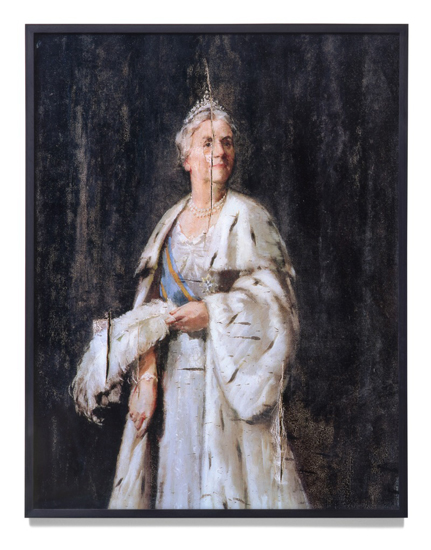 © Foam Gert Jan Kocken, Queen Wilhelmina, Jakarta. Defacement 6 May 1960, 2006, Amsterdam, Archives of the Rijksmuseum
In this context, one chapter of the history of the Soviet dissident movement is especially interesting-the strategy of the notorious, but, it seems, well-forgotten Alexander Yesenin-Wolpin. The son of Sergei Yesenin, Volpin was a poet, a mathematician and a lawyer and that rare representative of Soviet citizens who seriously belonged to the “laws”. In 1965, he organized the famous “Gades' rally”, and his shares - despite their pure seriousness and real risk - are given to modern radical performance. On the Constitution Day, he went to the square with the poster “Respect the Soviet Constitution” and was, of course, immediately arrested (exactly eight minutes later). There is an excellent record of his subsequent interrogation.
Our exhibition is an extraordinary space, a field of legal utopias and experiments, from very serious, hyperprofessional studies of the boundaries of democracy of Jonas Staal with his parliament for terrorists to the “fairy tale of the golden cock” Anna Parkina - a kind of naive parabole about the preventive strike of King Dodon. We specifically decided not to make a direct translation of the name from English Spaces of Exception , which refers to the concept of a state of emergency, and add additional aspects of "Extraordinary and Plenipotentiaries." This includes a self -reflex view of the exhibition as an extreme space and the self -identification of artists today. As you know, Georgio Agamben considers a state of emergency, or temporary suspension of laws by power, as a legislative fiction with which the law is updated and re - -absorbed: it can be a magical moment of transformation or be a disaster. The exhibition uses this dual potentiality.
Prigov will soar at the exhibition as a legislative spirit in the image of a patriarch-parliamentar.
- Yes, in recent years, and in recent months especially, lawmaking in Russia has been brought to the point of absurdity. But if you return a little by the beginning of our conversation - should representatives of the art community respect their laws? I mean this: everything that you plan to discuss will have a kind of normative character, that is, what you will come to during public discussions should, in theory, be implemented in practice. But how? Or do you not set yourself the task that way?
- Indeed, who is more absurd in our legislative drive, an artist or power is a good question. Of course, we do not put the tasks of implementing in practice, they are doing institutions, they have other time frames. And exhibitions and discursive projects - ephemeral in nature - outline a new range of issues, function as a field of experiments, form an alternative, critical, independent knowledge, etc. I don’t think that the assembly is a normative danger, opinions will be different, and no one is going to impose them, but of course, I really hope that interesting and necessary ideas will find a response - both in the other direction: this is the whole. And returning to the beginning: I planned the conference absolutely not as the next exchange of the West with the East, but formulated a question for curators, artists and critics about the current state of affairs and selected participants who have something to say to each other. Many artists work as curators, understand the context perfectly, and their own projects function as curatorial. Dutch and international participants either have already done projects in Russia, or are doing them now, and they are just as interesting to express their position, as well as understand what is happening in Russia.