
Translated material
Changing fate
The literary and life biography of Arseny Rovinsky is not banal even for representatives of his generation. Having left in 1991 in Denmark (at the age of 22), he only at the end of the decade published the first poems included in the book “Collective Images” (1999), to whose discretion Maria Mayofis complained 10 years ago.
That book was compiled by the texts sent by Rovinsky to the address of the long -terming network “catch”, in the name of which the desire to find a diamond in the tons of a network dump truck, which was not of particular interest (and later located on the website “Poems.ru”). Poems of Rovinsky late 1990s were one of these diamonds. Despite the fact that some of them reminded of the poetry of individual authors of the line of the 1980-1990s (for example, Alexander Eremenko), they did not cause a shadow of a smile: Rovinsky spoke about the traumatic experience of the emigrant (and for the 1990s this topic was somewhat fundamental: “Talking recently / with Sasha Eidinov / said to him: /-this is not a matter of emigration / this is no longer a question / living standards of the social system / and only climate " (Art. Lviv)), again and again returning to the “place of crime”, which constantly eludes the description. It seems that Igor Gulin is right when he calls the main theme of the early texts of Rovinsky (however, any attempts to periodize here are quite arbitrary-nevertheless at the time of the debut, the author crossed the thirty-year line) the collapse of the USSR, which entails the collapse of all and all kinds of connections. But unlike Timur Kibirov, who, from the position of a resentment, mourned the “outgoing era”, Rovinsky makes an attempt to once again play the cultural drama of the “emergence of a multipolar world” in order to forever get rid of the injuries of its destruction. Hence the motive of the theater, which is already present in the first poem of the first collection: “Where is the theater that began with a glass of vodka ...”, then Nemirovich, who wrecked out, and Stanislavsky, who laughed, and therefore the author on the right path arise. It seems that if you refuse to read Rovinsky’s texts in the light of the “new epic”, you will inevitably encounter the theater component of these texts. The angularity of the characters' speech, and as if “tuned” scenes are hinted at this: “Tom looks at Jerry and Jerry sleeps like a dead / and Tom says to Tom and Jerry died / and now no running around because they are mice and cats.” Once under the light of the Sofites, the characters are immediately taken to play scenes from the life of the changing fate. Here is a characteristic example:
Life She forever says Farid
Lenya took me to Polynesia
worked for organs and in 90
The result began to engage in commerce.
One could say that the characters relate to all these ups and downs as the inevitable given of the modern world: it seems that situational logic triumphs here, and not a long -term project of personal life. But the final lines of this text are able to sow doubts about such unambiguity. The words of Farida could have sounded from the lips of Lena from the famous text of Elena Fanailova (“Who is she, Lena <...> Who did she work in a past life? / Engineer? Librarian?”), After all, both of these lives are divided into before and after , or rather, after after, including And a careful memory of what was before. Otherwise, where did this voice come from, which, perhaps, was once well-set:
You will inhale as a great artist as a great artist
In this sculpture, although the tombstone
More life.
 © colta.ru
If categories are designated before and after, then a conversation about the border, or rather, about the need to overcome it, is inevitable. The heroes of Rovinsky, as mentioned above, overcame this mark and exist in a world where all global ones (and therefore indifferent to the little things that make the experience of Rovinsky’s characters: “Only when we are talking to each other / and all day ahead”) Events have already occurred and you can not breathe a sigh of relief, then try to get comfortable in the post -traumatic world. And what can serve as a source of life scenarios, role models, etc.? It seems that the series unusually popular today, performing both didactic and therapeutic functions. I can’t say for sure whether there are all kinds of quotes from modern series in Rovinsky’s texts. Perhaps, due to the specificity of the topic, there are no them at all. Rather, it should be said that these texts take into account the principles by which serial narratives are built: in particular, attention to everyday life and many implicit quotes from various sources, from telephone reference books to philosophical texts. Of course, today there is nothing extraordinary in contact with “low” genres: it does not fulfill the liberation tasks (which, for example, Brecht, for example), but also does not add democracy to the author’s statement (sometimes, even the opposite). The serial logic of Rovinsky’s texts indicates that we are limited by the frame of everyday life, where the characters regularly forgotten kinship are unevenly placed (it seems to me that in this matter we are in some way in solidarity with Igor Gulin, who writes that “the experience of these verses is the rejection of temporary parallels, any events <...> are synchronized, they are aligned along the lines the present. However, some of them may well recall what was happening in the “old world”, but this seems to be not their own property at all. In the next example, attention should be paid to the ironic interweaving of the past/present and document/speech, at the same time reminding us of the poetic practices of the 1970-1980s and resurrects that lost and almost unfamiliar world:
The surname of the customer will fit here here
such an impression is a man that you are illiterate
completely all unique two identical ones never
we don't have any further write “yes
perfectly "now see
well, as if a crack and you really need to go there
On Leningradsky Prospekt, only save a copy.
As you can see, something unique and important happens at the junction of two chancellery, due to their anonymity, not promising anything good. Moreover, this “important” in Rovinsky’s texts can be tied to completely distinguishable toponyms - such as “Leningradsky Prospekt” or “Sviblovo” in another poem - or is in the literal sense “nowhere else. For example, during a flight of a flight with a “stewardess similar to Medvedev”. I must say that in the “pearl catchers” there are a lot of characters and those related to the flight, flight, overcoming the boundaries: Gulin connects this with an important theme of “absolute permeability of the boundaries” - without it, the existence of the characters that we spoke above. I would like to note another vector of this problem, namely, carried out by the characters of Rovinsky’s rejection of the “soil”: moreover, from the notorious “small homeland”, which is the space of total anomia and cynicism (“in the village of Grandmas, he ate Koschey / why he was in the village of Babka / among birches and vegetables” - wrote Rovinsky in the book “Extra Dry” ), and from hard soil under his feet. In other words, Rovinsky invites his characters to think not at a dead end, but in a space devoid of any foundations, when everything becomes upside down. Literally. This situation is productive for the emergence of “penultimate truths” (D.A. Prigov):
The cyclist encountered a skier in a children's park just now
flies over her and still continues to fly
He is going internally
tells himself - Teimuraz
Olegovich, how good it is that Pasha gave me a ride
Everyone was so cold to you
as if squeezed and repeats - hello, hello
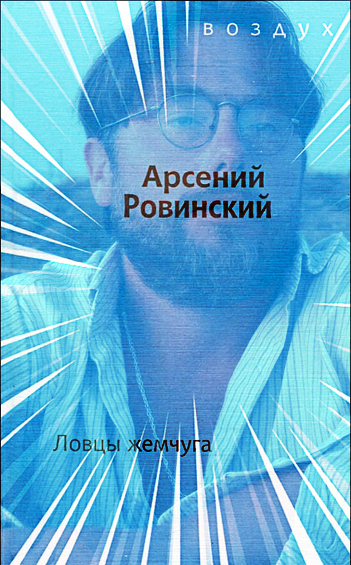
Arseny Rovinsky . Pearl catchers . -M.: Book Review (Argo Risk), 2013. (Book project of the journal "Air", Issue 63.)