
Translated material
Freedom and death
The Federation Council proposes to release the accused contained in jail or under house arrest to the funeral of relatives. According to Izvestia, senators Konstantin Dobrynin, Andrei Klishas and Vadim Tulpanov prepared a draft appropriate amendments to Article 95 of the Code of Criminal Procedure. The project also provides for the possibility of temporary release of those arrested for farewell to a seriously ill close relative. The authors of the amendments propose to limit the term of "dismissal" for two days.
Dobrynin explained that for the convicts such an opportunity is provided for by law, but for people whose guilt has not yet been proven is not. “This is a clear gap in the legislation,” the senator remarked. “And it’s just not humanly.”
At the same time, as stated in an explanatory note to the bill, the proposed norm “does not determine the unconditional right of the suspects and accused,” but only provides for them “taking into account the personality and behavior”. The project leaves the final decision at the discretion of the investigator or judge - depending on who is legally responsible for the accused. It is for them that the defendant must submit a petition. If the “dismissal” is agreed, paying for a trip to the funeral or a date with a relative will fall on the most arrested. At the same time, several FSIN employees will be escorted.
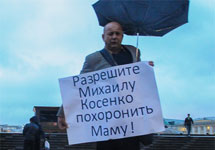
On the eve of the judge of the Zamoskvoretsky District Court of Moscow, Lyudmila Moskalenko, who is considering the case of the "swamp prisoner" of Mikhail Kosenko, refused the defendant to release from a pre -trial detention center for a trip to her mother’s funeral. Nina Kosenko was buried on Tuesday in the absence of her son. The press secretary of the court, Yevgeny Kazukhin, explained that Kosenko was not released to the funeral due to the disorder of the psyche, because of which he is allegedly dangerous to others and himself.
Meanwhile, the Strasbourg Court, having examined a similar case on the lawsuit of the National Bolshester Vladimir Lind, a few years ago, admitted that Russia violated the rights of the arrested, not allowing him to attend his father’s funeral. Kosenko’s lawyer Vladimir Ryanov referred to this precedent, but Moskalenko did not convince his argument.