
Translated material
Joy and torment of experience
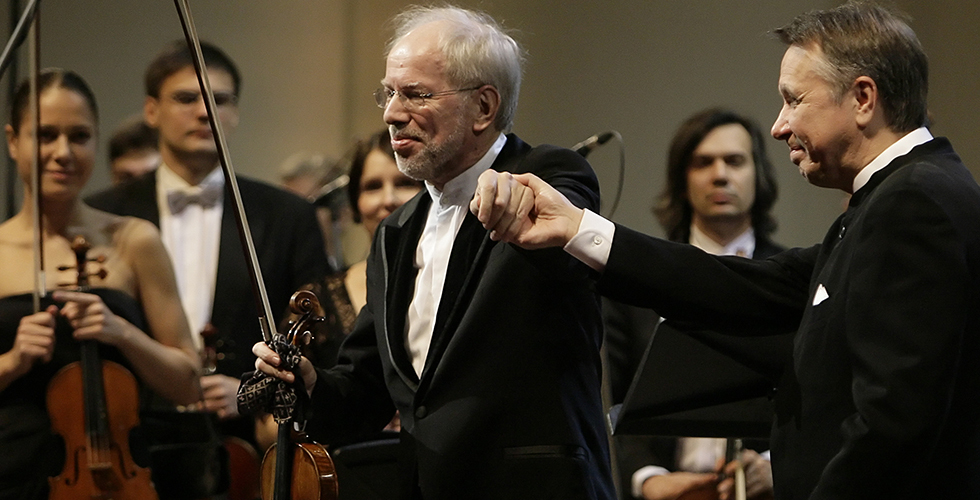
Within the framework of the Tchaikovsky V -Bolshoi festival of the Russian National Orchestra, the main event occurred now - the pianist Mikhail Pletnev and violinist Gidon Kremer played with each other. Two major musicians with indirect creative fate, completely different and at the same time similar - as now very clearly visible - this is precisely this indirect. Pletnev always has a dusk on his face, Kremer has a worked out a white -toothed smile, one is an unleasable and taciturn introvert, the other is also probably an introvert, but splashing his approaching in autobiographical revelations. Both are tired-from the musical industry, but not from music, middle-aged (now no longer important that they once belonged to different generations of Soviet musicians and that they have a 10-year difference in age), who survived the glory and weary, by some miracle, despite their misanthropy, raised two beautiful teams-the Russian National Orchestra and the Kremorat Baltic.
To hear them and one by one is an unprofitable story: Pletnev, as it were, reluctantly returns for the piano after several years, the creeper himself, Kremer, on the contrary, loudly cancel the concerts, as with mills, fighting with modern laid musical and market production. Their joint music (carefully began a few months ago outside our country) is completely unique.
The significance of a quiet and chamber event, which was a concert under the everyday name “Kreterat Baltika” in the guest of the RNO, is probably comparable only with the priesthood, which is the annual Petersburg clavirabend Grigory Sokolov (Muscovites are deprived of this privilege, the pianist has long denied the capital in his location). Actually, Kreterata was in the first department, where the Youth Baltic collective was first engaged in a reflected dialogue with the past with his chef (fragments from the program of instrumentation played already in Moscow, for which several modern composers made their own versions of the Bakho clavier plays), then with a wattle concert for piano for piano orchestra).
But the historical event took place already in the second compartment. This in the usual sense cannot be called a performance. Shine, technique, phrasing, carcass and a sense of shape - it was impossible to think about anything like that. These are all some kind of school-industrial concepts. From the area of windmills. Playing the tenth violinata of Beethoven and La Majoric sonata Schubert, two musicians spoke first of all to each other. Slowly, quietly, bewitching, each bringing their significant arguments.
And the point is not that Beethoven and Schubert are good composers. These two, Pletnev and Kremer, it seems, would have found something to talk about about gamma. BIS - the “flour of love” of the cruisler, an example of lightweight, lace and tearful salon music - was played as if there is nothing more important in the repertoire for violin and piano. Each note was immediately loaded with everything: sadness, irony, grace, skill, fatigue from skill, experience, joy and torment from this very experience.