
Translated material
Hood Bai, scoop!
The younger generation invests in changes
The main sensation of the elections in the capital: a generation that does not remember the Soviet regime, that is, those who are now 18-25 years old, as well as - especially those who have got on their feet in the last decade and do not need state help - the age category is 26–35 years old, no longer want to invest their votes in a big brother. They choose changes that are today personified in the image of Alexei Navalny.
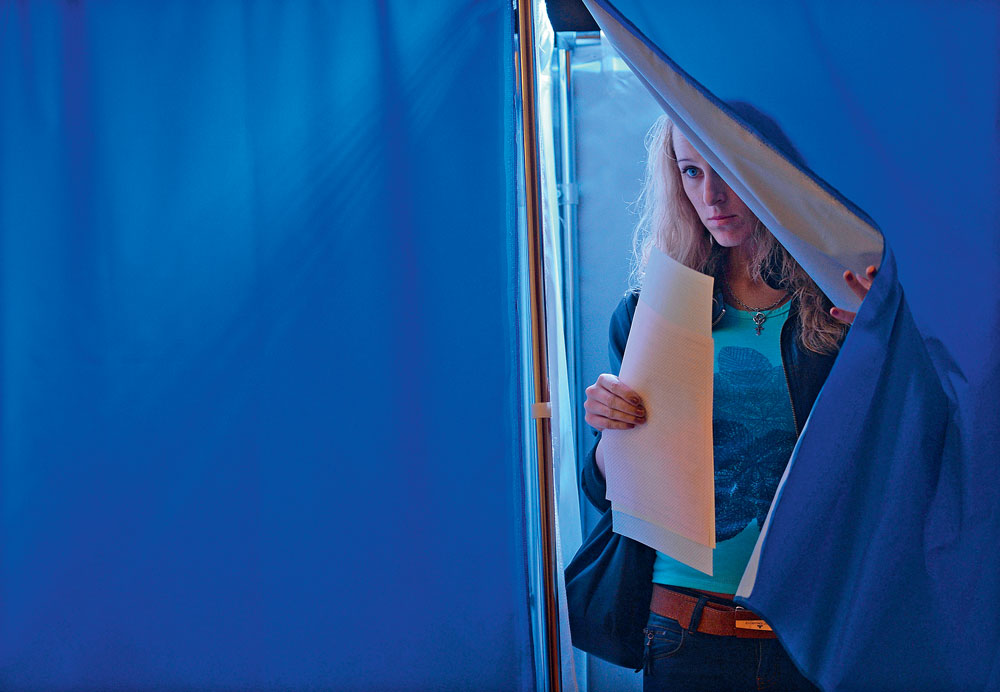
Elections of the Mayor of Moscow, polling station No. 17. 09/08/2013
It was what some analysts predicted: the moral requirements of Muscovites, put forward during the protest winter 2011-2012, began to transform into political requirements, and this happened faster than anyone expected. According to official figures, 27.2% of Muscovites cast their vote for Alexei Navalny (in reality this figure may be slightly more). Candidates from the parliamentary parties - the Communist Party, the LDPR, the Fair Russia and the Yabloko, which was quite built into the system of the party, scored fewer votes than Alexei Navalny.
An analysis of these sociological surveys shows: the main thing that unites its electorate is a request for changes in society and social justice.
Problems of sociology
How to understand what affects what candidate a person is ready to cast a voice for? During a sociological survey, several hundred or even thousands of respondents can be interviewed. Dozens of questions can be asked each of them, from the most basic - age, education and ending with ideological preferences and attitude to specific politicians. However, simple digital calculations-such a percentage loves, relatively speaking, cucumbers, and such and such tomatoes-explain little. Therefore, modern methods of mathematical statistics are needed, which allow us to calculate how the tendency to vote for the candidate depends on individual factors, such as age, gender, political views, etc. We cannot accurately predict whether this voter will vote, for example, for Navalny, but we can say as education, gender, age, ideology and other things affect the probability of such a vote. Some factors will be statistically significant, that is, we can make an unambiguous conclusion whether they affect electoral behavior or not. And if they influence, then in which direction and how much. But there will be insignificant factors regarding which the analysis does not answer the question of how they affect the electoral choice.
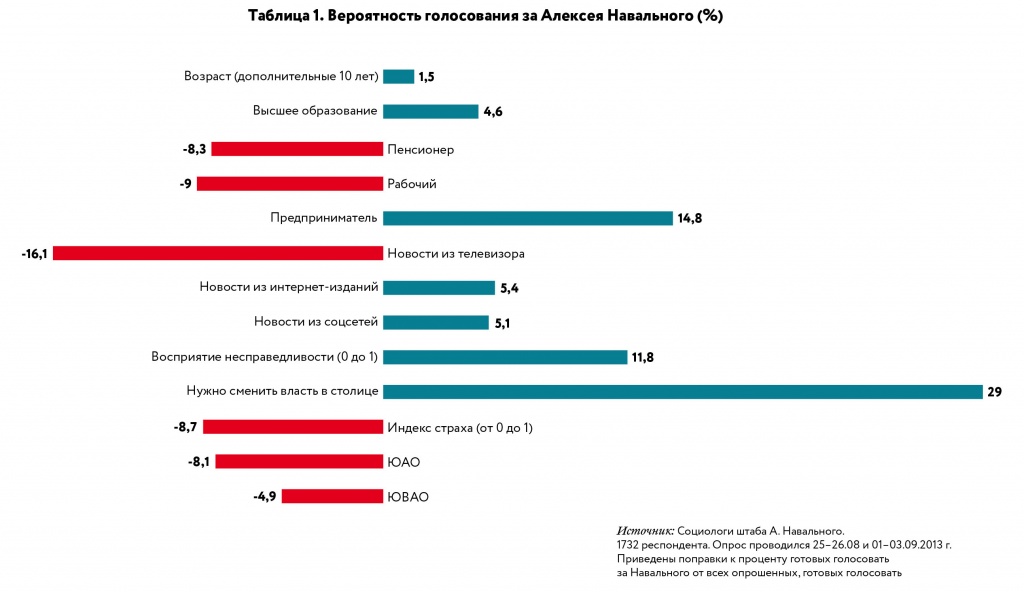
Table 1 shows the results of such an analysis based on these two polls. Each line of the table corresponds to one statistically significant factor (insignificant factors are not given), the value in the next column - how much it affects the probability of voting for this candidate.

Why is Navalny?
The main thing that determines the readiness of Muscovites to vote for Alexei Navalny is a desire for change.
In the last survey conducted by the sociological service of the headquarters of this candidate, the question was asked about how much it is necessary to change the system of power in the capital. This is how the electoral preferences of Muscovites were distributed depending on the answer to this question:
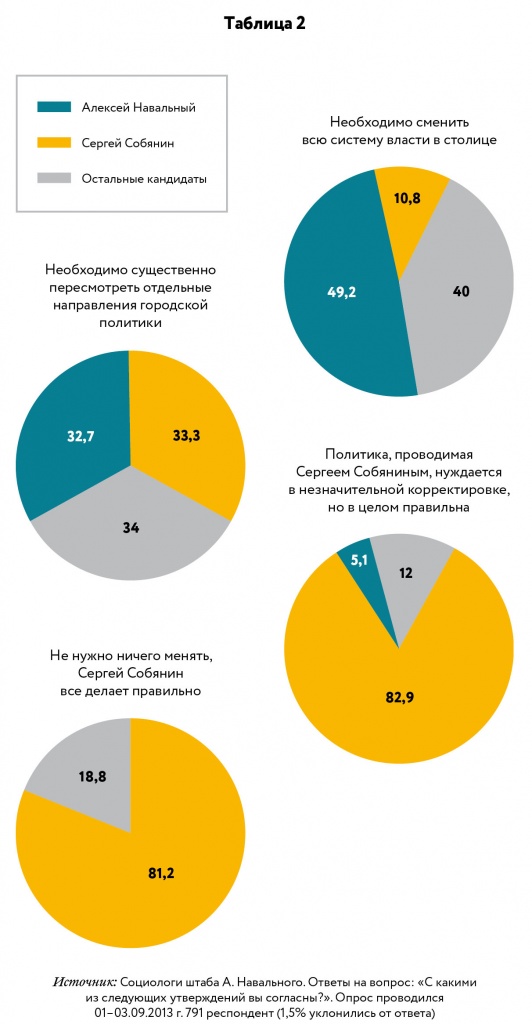

The request for changes is partly associated with how much a person is ready to overcome the dangers surrounding him - both those that personally concern him, and those that do not depend on him in any way. In other words, how much a sense of fear is characterized by. In the same survey, sociologists asked if the respondent of street unrest, epidemics, disability and other undesirable events were afraid? Those who were ready to vote for Navalny were afraid of less than those who were going to put a tick opposite the name of Sobyanin. This is not surprising: fear, especially fear of the future, unknown, is a very strong factor in politics: people who want to preserve the status quo (as in Soviet times said: “If only there was no war”), fearing any changes in the already established way of their life, as a rule, are more acutely prone to all kinds of phobias and hidden or obvious fears.
Social networks VS TV
The second most important factor, which, according to our polls, influenced the choice between the candidate Navalny and candidate Sobyanin, was the source from which people received political information. Among those who find out the news primarily from the TV, there were much fewer Supporters of Navalny. The effect of the TV is very strong - in terms of influence, it is inferior only to the request for change. State propaganda, alas, has not gone anywhere and is still a powerful means of influence on the minds of citizens. But among users of social networks and among those who read online publications, Navalny supporters are predictably more; The total effect of Internet publications and social networks is almost equal in strength to the effect of the “zombie” (and reversed in its orientation). However, it is curious that the audiences of television and the Internet are markedly intersecting: this means that the usual division of the electorate into a “batch of TV” and “party of the Internet” is too much simplification: not all users of social networks and news sites were ready to vote for Navalny.
Big Brother factor
The third most important factor is where a person spends his working day (see table 1). Firstly, pensioners were less likely to support Navalny than people of the same age, but continuing to work. Perhaps this is a consequence of the fact that pensioners as a whole are more dependent on the city government, and the circle of their communication is much more than one -dimensional. Secondly, the support of Navalny, of course, is higher among entrepreneurs, that is, financially independent people, independent of state crutches than among state employees. But the people of working professions are not inclined to support Navalny. As for other categories of citizens - housewives, students, unemployed, all other things being equal, their electoral preferences are statistically indistinguishable from the political affection of state employees.
Diploma, age, gender
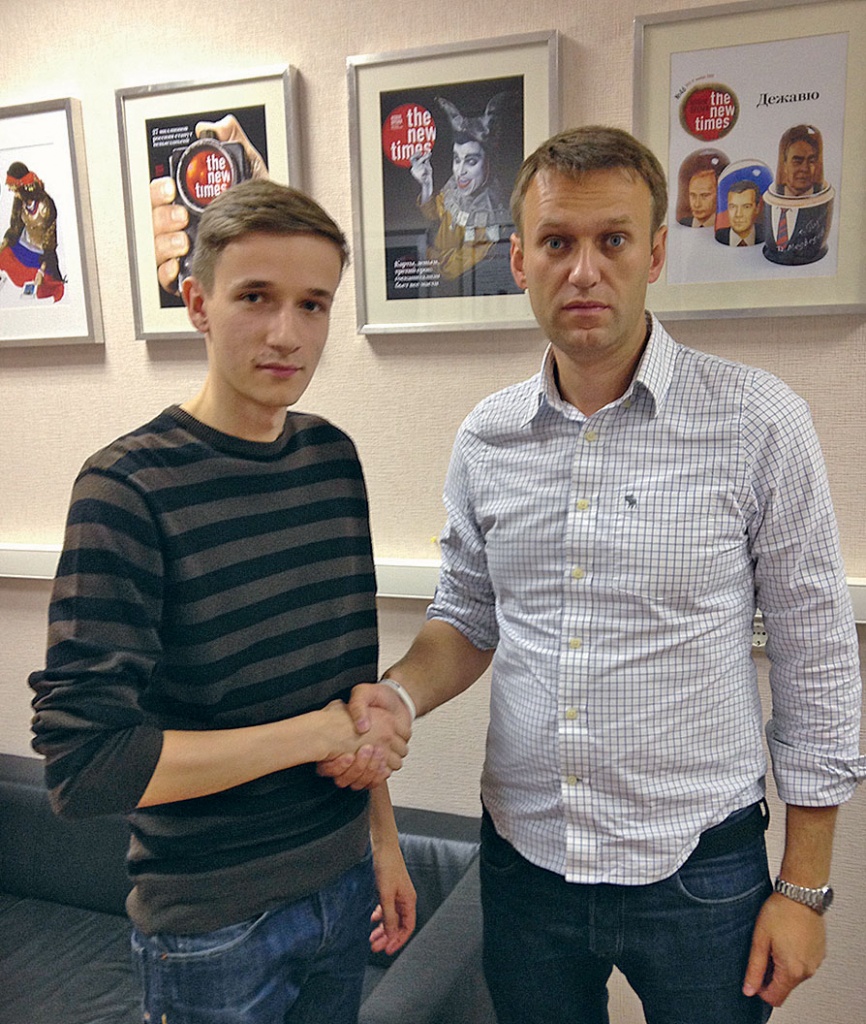 |
| Designer The New Times Ivan Stepanenko (26 years old) is a typical representative of the electorate of Alexei Navalny. As amended by the magazine after the election. 09/10/2013 |
Education plays a serious role. If we compare two people who differ only in the presence of higher education (and possessing the same income level, age working at the same work and living in the same district), then a person with higher education will be more likely to be a supporter of a bulk, as a person without education, as well as more likely to take part in voting. Both the world and Russian experience say that more educated people are always better socialized, more politically subsidized and politically active.
Age and Paul are factors that largely affect the choice of politics and, accordingly, a candidate who personifies this or that policy. Alexei Navalny is certainly the choice of younger people. The only trouble is that the 18–25-year-olds do not go to the polls: their brains are occupied by other interests that are not tied to politics. Therefore, the most numerous age group in the electorate of Navalny is people from 30 to 40 years old (see table 3). The electorate of Sergei Sobyanin is much older. However, here the matter is not so much in fact, but in what excites the elderly people - pensions, fears, the desire to preserve the usual, limited sources of information about the outside world. The age itself even slightly increases the likelihood of voting for Navalny - perhaps due to the greater electoral activity of the elderly.
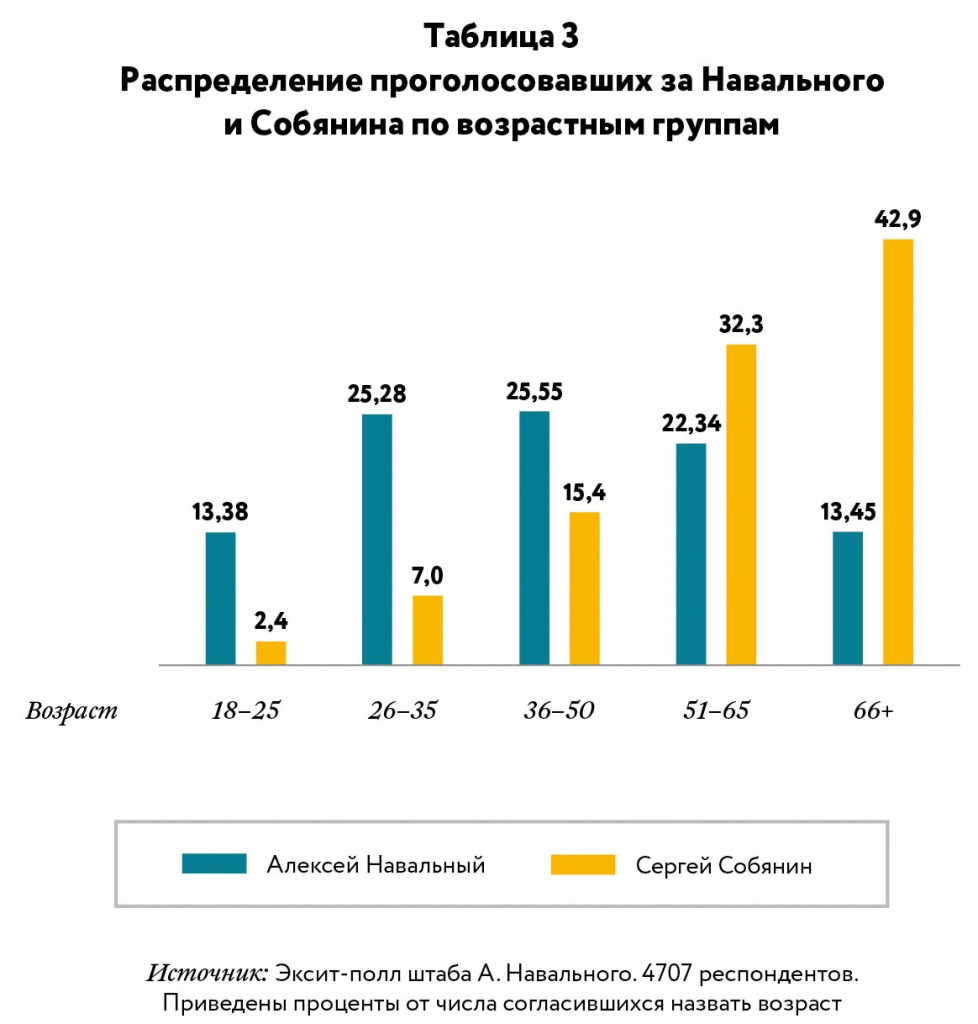

The share of youth among the electorate of Sergei Sobyanin is very low. In total, a little more than 10% of those who voted for Sobyanin were people under 35 years old! If we compare the absolute numbers, it turns out that among people of the age of 18 to 35 years, the number of voting for Navalny is about three times more than the number of voted for Sobyanin. And if you take into account a very low turnout among young people (it was lower than the average in Moscow (32%), and amounted to about 20–25%), it turns out that for Sergei Sobyanin, no more than 5%of all Muscovites aged 18 to 35 years old.
It is generally accepted that women are more likely to support candidates from power than oppositionists. In our case, this is only partly: both men and women, ceteris paribus, were equally inclined to vote behind Navalny. Regarding Sobyanin, the old truth turned out to be true: women really were more likely to give him preference than men.
Thirst for justice
Among the supporters of Navalny, a strong request for justice is traced. In one of the surveys, various professions were listed (trolleybus driver, university professor, official and so on) and the question was asked about each: does this person earn too much, too little or as much as necessary? Further it was possible to calculate how many professions the distribution of income is perceived as unfair (when a representative of this profession receives too much or too little). It turned out an amazing thing: Navalny’s electorate turned out to be more left than the Sobyanin electorate. The more unequal a person perceived the distribution of income, the more likely it is that he would cast his vote for Navalny, and the less likely it would be that this voice would go to Sobyanin.
It is possible that this thirst for justice is exactly what has taken away the votes of both the Communist Party of the Communist Party of Ivan Melnikov and the candidates from other parties of the social democratic orientation from the so-called “systemic opposition”.
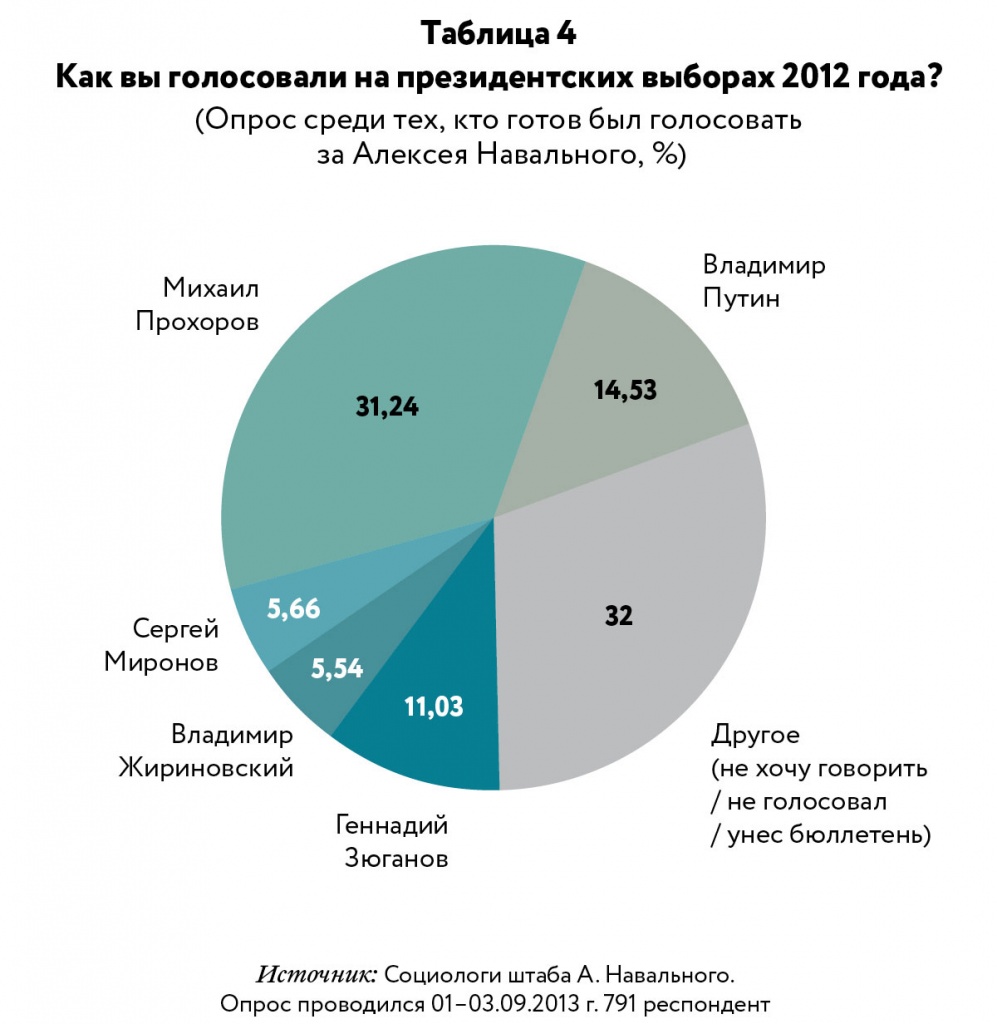
Our data show (see table 4) that Navalny was supported not only by those who voted in the presidential election for billionaire Mikhail Prokhorov in March 2012, but also a significant part of those who voted for Gennady Zyuganov and Sergey Mironov.

Money
Statistics do not allow us to say that income somehow affects the readiness to vote for Navalny. The income is associated with voting only indirectly: an independent entrepreneur (and this is the electorate of Navalny) earns more than a civil servant (or even more than a pensioner) who votes for another candidate. However, when voting, not the number of bills in the wallet is important, but a relationship with the institutions of the state. The entrepreneur constantly has to face bureaucratic arbitrariness, while for civil servants and pensioners the state is a source of welfare.
However, the level of income was important when voting for a candidate of authorities: more wealthy citizens were more likely to vote for Sobyanin than for representatives of the Communist Party, LDPR, “fair Russia” or “Yabloko”. This once again shows that in modern political reality, the electorate of the ruling party is actually located on the right side of the political spectrum, and the electorate of the main competitors is significantly left.
"
Alexey Navalny - of course the choice of young people. For Sergey Sobyanin, no more than 5% of all Muscovites aged 18 to 35 were voted
"
VS center sleeping areas
Geography itself also has a little little affects the electoral preferences of Muscovites. It is known that individual areas of Moscow-the center, the south-west-traditionally often vote for the opposition than others. However, if we take into account all the variables listed above, then almost nothing remains for the share of geography. The support of Navalny in the Central Administrative District is really much higher than in other districts of the capital (it is also high in the southwestern and Western districts), but this is because there, apparently, there are more entrepreneurs and people with higher education. The districts themselves are not important, with the exception of the south and the southeast of the capital: those who live there are less inclined to vote for Navalny.
Future
We cannot know for sure how the preferences of the electorate will evolve in the coming years. Today it is obvious: we are now at the very beginning of the new political paradigm, in which the post -Soviet generation will play the main role, for which it is important not only to live, but also how to live. This generation does not need a big brother, and they have money and time, and the desire to invest it in politics. This generation can itself, without a hint of propagandists, choose a leader who is ready to present their request for changes. But there are many unpredictable values. They will not be put on Navalny, they will intensify repressions or red flags will be put around the security forces; Oil prices will stay in today's values or will fall, and therefore, the authorities will not buy the loyalty of citizens. But in any case, the requests for justice and changes will become factors of the following elections - for example, to the Moscow City Duma in 2014. And the new political movement has every chance to convert this request into the voices and deputy mandates.
Photo: Konstantin Chalabov/RIA Novosti