
Translated material
Contrary to the law
The texts of Anna with an elusive way abide in two dimensions simultaneously: on the one hand, this is a situation of speaking from a certain metaphysical field, some transcendental view of things (and on the body as a thing, of course), on the other, it is the bodily in it always hot and trembling, not symbolizing anyone, without being a thing in itself, but only knowing what to get sick and moan
A slice begins on a hair from you,
And it is not thinner.
You feel two sick halves
And you moan. but the cut cannot moan
- or:
... Holds over the stream
The fact that it was as if solid should be
singing, not floating birds,
and to their thin beaks, brilliant eyes
The water stretches - viscous, and you can’t hold it.
In two given examples, the objective experience of the living as an object is clearly visible. So, the cut -ran becomes just a gapy in space, which is close to the body -turning into two sore halves -and is impossible, not mentioned to him; The birds are hardened, and water is heavy around them ( viscous ). This is also facilitated by the impossible, illogical aspect of experience ( you moan , but <...> cannot moan ; as if solid - birds; water stretches - to <...> beams, <...> eyes ). However, it is also impossible not to notice what powerful vital energy these substances are saturated, which almost becoming an abstract cut vibrates and how convex ( as if hard-thin beaks-brilliant eyes ) is not given floating birds and this other people's water, which nevertheless attracted by them, wishes them, is applied to some kind of predatory properties.
In the same tension, one of the most integral cycles of the book - “Laws” . Glazova-quite in the spirit of the modernist tradition ( “Law, Like Love” , Oden, for example)-undertakes a deconstruction of a stable model of perception of causal relationships, exploding it from the inside with a voice of mistrust. The cycle begins (as well as the poem of Oden, by the way) with a persistent attempt to reach the point of what the law is. Law-1 is proposed (the “Wine-Retribution” model: he stole the guilt of the guilty <...> / <...> so that <...> / <...> the law has grown ), the Law-2 (the model of the thing is the order of things ”: to extract / the whole law, the key to each sound ), the law-3 (the model“ Natural Law ”: the Law will cool with the light ), then the law will arise that <...> everything is mixed and the law of contradiction . But each of these laws is sequentially destroyed. Law-1 is crumbling under the influx of the Aporia (a very important property of Glazovo poetics, apparently, who deals with the work of A. Dragomoshchenko): He stole the guilt of the guilty-stole the ownerless-lied that he stole-guilty , and all this powerful, ancient, it seemed, the law-grows in a stolen place ( i.e. reasons that is impossible for the law). Law-2 instantly joins Law-1 through the introduced feeling of guilt (to call it, to indicate the thing-the same as the close under the oath of the oath -Wittgenstein notes) and ends with complete rejection: it would be better to release the name from the memory . Law-3, which stages that each living creature should find its end, also wriggles in contradictions: despite the fact that the subject ( we ) is not so mortal , but almost with death, nevertheless in it- as in the boat lies in the body of fuel . Despite the fact that the body is motionless , it is inner heat , and it turns out that even after death, a breath will be possible, but here the natural law completely disappears: what will be inhaled will not be air .
 © New Literary Review
Interestingly, very similar transformations occur with the tongue of the eye. The texts of the book are oversaturated with virtual constructions, replete with verbs in the subjunctive or desirable inclination and subordinate conditions or targets (many temporary subordinate clauses are approaching them in meaning). Here are examples only from the "laws", marked by the cause and investigation, condition and purpose: stole - so that it grows up; I made it - to take it off to grow, so that it is ; extract - it will be in the voice - if you call it - it would be better to release ; They engaged - cooled - the meaning of the cause and investigation here is often expressed without an additional union - with the help of the verb of the future tense, in this case, after the verb in the form of the past time, the indicative will be extracted in the example - after the infinitive, and in the example it is better to judge - then I will agree after the imperative); If you do not take the law, take with a rim ; The streams would be the glasses themselves, and the salt disappeared; If the law, you could not fail ; Better to judge - then I will agree; When the plows bloom and grow - the stars fool him , And when the stone is thrown - this is a dream ; Do it - to be to go - when they look ). In the fourth fragment, these designs “if - then” intensify with a visible hint of narrative:
But the boat and I dived already and we dive,
then two exhalations on the surface, then in a deep dream
- The boat , apparently, is from the previous fragment, where fuel lies in the body in the boat . However, then the illusion is overhaled by an impossible combination of adverbly circulation of frequency with the verb of the past tense of a perfect species ( they returned many times without cargo and death from trouble ). A similar one comes from the law of contradictions from the sixth fragment: the contradiction itself ( what <...> you said, was / not so said, but to another ) given in the middle of the text and expressed in the modality of will, wishes ( judgment , say ), it would seem, gives the grounds for the existence of the law and the adoption of a value judgment ( judgment ) associated with the very first fragment, about wine . At the same time, the predicativity of the investigation is designed as a verb of future tense in an analytical form ( then I will agree to conspiracy / with small movements / hands and face ), which implies a long or repeated nature of the called action ( agree ), but does not guarantee its completeness. In combination with small movements / hands and face, this offers a truly chaotic picture, which is unlikely to leave the possibility of even the law of contradiction .
In the world, you are easy to like evaporates inside.
The laws of the eye are fooling , show a stray dream . The only way to fight them is the first rule: do not remember (returning to law-2). At the end of the cycle, the exhausted, brought to frenzy, I turn to a prayer to whom - a prayer, which, it seems, legitimizes everything that has sequentially destroyed the cycle, establishing stable rituals as a given (a stable value model make it so that ). At the same time, the most severe irony, disappointment that through in this text, organize poetic tension in such a way that it is already impossible to exist in it. The first proposition of “prayer” is a tautological distortion of the formula of social Darwinism “man of a man of a wolf” (which refers to a fragment of the natural law ): so that the wolf is a wolf . The second proposition- so that the red spots are on the skin under the skin / shame when they look at you -on the one hand, it sounds some kind of Victorian, Dikinson frenzy of a woman as another, on the other, it remains completely defenseless from the awareness of the alienating power of the law and burden of guilt from the first fragment, again shown here as an object of lust.
By a complex combination of virtual rhetorical figures and archetypal, “large” words ( wood, house, copper, stone ), coupled with the acute sensation of bodily, the poetry of the eye unfolds the universal canvas, where the poetic develops into “blood of the poet”, and the routine of things is subjected to total doubt. It seems that these texts are an example of “relevant poetry” in the highest sense of the word, where more modern manifestos of left -wing poetry. They deal with perhaps the most painful nerve node of modern culture - and reveal to it, honest, defenseless.
The problematized experience of the body and space already mentioned at the beginning is also realized in these poems through numerous virtual figures. The very practice of such a view, even for modern Russian poetry - already in a sense, Uzus, we can recall the textbook examples from Ivan Zhdanov: no one managed to / lean, crying, above themselves ; Or touch death and do not close your eyes, / or stand on the side - look at yourself? -Or this: try to tell me that I am a phantom / and someone’s part, painful at the same time, / and if not, then what is sick? -Or: we also sailed in the shores on which we stood / ourselves once, now we are escorted . So many other people's examples are given not by chance here: the similarity is very clearly visible, but the differences are also visible. Still, the empty signs that Zhdanov operating, Glazov no longer believes. Her "body" - beats and pulsates, here and now. And the figures of removal, which are poured on him with a predatory stream, is only an external existential factor, but not a condition inherent in the body. Glazova is trying to survive the perception in an animal way, the feelings themselves are felt by it as mythological structures (tree branches or the transitional time of dawn): the branch hits the roof somewhere behind. / He does not look but sees the narrowness of vision ; Before dawn, the light rests against the body and does not pass ; A branch, honeysuckle: / you and my zeal / may not have survived . The reality here is also often turned upside down (the first cycle of the book is focused on this, “almost in the opposite direction”): with your swings on the hill or your feet or Behind you, who has become a fork / hands. // We were carried out here, / upside down - but it is fundamentally that such Modus Vivendi does not make a speaker a phantom, but imposes new restrictions on the statement. Especially in the last texts of the cycle, this can be seen: there are other people's walls, / on the other side, maybe there is a conversation - and in the next text: a rude chopping is burden, / as a deep spray from the well, / but it shines. // - without the right to vote, mouth, closed, seal the ambiguity . At the same time, it is worth repeating that the lessons of metarealism are learned here and these are no longer classic texts about doubt about the possibilities of a poetic voice.
Speaking about space-road and from where the poetic is born, one cannot bypass the “dead” cycle, where the motive of filling is manifested with special clarity for the whole book. In the focus of Glazovo poems, there are often words with semantics of capacity, vessel: shell, grave, emptiness, dress, gaps, the body, the body , oddly enough, even in the word turn , the characteristic of the space to be filled is updated here. Glazovsky gaps are looking for this filling, they want, wait - and bread gets into the grave , azure - a stone - a stone is thrown into the gap . The mechanism of such a structuring of experience is persistent (obsessed?) The use of the preposition "B" (“V”), regardless of whether the value of the direction is realized anywhere or finding somewhere: the glazing landscape seems to be indifferent to this, every routine of things is ready to move somewhere, a stable experience of space-to turn into a landmark, into a source of Sehnsucht 'a. "IN" ("in") Organizes the conflicts of these poetic texts according to the model of filling the passive vessel with the dynamic energy of the object/process: in the chest-a voice, in a gaping from a hungry dough-a holly house, in a boat ( as in a body ) -fuel, inhale, not air, in the sink-burned flowers (into the flan)-entrance (LI) . This is especially clear in the next poem:
There are too deep azure flooded cracks.
In the world, you are easy to like evaporates inside.
In the leaves of the vein in man, the vessels in the vessel of what is stored.
In a suffocating depth, someone left by light lives.
Only from his own eyes he has light.
And someone is blind.
The land lying in the ground is not bread and water.
Sometimes silence is silent.
Not you holding your hands in the sky, the clearance.
The cascade of nouns with the semantics of the capacity is enchanting the control, directing energy of the word B ( inside ), and virtual figures illustrate that discursive that stands in the heart of this text: the body is like a vessel , the earth of the dead (not) as a body of the living, vision and perception as a welcome light , the poet’s voice (also light), the hands of the dead, which at the same time only Some are the essence - in the sky is a clearance . Such a genealogy of the poetic is traced in the entire cycle “Dead” and wider - in the poetics of Anna Glazova. It also provides a sufficient impulse for doubt in the formal structures of the “Laws” cycle, it comes to the surface in the “What is heard” cycle, almost completely devoted to the situation of capturing the poetic voice ( how the world / <...> you will forget yourself ), it already works as a background in the final cycle “part of fullness”, which sequentially analyzing the conflict of things and space as independent Private: Consciousness, whose creative energy is chained in dead hands, nevertheless sees:
Mountain crystal
matches
Like a strawberry berry
But grains inside.
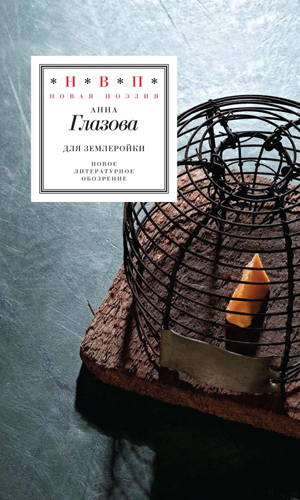
Anna Glazova. For shrew. - M.: New Literary Review, 2013