
Translated material
Against the image, or the appeal
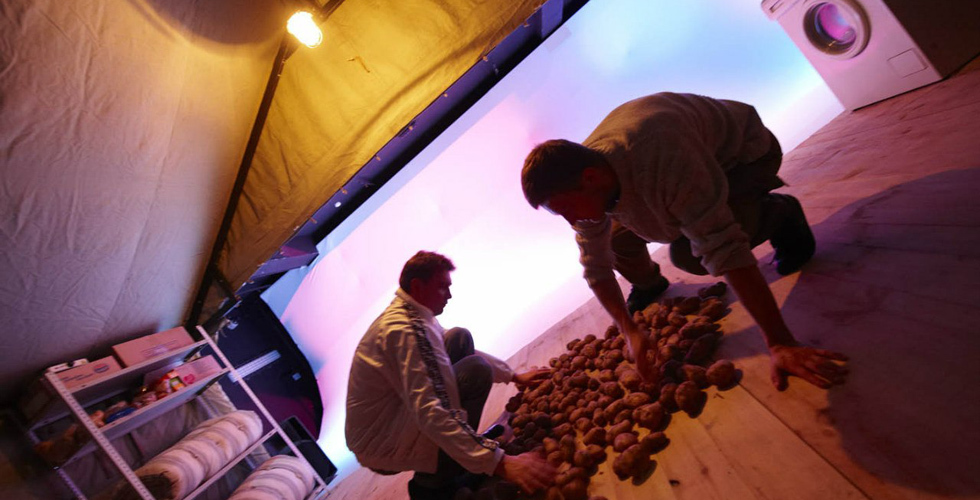
Dmitry Volkostrelov meticulously engages in Pavel Pryazhko’s plays, and, as everyone knows, the Volkostroelov Theater is “This is not the theater”. Well, like "this is not a tube." The culmination of their non-performance-"I am free." More than 500 photographs were projected onto the screen in front of the auditorium, and Volkostrolov voiced the image of thirteen, it seems, replicas. Conceptual, or rather, post -conceptual art overtook our theater to destroy it (the gesture of sudden modernist) - to initiate the imagination of the viewer, ignite its ability to critical judgment. Not only about the specific action of the director, but also in relation to the reality captured in the texts.
“Three days in hell” is a step of Volkostroelov further and to the side, as they say, “total installation”. The reduction of the stage text, which invariably entails the director, is made up here by much one, reproducing the author’s text in audio recordings due to the scene. The text, as is characteristic of the dramatic (and not post -dramatic) theater, becomes the main character of “Three days in hell” - an unusually sharp name and concept for the buckle. This text, divided into male, female votes of the soloists, which they are unit, intentionally accelerate it, do not intonate, leaving a speech stream with a neutral list of terrible, but familiar household sketches, scenes and removing replicas, drawn into the same stream, is essentially in chorus. Yes, this is a choir, a storyteller of events of a small (for an hour) post -tragedy.
The lowered text in “I am free” testified to his presence, which is so unbearable that I want to shut up my ears. Now Volkostrokov cleans the blurry eye of the public with reduction of the image. And the text reproducing the “fundamental vocabulary”, “the poetry of the catalog” and other serial conquests of conceptualists, he puts forward as the main character, who experiences the possibilities of perceiving the viewer. Its ability to think. And even to see if he hears at least something (and does not listen).
Spectators are sitting in a tent in front of a tiny princh, on which a sink and a table with kitchen utensils (scenography of Ksenia Peretrukhina). The backdrop or screen, devoid of its visual role, is illuminated by the color of the morning, dusk, night - the forgery rhythm of the shift of three days in a normal hell. This backdrop blocks the audience from the immense world, from where the noise of our contemporary’s massive, its collective body, with which the cultural viewer reluctantly shakes in the minibus comes from. “A minibus, what is this? Equates to the bus, or taxi? " Even those who (and Pryazhko) have to climb into such “or - or” know about Xavier Dolan, but does not know the answer to the question (from the television game) “What are quantum non -cabinal correlations?”
The list of numbers is becoming a grotesque version of economic ties that humiliate, unify and reduce the way of people along the route from birth to death.
The text is a bundle change in the genres. This text - the visions of the author who captured that others, rushing past, do not see - includes scraps and internal monologues of anonymous characters. The list of numbers (numbers of houses, buses, minibuses, one of which reaches numbers 1134, the amount of money for renting an apartment or its purchase, the cost of chicken, etc.) becomes a grotesque version of economic ties that humiliate, unify and reduce the path of people along the route from birth to death.
This intelligible noise is inconspicuous, familiar, not depicted, so as not to be fanned, you can imagine the world, but not to show. It would be good to cover your eyes in order to force to see the true - but not in the sense of .doc - and as if a familiar reality.
“For three years she will wait for her housing. Not 17, not 20 years old, not since 1987 of the 20th century. Three years only. During this time, she will pay the hostess an apartment $ 8640 plus a communal apartment in three years. She will continue to pay already entering a new apartment. He will pay for doors, wallpaper, household appliances, lamps, windows, if he wants to install a shower. She will pay, like her friend, all her life, until she died. Then her relatives will pay. For the coffin, for wreaths, for a place in the cemetery. One of the relatives at the funeral will say: she loved life so much. ”
Wolferships materialize "Voices from the choir." Selects two messengers of the extra -exposure space (artists Alexander Userdin and Pavel Chinarev). One moves from the backstage to the wings, screws up something in the pipes under the sink. Here is the image. Refroll of ritual action: household rotation, rhythmic, as a change of days in a peaceful hell. Another messenger also flanifies along the back screen, enters the kitchen in order to wipe glasses with masterly zeal. Imitate the action "from empty to empty." Silent messengers examine here the “collective unconscious”, which articulates, temporarily paces in a complicated speech by Porkoko. An attentive observer with sophisticated hearing, he cannot skip the raven who “sit on a birch in the yard” , or, say, not to look into the head of a stranger who decided that someone had thrown a brick “from Stalinka” , but after a second, who “had fallen a lump of snow from the roof of the roof” .
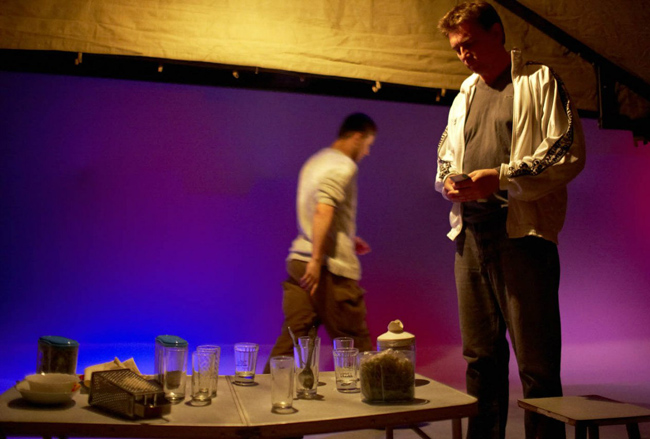 © Sergey Petrov / Theater of Nations
One messenger is nevertheless instructed to voice the last fragment of the text of Pryazhko. More precisely, remarks. She clarifies why the audience was driven into tents that protected them from the drops of rain, hinging the “real world” in buckets and reporting an echo, the voice, oddly enough, is still living nature, and weather - marching (in a tent) surprise.
The audience sits in the LTP, and this is “5 tarpaulin tents, a hundred kilometers from Minsk, not far from the village in the forest. There are 10 people in the tent. These are all middle -aged men, drunkards, parasites, those whom the country is not going to warm. In tents it does not heat, and there is no light. At temperatures on the street minus 10 in a tent minus 10 ... " .
Cutting, rethinking the border between art (including conceptual) and inability (including theatrical) means to take an experiment. But neither delight nor disgust of the public are no longer the criterion of his good luck. The tickets did not indicate places in the firmware-tan. After “three days in hell” no one thought to applaud. The conditions specified in the premises of the small scene of the theater of nations did not imply ritual services to the public to the author, director, actors.
But the transparent experiment of Pryazhko and Volkostroelov is addressed to another participant in operating in it. Namely: to the viewer, only for an hour in a treatment and labor dispensary. The interpretation of what we saw may be arbitrarily free. But to those who use the physiological detox or dream of it, it is useful to visit the labor dispensary in order to submit their senses. Clean the hearing and vision. Or wake the opportunity to think. Which is easy at a comfortable temperature in the conditional - theatrical - tent.
The quotes used in the text from the play by Pavel Pryzhko “Three Days in hell” are published in the author (punctuation, syntax, the use of title and lowercase letters) of the editorial office.