
Translated material
Iron Frau
How does an angel Merkel manage to stay in power?
The success of the ruling right coalition in the parliamentary elections on September 22 for Angel Merkel means the third chancellor term - four more years plus by eight existing. The Germans seem to love her forever. Deprived of charisma and outstanding oratory abilities, she confidently runs one of the leading economies in the world, keeping both her party and the coalition government, and some say that all of Europe. How she succeeds - The New Times found out
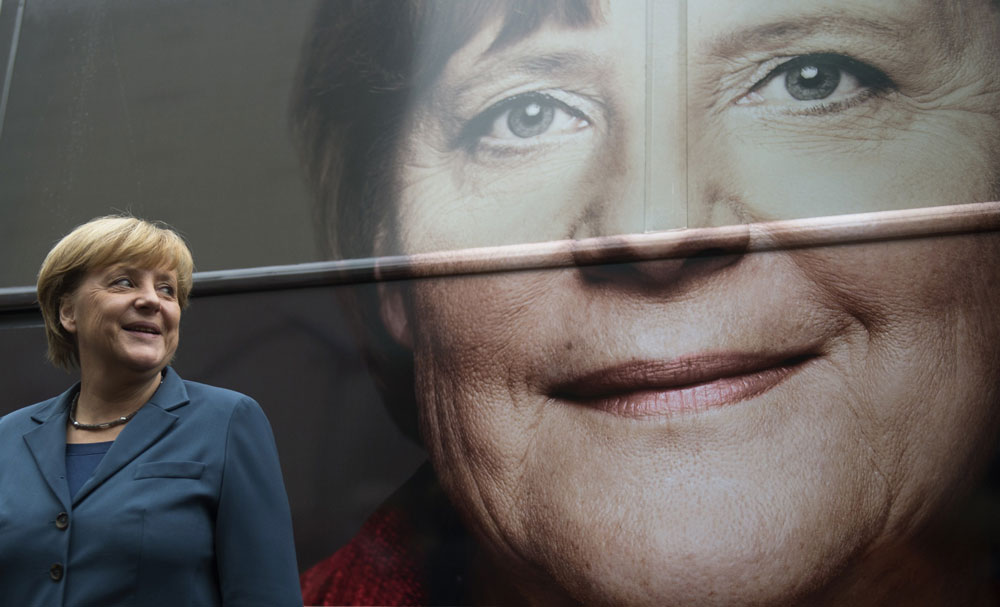
September 2013 during the election campaign of the CDU in Berlin
“I hope you do not mind that I am clothed in the words how wonderful life on the same planet is with you,” admitted the British pop musician Elton John in the song Your Song, performed by him during the recent September concert in Berlin. The song was dedicated to the chancellor of Germany. And 12 thousand spectators on the famous open "forest arena" (Waldbühne) by ovations met these words.
"Own" at the very top
Angel Merkel does not get used to associations inspired by pop stars. At many rallies, she is met with an Angie post and screams and even start this famous song by The Rolling Stones when it appeared.
But this is not a sign of adoration. This is recognition: she is her own.
This woman with an inexpressive face, a discreet haircut and a dreary wardrobe, which Forbes magazine has repeatedly called the most influential in the world, always appears without delay even at the most modest meetings with voters. And at the same time retains his image of a leader who knows how to talk with people calmly and frankly.
She can calmly wave a couple of liter mugs of beer, sitting surrounded by a huge crowd of half -drunk fellow citizens at a beer festival in Munich.
She can conduct a history lesson in high school in the metropolitan school as a shift teacher, telling about the Berlin wall (and she knows well what it is, since she lived in the GDR for most of her life).
She loves and knows how to work, which is very important for the German national worldview. The fellow citizens came into tenderness when they saw how the chancellor, sitting under the cap in a hairdresser, worked with documents on television.
She sends dozens of ESEMEC to her employees in a day. In general, text messages are the best way to contact the chancellor, given that the voice mail on her phone has been disconnected for many years (the Chancellor fears that he can skip a message or forget to answer it), and it does not use e -mail for security reasons. In addition, she does not have a laptop. The only concession to the newfangled trends was the iPad, with the help of which she reads news sites and monitors exchange quotes.
Together with her second husband, a professor of physics, Joachim Zauer, she lives (as well as most Germans) in an ordinary rented apartment directly opposite the tourists of the Berlin Museum of Pergamon, although she is supposed to be a service penthouse in the department of the federal chancellor. (By the way, the journalist’s leg has never stepped into her apartment.) With her first husband Ulrich Merkel, she divorced during the GDR. She has no children. “I did not exclude such an opportunity, but it did not work out. And when I took up politics, I was 35 years old, and I no longer asked myself this question, ”she admitted in one interview.
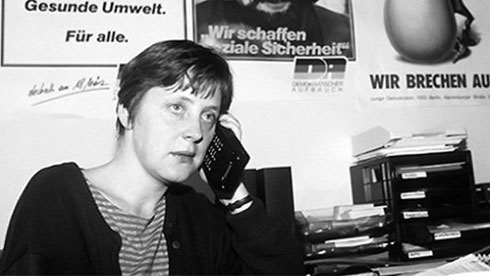
1989 Angel Merkel-press secretary of the Democratic Breakthrough organization
And Frau Merkel admits that he loves to bother in the garden and cook. In her own words, she best succeeds in potato soup, broths, schnitzels, fish dishes. She bakes pies with pleasure.
Finally, she is a woman that for feminist Germany, where they almost legally try to establish a quota of women both in representative bodies and in large concerns, plays a very serious role. At one time, many women perceived the election of angels Merkel by the Federal Chancellor of Germany as a personal victory. It is pretty to them that it is not distinguished by female beauty and charisma. And also by the fact that it reached the top of the political career, stepping over the critical threshold of 50 years of age critical for the female career. Outwardly, Merkel is an absolute reflection of the average German voter, this lies the secret of her personal electoral attractiveness. However, the ambitions, grip and performance of this woman sharply distinguish it against the general background. And the inconspicuous appearance and lack of charisma became for her at a certain stage an excellent disguise from the machinations of competitors. Cicero magazine claims that her only trump card is “the modest charm of an ordinary woman who does not want anything for herself.” When, candidate for the post of chancellor from the Social Democrats, Peter Steinbryuk said that the salary of the head of the German government, in his opinion, was too small (about € 18 thousand per month.-The New Times), Merkel answered with one phrase: "Enough."
By the way, to be fair, then the head of the Berlin garbage service receives more than the chancellor. Not to mention the directors of regional banks.
Chancellor girl
Angel Dorothea Merkel (nee Kasner) was born in Hamburg in the family of a Protestant priest and teacher. In 1954, the family moved to the GDR, where my father received a parish. Having graduated in 1978, the Faculty of Faculty of Leipzig University, the Angel began working at the Institute of Physical Chemistry of the Academy of Sciences of the GDR, where she defended his doctoral dissertation in physics. After the dissolution of the Academy of Sciences, Angela in 1990 unexpectedly sharply changed her life, deciding to seriously engage in politics. She joined the “Democratic Breakthrough” party and became its press secretary. After the “Breakthrough” unification from the West German CDU to Merkel, the omnipotent Helmut Kol drew attention to. They say that he even chose her a constituency where she was able to break into the Bundestag. And soon he invited the government to the government for the Minister for Women and Youth. “You will lead women,” the Chancellor told her. He called her "girl." And the journalists for a long time called the Angel Merkel "Girl Kolya." “Friends and acquaintances in the 70–80s were very surprised by her political career in the CDU,” Merkel Gerd Langutt, biographer Merkel Gerd Langutt, notes in a conversation with The New Times, “since Merkel was rather close to“ green ”in his worldview. Nine years later, having replaced another ministerial post, she unexpectedly for everyone became the Secretary General, and soon the chairman of the CDU.
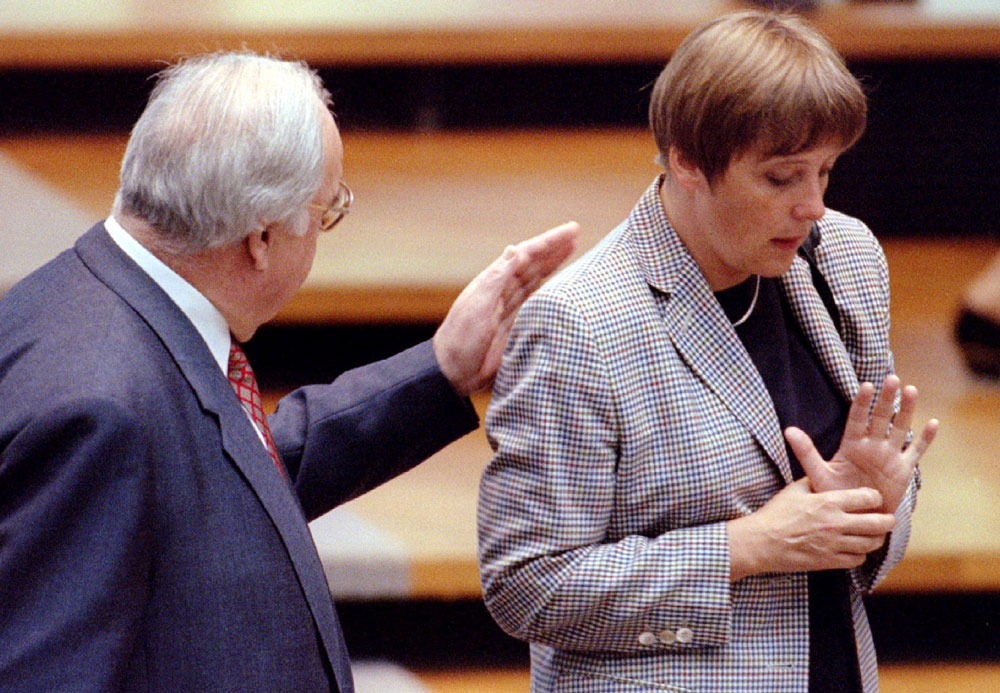
1997 Angel Merkel - Environmental Minister. On the left is her patron, Chancellor Helmut Kohl.
In November 1999, a scandal broke around illegal financing of the party. Kohl refused to name the names of the sponsors, referring to the honest word given to them. And then Merkel's hour came. December 22, 1999 in the newspaper Frankfurter Allgemeine Zeitung, her article was published, in which she called on the party resolutely to break with the “old guard”: “The party should take the first independent steps, should believe that without the“ old battle horse ”(as Helmut often called himself. - The New New Times) will be able to continue the fight against their political opponents. As a teenager in a puberty, she must break away from her parental house and go her own way. ” He left the post Kohl. Then the second man in the party Wolfgang Shoible left. And Merkel got up at the helm.
This is how her ascent in an interview with The New Times, an analyst from Hamburg Andrei Bogen characterizes her: “The biography of Angels Merkel is a biography of a typical nomenclature worker, who has for the time being from a policy that came to it when the right moment has come up and moved up the party-bureaucratic staircase thanks to its diligence and ties. "
Moving the figures
The former “Kolya girl” managed to deal with all political competitors, either withdrawing them from the game, or by integrating them into their system. And all this is quiet, without scandals.
Her patron at the initial stage of the political career, Gunther Krause, who once held the post of parliamentary Secretary of State Democrats, is attributed to the phrase: “She is a sweet, pleasant woman from whom only you will turn away-you will get a kick under the ass.” But what another biographer Merkel Jacquen Boysen writes: "She moves the figures on the chessboard so that no one is dangerous for her." So, for example, happened to Christian Wulf, a bright regional politician from Lower Saxony, whom Merkel “nominated” to the president of Germany. Further is known: Wulf fell victim to an exorbitantly inflated press of the scandal around a “friendly” bank loan with a suspiciously low percentage. Merkel, Boysen writes, “makes decisions on the basis of numbers, data and facts, easily forgetting about the ideological attitudes of his party, if arguments speak in favor of any step.”
Perhaps the most famous example of Merkel’s pragmatic attitudes is the conclusions made from the accident at the Japanese Fukushim NPP: the atomic energy supporter turned into her opponent once. And now Germany is gradually closing its nuclear power plants.
The Berliner Morgenpost newspaper in one of the articles put forward a hypothesis that the real angel Merkel did not exist. It should be characterized in the context of the role that it plays at the moment. Times and roles are changing, and with them Frau Merkel changes with them. And at the same time, all the same pragmatism, apparently, encourages her not to make the mistakes of her mentor Helmut Kolya, who left behind the “scorched land” on the personnel field. Shortly before the elections on September 22, Angel Merkel had already voiced the idea: in case of victory, she will most likely rule only until 2016. And after passing the Brothers to the successor so that he gains the first -person experience and approaches the new elections fully armed.
At the finish and after it
| *One of the consequences of this agreement signed on February 7, 1992 in the city of Maastricht (Netherlands) and laid the foundation for the European Union was the introduction of the euro as a single European currency. |
The tireless struggle against the crisis of the Eurozone is the main theme of its election policy - undoubtedly brought her the voices of a huge number of voters. “Greece could not be allowed into the eurozone, since (Athens) were grossly violated by the Maastricht agreements”*, ”the chancellor said to one of the election rallies, thereby deftly transferring arrows for Greek debts to social democrats: after all, it was the Social-Democratic predecessor Merkel Schroeder who at one time gave the good to accept the Greeks to the currency union.
Merkel does not like to conflict publicly and during the election campaign tried to avoid “oncoming battle” in every possible way. For accusations of his main competitor from the CDG candidate Peer Steinbryuk, that she, they say, leads the election campaign, without leaving the red carpet paths (that is, negotiations, visits, etc.), she harshly replied: “I have no reason for idle rallies.” And having said this, she scored glasses again.
“During the crisis, people do not want a fierce election struggle,” explains Manfred Gulner, the director of Forsa, one of the leading German public opinion institutions in an interview with The New Times. “Merkel during the campaign appeared as a national leader who was able to provide consensus in society, and this position was close to voters.”
"
"She is a sweet, pleasant woman, from whom only turn away - you will immediately get a kick under the ass"
"
It has been noted more than once that Merkel knows how to wait, quickly occupying a winning position. So, literally on the eve of the elections, she quickly decided the issue of minimum salaries for employees with a limited hiring agreement for a long time for long -fierce disputes. As the opposition demanded, workers will receive the same € 8.50 per hour in the west of the country and € 7.86 in the east. By 2016, the salary will increase even more.
Political credo Merkel in the international arena - caution. Only once, in 2003, she allowed herself a sharp political demarche, supporting, unlike Gerhard Schroeder, the policy of Bush Jr. in relation to Iraq. And in the future, by the way, she won: in America it is considered a reliable ally, and US support is still much worth it. She also shows caution to the historical past of Germany. If you believe the official website of the Chancellor, Angel Merkel has not named Bismarck aloud since 2009. In the same way, in 2012, she did not take part in events on the occasion of the 300th anniversary of Friedrich II of the Great. Both are considered to be militarists in Europe.
Nevertheless, in June of this year, Merkel was not afraid of diplomatic embarrassment in relations with Russia, demanding at the exhibition “Bronze Age. Europe without borders ”to return the collection from Germany. (By the way, Merkel speaks well in Russian, in 1968 she even won the school Olympiad in the Russian language, for which she was awarded a trip to the USSR.) This demarche did not surprise at all. “Merkel has been holding all these years and, it seems, is going to continue to keep the distance in relations with Russia,” says Manfred Gulner. The intra -European dossier now looks much more relevant and topical for Berlin.
"Germany for Europe or Europe for Germany?" - Many German media are wondering, hinting at the unenviable role of a German locomotive, drawing that there is urine of the European Union from the crisis. However, experts here do not see much contradiction. “Regardless of the election result, we believe that Germany’s policy in relation to the Eurozone will not undergo serious changes,” said Holger Schmiling, senior economist in Berenberg Bank in London.
And it looks like the truth. The famous publicist Ralph Bolman in the book with the characteristic name “German. Merkel and we ”so characterizes the attitude of the Chancellor to the European project:“ She understands that the preservation of the EU and the euro zone is in the interests of Germany, but unlike its predecessors is not ready to sacrifice other national interests for this. As soon as the Chancellor understands that a single currency policy interferes with the economic growth of Germany, it will become the main manager at the Euro funeral. ”
In Europe, Angel Merkel is often compared with Margaret Thatcher. The Chancellor itself once noticed about this: "There is one significant difference: she was a chemist, and I am a physicist." The analyst of the German Council on International Relations Joseph Yanning adds such a stroke to this replica: “Merkel is represented as a firm person as steel, hard and prudent. But the Germans see her on the other side: for them she is a caring “mommy”.
... At the end of the election campaign in Germany, in the midst there was the Internet sales of designer plush cats, allegedly similar to Angel Merkel. Chancellor is not offended by inventors. Moreover, this, as sociological surveys show, only adds popularity to it.
Photos: Michael Urban/Reuters, Johannes Eisele/Afp Photo, Bundesregierung.de