
Translated material
"Subsequent exhibitions will become even more serious"
On September 19, the main project of the V Moscow Biennale was officially opened in the Manege . The exhibition "More Light", which is the curator of which is Catherine de Zeger, will last until October 20.
The main project of the Moscow Biennale caused serious disagreements. On the night after opening on social networks, artists, critics, curators and other people related to the art world shared the first impressions. As usual, the opinions were dotted and at the same time extremely emotional. Not surprising: in order to think about your position in detail, to doubt the first considerations and guesses or to analyze the opinions of others, there is simply no. The existing system requires quick reviews-it doesn’t matter which, the main thing is to fix your staming, since otherwise there is someone faster and take your place. No one wants to fall out of the prevailing system of expert votes circulating in specialized or news editions and social networks, and this concerns not only representatives of the press.
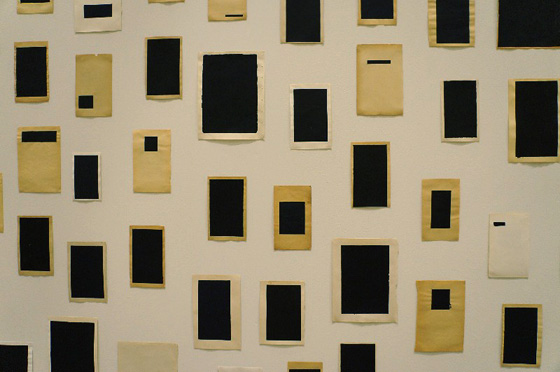 © colta.ru SIMRIN GILL, on the beach, 2012. Courtesy: artist / Tracy Williams, Ltd., New York
If you summarize disputes, there were two conflict faults. The first question is about politics in the broadest sense. Some complained that the project is uncritical, others said: well, well, enough radicalism, tired of us, give art, work with space! Of course, at the exhibition, which is protected by the FSO and is located at the side of the Kremlin, one can expect a radical attack against the situation in Russia, and figs in the pocket, and terrible censorship, and sedimentation in relation to the authorities - but none of the above. For example, Vladimir Medinsky came. Firstly, whoever he is , nevertheless he is the Minister of Culture, who simply is obliged to attend such events (and he himself, apparently, is also not particularly in joy). Secondly, his short performance , which is actually very funny, drowned out the noise. That Medinsky was there, which was not, it is strongly not important, he, in fact, was not noted in any way. As for the exposure, there were, of course, several works marked by signs of protest aesthetics - a paper demonstration with a bunch of protest slogans from around the world, including with Putin (the work of the Irish Tom Malliy), or a pipe layout built by Peter Bely, through which a certain thick substance is pouring from the Kremlin (I suppose, oil or shit, with anything else, with anything else. Is the place associated?),-but both of these works did not have any specific political vector. The same Mollya gathered a variety of protest slogans, such an undifferentiated explosion of emotions, and the figures of protesters, like slogans, were simply tiny for a huge arena. The work itself has an excellent name about nothing - “protest”. It looks like a parody of any political activity, however, a random parody. In general, there were no completely direct statements with criticism with criticism, as well as, on the contrary, cynical glee in connection with the position of things.
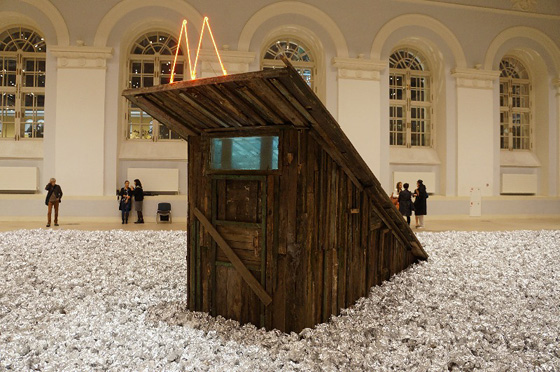 © colta.ru Alexander Brodsky, without name, 2013. Courtesy: Artist
The second factor who split the exhibition were sexist remarks, even before the disputes on Facebook, those who sounded at the exhibition itself: the curator was remembered by its gender, and art was defined as “female”, which meant in the lips of those who spoke and wrote: and there is nothing more to discuss here. ” It was this second conflict that was destined to become the hottest. However, another question-whether the exhibition was devoted to the position of women and men in modern society or the exposure of gender stereotypes, in general, whether it was feminist-they somehow did not particularly put it. Despite a certain number of work, which one way or another affecting this issue, in general, the main Biennale project was far from all this. And for me personally it was a surprise. This summer I had a private conversation with Catherine de Zeger (in general, she actively communicated with different people and was interested in this). Then she revived very much when she heard the story about the exhibition “International Women's Day. Feminism: from the avant -garde to the present day ” , especially one detail: in the process of preparing for the exhibition, the curators changed the series“ Female ”Victoria Lomasco - and this, according to her, is“ portraits of women with the recording of their dialogues about the female share ” - to sketches from rallies (which were ultimately removed from the exposition of the same curators), where there were a lot of slogans and bright ones and bright types, but there were practically no specifics of the existence of different gender groups in modern Russia. De Zeger was surprised at how many of her colleagues from Russia were surprised that the curators of the feminist exhibition were not interested in basic things, but superficial and, say conditionally, spectacular, - however, learning about censorship, she took this news calmer. Having talked with de Zeger, I suggested that she wants to show just such basic things, and at the exhibition I really found several similar works: for example, “fish traders” and “on the beach” Simrin Gill, or “On the arrangement of sleep of the sixth five -year -old” Alexandra Paperno, who talked about the life of Khrushchev, still relevant, or nostalgic project of Chinese artist Sun Duna "Do not throw it away!" - He collected things in his mother, accumulated over many years, and laid them out, very conditionally systematizing. However, everyday life and conditions of existence as a general mood at the exhibition were more likely by accident, and they did not have something specific from the point of view of the gender or, say, age.
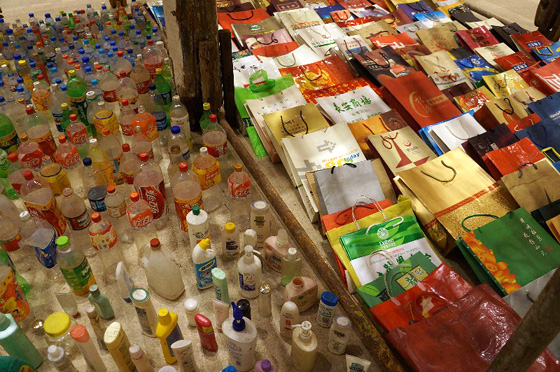 © colta.ru Sun Dong, do not throw it away! 2005. Courtesy: Artist / Tokyo Gallery + BTAP
It seems that this is an extremely closed project, and if you play with the name “more light”, then in this case the exhibition resembles super -heavy space objects that collapse and begin to absorb everything, including light, and therefore it is impossible to see them. More light is like Light Light. And this situation is far from new. It can be seen how the problems that Massimiliano Joni faced in Venice migrated to Moscow. From there, in addition, at least one artist and anonymous tantric drawings arrived. The work, it seems, were not repeated, but it was evident - especially in the case of tantric drawings - that the last Venetian project was taken into account. Meanwhile, the “encyclopedic palace” of Joni turned out to be (to speak very rudely, but accurately) with a landfill, on which, although you can find real pearls, in general it is simply unbearably difficult to engage in searches. Even the abundance of light, witty work could not correct the situation. In Moscow, the situation was slightly easier, since the Moscow Biennale did not have such a number of art and square meters of exhibition sites, as in Venice, but still: several really good works were lost in many works in no way related to each other.
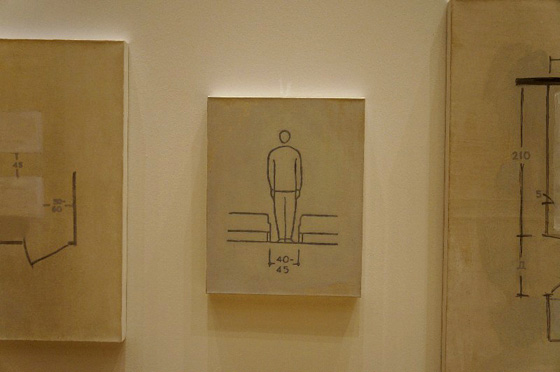 © colta.ru Alexander Paperno, On the arrangement of sleep of the sixth five -year plan, 2012. Courtesy: Artist / "Art Finance" (Gazprombank)
I would not say that the main project of the Biennale is incomparable, rather the opposite - there is something to look at, but it is decisively incomprehensible how one develops with the other and that all these works are doing together. It is quite expected for the fair, but for a large regular exhibition - no. In addition to the will of the organizers and the request of the Moscow authorities to the festival, no other unifying factors have been noticed. As Alexander Novozhenova correctly wrote, it makes sense to discuss “administrative and ideological circumstances” , in which individual work and curatorial statement are dissolved. The place and nature of the event, chosen by the “authorities”, dictated the choice of art up to the form of individual works made for space-and I recall the place, has a long-standing fair history, therefore, walking at the exhibition, the audience of Biennale, who had the experience of visiting the arena in the 1990s, recalled the art mif artistic fair. But this amorphous authorities are important not some kind of party line, but simply a large “festival of art”; They received it, but neither the curator nor the Biennale team was built on top of this request. The experience of this Biennale shows that, no matter how good the curator is, no matter how interesting artists, no matter how interesting, age -related and ethnic groups, the participants and organizers belong, no matter what political views they adhere to, the system of such events in Moscow turns any large -scale artistic activity into such a general collection of things - not hot, not cold, but warmly, but warmly, warm New Testament. And as Medinsky said in his bureaucratic dialect: “I think that the sixth, seventh and subsequent exhibitions will become even more serious.”
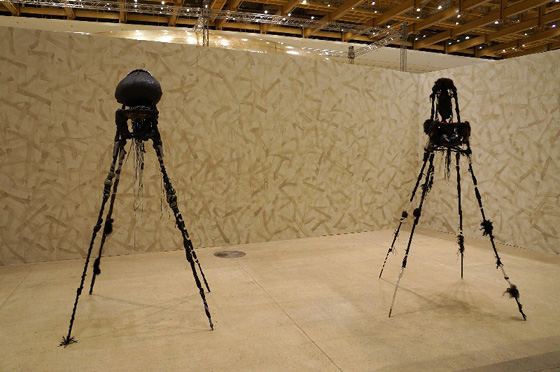 © colta.ru Vongechi Mutu, Black Trons, 2012. Courtesy: Artist / Gladstone Gallery, New York and Brussels