Date
Author
Александр Генис; Соломон Волков
Source

Preserved copy
Translated material
Pictures from the exhibition
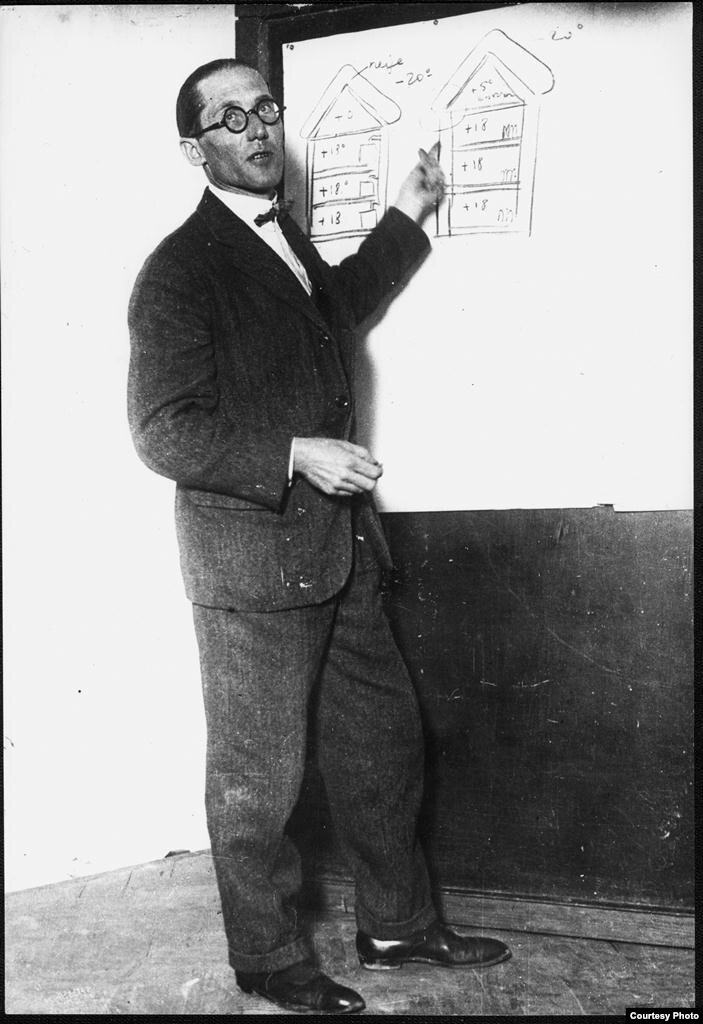
Corbusier in New York. The music of the Machine Age
Alexander Genis: Today, our traditional section will go to the second most important Museum of New York-Moma, the Museum of Modern Art, where an extremely important exhibition is held, dedicated to the work and personality of the great architect Corbusier.
The prologue to my campaign to the exhibition was the statement of the Corbusier, which was quoted by the American critic.
With hope and envy, peering into Soviet Russia, Korbyuzier wrote about Moscow of the 20s in this way: “The embryo of the New World, it carries the skeleton of the Asian village”.
Founded in a quote, I went to the Museum of Contemporary Art to the grandiose exhibition of Corbusier, which all summer tired by the long heat of New York residents of not only conditioned coolness, but also the spacious plans of the great architect.
On the one hand, studying architecture in the museum is ridiculous. Sketches, drawings, models and pictures withdraw a building from a natural habitat for him, whether it be a city or village. On the other hand, the Corbusier creativity in the museum and place. The author of 400 most of the unfulfilled projects most loved the “View of the top” and flew around the city (Montevideo, Rio de Janeiro, Barcelona), conceiving their restructuring. From the point of view of the pilot, God and birds, after all, everything really looks better. But, as Gorky showed, not only the east is not to understand the falcon, but also to the falcon - Tor.
Perhaps that is why I doubted the genius of Corbusier, which most clearly manifested in his theories. In them, he promised to replace the old cities with new ones: spacious, comfortable, green, concrete, simple, identical and faceless.
The Prophet of the International style, Corbusier dreamed of starting from scratch. Therefore, at the beginning of his career, he developed the deadly plan “Voise”, which provides for the demolition of 240 hectares of historical development in the center of Paris.
Fortunately, they did not listen to him, but the plans of the Corbusier, his students and followers, still prettyly changed the world. Another great modernist - Brodsky - spoke out on this occasion unequivocally:
Korbyuzier is in common with the Luftwaffe,
that both worked from the heart
Above the change of appearance of Europe.
That the cyclops will be furious,
then the pencils will soberly complete.
Brodsky can be understood. He grew up in a city with columns, and in a new light he lived in his old part: on a crooked street Greenwich-Vlaledge, in the 19th century fires, in the Brooklyn district, in a two-century hut of the university town of Mount Holocye, where he boasted guests with the width of antediluvian fruit fruits. Brodsky, however, preferred people with old ones, loving the appearance of those at whom the time signed wrinkles - Oden and Beckett.
After all, the years are not only taken away, but also added, especially the stones. And architecture is the art of circulation over time. The architecture is aging like us, but lives longer and often changes for the better. Centuries replace gray hair with a patina, ruins crown the landscape.
The durability of the architecture forces it to the coexistence of styles, which is often called eclectic, but it also benefits the old cities. Either rhyming, then fighting, the styles accumulate, turning into a unique ensemble, like a forest and a garden.
The best of them is the most beautiful area of those that I saw: Red. She really is all to face. And the Russian domes of the cathedrals, and the Renaissance teeth of the Kremlin, and the wild trick of Basil Blessed, and the gingerbread stylization of the historical museum, and the merchant baroque of the GUM, even the pagan pyramid of the mausoleum. Only the exaggerated simplicity of the cubic palace of the congresses infuriates the eye, like a steel fix on the face of a beauty.
This, of course, is no exception, but the rule. In almost every old city there is a glass concrete tribute of utopia in the form of a geometric figure that spoils the perspective. In my native Riga, this is a multi -storey Latvia Hotel, living in which is the only way to ignore it. The same monster is crippling the therapeutic sky in marvelous Charles Vara. Even Paris once surrendered, erecting the crazy skyscraper of Montparnasas.
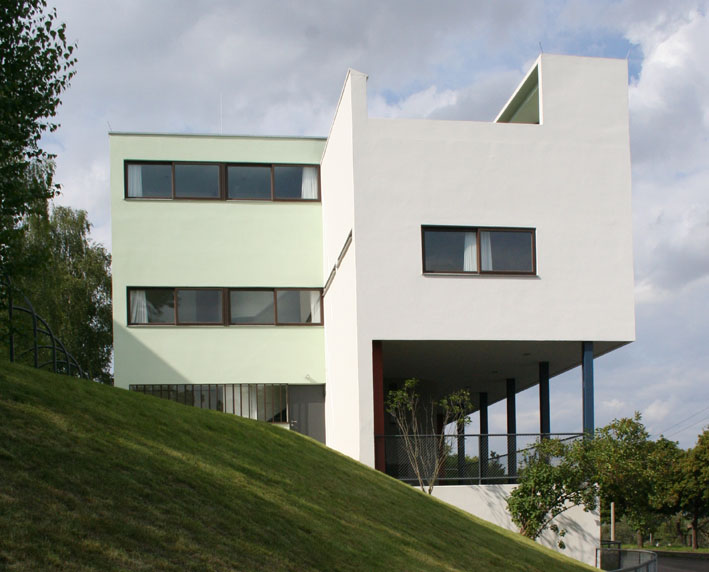
In essence, the Corbusier is only to blame for the fact that its aesthetics, announcing the house with a machine for housing, changed the fundamental metaphor for architecture from organic to mechanical. The tree grows, the car rusts. Inanimate in living can only be a prosthesis. That is why nowhere and never the architecture of the international style is appropriate. That is why the new buildings of the twentieth century who do not be able to age often resemble dead children: they can no longer grow.
Walking around the exhibition from one majestic project to another, I caught myself thinking that I would not want to live in any of these sunny, but devoid of souls and nooks of cities. The only house of Corbusier that I liked is the one that he built only for himself. This is Le Cabanon, Cabin, Wowl or Sarai on the Mediterranean beach of the resort cap-March. Having restored all the details, the museum transferred this miniature box with a narrow window, a lonely lounger and a table for two glasses to the exposition. This is housing, where he died, Korbyuzier loved most of all what he proposed to others. It seems that only here he found refuge from his own ideas.
Alexander Genis: We continue the next issue of “Pictures from the exhibition” with a musicologist and cultural scientist Solomon Volkov.
Solomon, I brought Brodsky’s poems about Corbusier and architecture, but I remember the statement of Brodsky and in prose, where he said that Bauhaus worked on Europe no less than the Luftwaffe. You have long dialogues with Brodsky, where did he get such hostility to modernist architecture?
Solomon Volkov: By the way, he, in general, had hostility towards modernism, in my opinion, was in the visual arts. And in music, with the exception of Stravinsky, he also did not like modernist music, he did not like Weberna. He had the tastes quite classicist with some exceptions that can be counted on the fingers.
Alexander Genis: At the same time, he himself was a modernist, let's not forget the main thing.
Solomon Volkov: You know, for some reason, I myself attribute Brodsky according to the department of classicism. Somehow it is associated with me with St. Petersburg columns. No?
Alexander Genis: I don't know. The fact is that Eliot, who was very close to Brodsky, he began as an avant -garde, and then came to classicism. Eliot is an avant -garde.
Solomon Volkov: Catholic classicism.
Alexander Genis: One way or another, but the classicism that the avant -garde swallowed is not at all the classicism that was before the vanguard. The same can be said about Brodsky. But Brodsky has a special hostility to the “international style”, it is to the antics in the spirit of the Corbusier. Once we gave him a coffee maker for his birthday, he loved good coffee, he had Italian tastes. The coffee maker was also Italian, in my opinion, very elegant. So, Brodsky categorically did not like it. He said that she looked like a shell of the First World War (the similarity was really), in short, he removed the gift from his eyes away. So he had hostility to the machine style and spirit always.
Solomon, I believe that the whole problem with Corbusier and his buildings, or rather, with his followers, because the world suffered most of his students, is that these architects were slaves of the car. Remember how Berdyaev said: “Man defeated nature to become a slave to the car.” So they became the slaves of the car. And in this regard, “housing as a machine for housing” is a rather frightening prospect. Postmodernism, in fact, was not in vain began with architecture, with the fact that the architects abandoned the metaphor of the machine, abandoned the slogan of functionalism “Ornament is a crime”. That is, they abandoned the idea of straightforward, square, geometrically simple architecture, which can be planted in any city in the world, and in any city it will be superfluous.
Solomon Volkov: I, unfortunately, all the time I stumble in the same New York on attempts to put another parallelepiped of glass and concrete. This all makes a depressing impression.
Alexander Genis: And I think that the Romans, when they built something, were counting on two hundred years-they had such an expiration date. And this architecture is already outdated now. But what will happen to all these skyscrapers, say, two hundred years later?
Solomon Volkov: They will not stand two hundred years old, that you are New York. Here, if the building stood 30 years, it is already outdated, it is demolished and erected by a new one.
Alexander Genis: Not really, Empire Steit Building is a work of art.
Solomon Volkov: There are, of course, buildings that are guarded.
Alexander Genis: And they are properly guarded, because Empire Stayt Bilding is art deco in its best manifestation. But in general, all this architecture has not been conceived for a long life. Because I can imagine the Rastrelli Palace in two hundred years, and the Central Union, which Corbusier built in Moscow, is already definitely not needed today, although I know that it is protected by UNESCO and correctly, because it is a museum value, a monument of the era. So, in principle, I, of course, agree with Brodsky, and I prefer the old city to be new always and everywhere.
Solomon Volkov: The most amazing thing in this is that when Corbusier built something for ordinary housing, then the tenants in these houses were terribly tormented not for aesthetic reasons, but for purely practical. Housing was supposed to be comfortable, but it was uncomfortable, it, say, was terribly heated from the sun. Strange: This man put forward its practicality by the criterion of high -quality architecture, but in practice its constructions turned out to be extremely inconvenient for life.
Alexander Genis: You know, this, perhaps, can be said about Marxism ... It is curious to draw a parallel with another great architect of the twentieth century Gaudi, who preceded Corbusier. In Gaudi’s houses, it is unusually convenient to live (the rich Barcelona still live in his residential buildings), because every detail is thought out there. For example, he foresaw that the person who opens the door to the house should turn the handle with his left hand, because he has the key in the right. And he has a handle on the door such that it is convenient to open it with his left hand, and not with the right. I would have erected a monument for him alone, a very subtle detail.
But, Solomon, let's move on to music. If you and I gnawed at the architecture of the Machine Age, then what will we say about the music of the Machine Age?
Solomon Volkov: Fortunately, the Machine Age music is essentially not. Music is still an art that cannot be built from materials that Kobyuzier would like. In music, the matter boiled down either to some extravagans, as you like to say, such as “one hundred metronome” at Ligeti, when they turn on and turn off in turn, or to the manifestos, which with the music itself echoed in a rather indirect way. But there were, of course, such attempts, because somewhere in the 20-30s of the last century the slogans about the cult of cars were very fashionable and we could have our help. Composers undertook this kind of experiments. Pasifik-231 is a very famous symphonic play of Onegger, which supposedly depicted a steam locomotive. Onegger, however, denied that it was a steam locomotive, however, the name was fixed and brought success to its opus. There were works like Ballet Prokofiev “Steel Skok”, also with such a glorification of machine in modern civilization.
This is a music that could conditionally be called futuristic. She has a very curious representative of an American named George Anteil, who was born in 1990 and died in 1959. He was born in New Jersey, but went to make his musical career in Paris, because there, in his opinion, and not in such a provincial outback as New Jersey, it was necessary to make a career then. He himself dreamed of following Stravinsky’s footsteps, which, according to Anteil, could be non -reasonable, became famous thanks to the grandiose scandal associated with the premiere of his “Spring Spring”. Antile decided to repeat the same story in Paris in 1923, that is, 10 years later. Thus, we can celebrate the 90th anniversary of this concert Anteil. He was not as famous as the premiere of “Spring Spring”, although the whole Parisian artistic society was present at this concert, there were Picasso, Stravinsky, Joyce, Diaghilev, and Marseille Duchan - an ultra -sharing audience. Antile, depicting naivety, was surprised, firstly, why did they all come there, and secondly, why they took all part in the Anti-Ballet of Antila, which erupted after the performance of the work of the Anti-Ballet. In fact, the casket simply opened: all this was conceived in advance as a scandal, and not only was conceived in advance, but the whole story was supposed to enter the French film, which was shot then. And they really shot an episode with a raging public, with Joyce, who shouted into the audience something like “all of you pigs” and so on. This episode brought fame to Anteille, but fame, according to Andy Warhela, for 15 minutes. Antile does not sound so often these days, although his music is not not indifferent. I want to show excerpts from two works of Anteil, in which he declared himself a supporter, if you like, “machinery” in music.
The first opus is a sonata called "airplane" composed by him at the age of 22. This essay preceded the “mechanical ballet”, which I was talking about now.
(Music)
Solomon Volkov: Another Opus Antila is also a piano play called “Mechanisms”, it also dates back to 1922.
(Music)
Solomon Volkov: Anteil did not continue to compose in such a style for long, he became a more conservative composer, but in the history of American music he remained as a young man who decided to conquer Paris and who in the end failed. Another remarkable moment of Antiral’s career, no longer musical, lies in the fact that during the Second World War he invented, there may be his tendency to all kinds of technical devices and machines found himself a way out, he invented navigation devices that direct the torpedoes to the ship, but, in my opinion, it was never involved in the US Naval Department.
And now I want to show another example of American music related to the machinery in musical creativity - this will be the work of John Cage for the prepared piano. That is, the piano was considered by Cage as a kind of mechanical device that can be modified. What is piano? This is such a large car, rather difficult, with all these hammers and other things. And Cage also improved it, or complemented, or complicated it with the help of all kinds of delays, records or other things that he inserted between the keys and between the strings of the piano and thus achieved a very peculiar effect: the piano in this dissected form or prepared form of Cage resembles the sound of harpsichord. Sonata No. 1 of the Cage for the prepared piano.
(Music)
Alexander Genis: Solomon, Korbyuzier, as you know, was passionately interested in Russia, he carefully followed all the architectural news of Russia. After all, then Russian architecture was probably the most advanced in the world. The buildings of Corbusier in Russia, as I said, are known, the Central Union building. And how did this hobby for cars reflected in music, which was so characteristic of Soviet Russia for the first years?
Solomon Volkov: You are right. Even, by the way, Anteil precisely as a representative of the machine direction in music enjoyed the famous glory in the Soviet Union. His articles, his manifestos were published as an exception, because the American composers of that time in the Soviet Union simply ignored, but Anteille was given some attention precisely because he so persistently declared his commitment to the image of all kinds in music, and this was a very fashionable topic.
The composer, who also worked in this direction, was the Leningrad author Vladimir Khiloshev. When I arrived in Leningrad in the late 50s and began to study music, they still remembered the cheaply, he was a St. Petersburg attraction, quite famous in the city by the author, but his glory days were behind. And his glory was very loud, in certain, of course, circles - in the circles of advanced proletarian musicians. He was opposed to the dull Tchaikovsky and boring Beethoven. And they said: “Our listener does not want to listen to the dull of Tchaikovsky and he becomes bored from Beethoven to the foulor. And the works of our author, an advanced modernist with a proletarian bias of Vladimir Khhnevyov, a working audience, wrote in the magazines of that time, they meet with enthusiasm.” An example of such music is the piano play of Khskhnev called “Rails”, composed in 1926, which will be performed by the pianist and composer Anton Batagov. I am sure that this music is cheap, this work called "rails" would definitely like Le Corbusier.
(Music)