
Translated material
Crossed with lemon
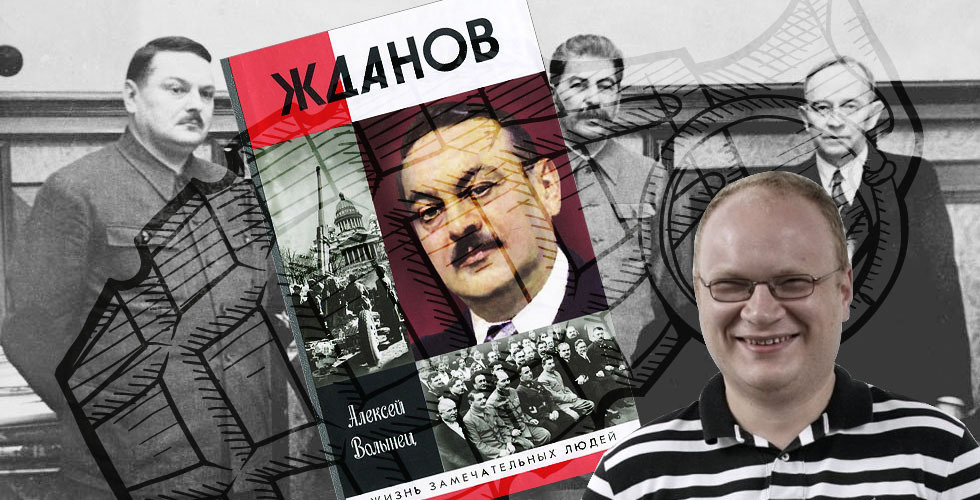
In the ZhZL series, Andrei Zhdanov’s biography was released, and to whom I tell about this, everyone react equally - they say, the very compilers of the series have gone crazy, so they have a wonderful person Zhdanov. In fact, the word “wonderful” is not at all equal to the word “good”; Wonderful - this is noticeable, notable, and these criteria of Zhdanov, of course, meets more than completely. The influential employee of Stalin, the party governor of the pre-war and blockade Leningrad, the founder of the Cominform and the ideologist of the Cold War from the Soviet side-even as the persecutor Akhmatova and Zoshchenko Zhdanov, of course, deserves at least a few detailed books about him, and if it is worth surprising something, then first of all, there were still no such books. An indicative joke from the new biography: Finnish memoirists (and after Finland left the war, Zhdanov headed the Allied Control Commission with the participation of the British in this country - do they know about this?) They described the first meeting of the Soviet representative with the president of the Republic Karl Gustav Mannerheim - human contact was established from the first minutes of the conversation when Zhdanov informed the Finnish The president that “had the honor of serving” on the Romanian front during the First World War precisely in that Cavalry Corps, which was then commanded by the Russian General Mannerheim. Zhdanov even remembered the corporal of Polishchuk, who served in Mannerheim in those days as a personal driver, and it is not surprising that those who promised to be difficult are the negotiations of the two former enemies in two heavy wars suddenly turned into a warm meeting of old combat comrades.
The joke, however, lies in the fact that Zhdanov never was on any Romanian front, his participation in the “imperialist war” was limited to the Tiflis school of warrant officers and several months of stay in reserve, and the names of Mannerheyov soldiers and officers Zhdanov learned from the certificate, which was prepared for him for those negotiations in Moscow. Such stories-I gave myself out not for who he was, used the “legend” compiled in the center-are more suitable for the biographies of scouts, and not politicians from the top 5 of the leadership of the largest power of the world, but in the twentieth century it happened (and, by the way, it continues and whether we really know about the current Russian chiefs, including Putin?), In the Kremlin, people were sitting without biographies, in the Kremlin, in the Kremlin. The past of which for decades could be indicated by the powerful means to mean phrases such as “engaged in underground work”. People who came from nowhere, in whose hands the highest power in the former Russian Empire suddenly found themselves - we still do not really know and do not understand anything about them.
Joseph Stalin studied at the Tiflis seminary in textbooks written by Santa Zhdanov, rector of the Moscow Theological Academy Pavel Platonov-Gorsky. Perhaps this circumstance explains Zhdanov’s proximity to Stalin more exhaustively than the better story about the marriage of the daughter of Stalin Svetlana and the son of Zhdanov Yuri. It is also possible that the role of the main Soviet composer, the author of the anthem of the USSR and the “sacred war” and the head of the world-famous military-music ensemble went to Alexander Alexandrov not only because of his musical talent, but also because it was he who once worked in Tver by a teacher of music by the future Bolshevik chief of all Soviet composers Zhdanov. Such connections between people are described at least Soviet, at least any story is much more precise than any formal biography, and just the abundance of just such details - the main dignity of the Jesaele book about Zhdanov.
And her main drawback is her author, Alexei Volynets, a veteran of the National Bolshevik Party and a long-term, until its closure, the editor-in-chief of the newspaper Limonka. What is insanely annoying in the book of Zhdanov - Volynets writes about Zhdanov not as an object of academic research, not as a man buried under black granite near the Kremlin wall of the two -time man, but literally as his party comrade. One of the chapters of the book (apparently, for the sake of her was written) is even called “National Bolshevik Zhdanov”, and a little earlier, telling about the Bolsheviks of the 1917 Lenins, Volynets calls them “radical social democrats”; I remember how ten years ago one of the National Bolshes of the “Volynza circle” (the Limon Party also divided into factions and groups, although they were prohibited in it) precisely this expression in a conversation with me called himself and his Sopartians, and then, acting as a witness in the next trial of the National Bolsheviks, I repeated these words - the judge asked if I thought it was extremist, I answered: “that I answered: You, your honor, are just radical social democrats. ”
“And to this day, at the beginning of the 21st century, the theses of Comrade Zhdanov are relevant” - and even if they are really relevant, I want to launch it with my own book in Volynz. "Yes, you went to Zh*Pu!"
The National Bolshevits is ready to justify the National Bolshevy Zhdanov in everything. Attack on Akhmatov? Volynets takes the biography of the Zhdanovsky colleague Andrei Andreev and indignantly indicates that "the daughter of the St. Petersburg official Anya Gorenko wrote bohemian poems just at a time when he, the son of a poor Smolensk peasant, worked as a dishwasher in the Moscow tavern." In another chapter, Volynets writes about Akhmatova’s “very free personal life”, which, of course, could not like the sample familyman Zhdanova. So that Zhdanov does not look like the opponent of poetry as such, Volynets tells in detail about the old Tver peasant poet Spiridon Drozhzhin, whom the Tver Bolshevik Zhdanov in the seventeenth saved from the Socialist -Revolutionary influence. Volynets quotes Drozhzhin’s poems - “What is this bad weather, cold, winter snowstorm, when a chisel is waiting for me, a young girl is a young girl” - and writes that you can understand Zhdanova, to whom this real poetry (the yeast Volynets calls “Diligently forgotten poet”) was closer to Akhmatova’s salon poems and the Silver Age Standard imposed on us ”. A sort of lemon in Akhmatov, if we use the terminology of the newspaper from which Alexei Volynets came to us.
The same thing is about Zoshchenko-the National Bolsheviks is completely sincerely treated by the “self-digging” story “before sunrise” as something unacceptable, if not criminal, in the difficult war years. “This is in our prosperous time, when other people's bombs do not fall on top, well -fed lovers of this type of creativity have the right to appreciate the reflection and self -digging of Zoshchenko,” and during the war, such prose did not cause such a “warring majority” nothing but “fair irritation and understandable anger regarding the spiritual deserter,” this is not a quote from Zhdanov, this is a Volynets, and he is not no one from himself. Palais, this is quite in the spirit of the "lemon" nineties. And in an attempt to conduct a science narrative, the Volynets breaks into the chancellery of a schoolchild writing an abstract: the wife who left Zhdanov returned to him, of course, “after a number of years”, but the book that we read is not just a book, but, of course, “this book”. But the Volynets language speaks the language of the party report perfectly: “And to this day, at the beginning of the 21st century, the theses of Comrade Zhdanov are relevant” - and even if they are really relevant, I want to launch it with his own book in Volynz. "Yes, you went to Zh*Pu!"
And if without curses, but just in Zhdanov’s, then it is worth saying that Comrade Volynets showed ideological immaturity and political infantilism in the work on Zhdanov’s biography. The teenagers of the nineties (judging by myself) loved such plots-this is the Minister of Foreign Affairs of the Bourgeois (for some reason the Volynets calls it “self-plating”-apparently does not know how “independent” will be “independent” in Estonian), Estonia cries at the window of his office, when Soviet tanks enter the city, here the warships go according to the magnificent hydraulic construction-White Sea (human victims? Excuse me, but “no one remembers that in terms of the number of victims, Belomorkanal is quite equal to Panama” ”), here the children's choir sings the“ Song of Zhdanov ”(“ The cult of personality is an effective means of controlling the patriarchal society ”) and so on. Almost in every chapter, Volynets uses the “Black Legend” turnover - about Zhdanov in the blockade, and about Zhdanov’s relationship with the creative intelligentsia, and about “courts of honor”. Zhdanov in Volynz is a “second Lunacharsky”, the best friend of real writers (Volynza is offended that in modern Russia the reader is “actually deprived of” the books of Peter Pavlenko and Leonid Sobolev), he was probably collected by the Biology, but against the backdrop of Volynza’s reasoning that the “kulaks” was correctly killed and the red terror was the red terror. Fair, even the biological library of the unfinished student Timiryazevka Zhdanov is outraged. What the hell is at all, huh?
This is the most offensive to the reader-to find out the really fascinating story of the transformation of the provincial Russian intellectual, the son and grandson of the famous theologians, in a small dictator, you need to wipe through dozens of pages of parodiably sounding even Levatsky, but extensive non-Soviet manifestos. Only at the end, when Zhdanov dies, the Volynets turns off the national bog and turns into a normal writer. The penultimate heart attack, nitroglycerin does not help, Zhdanov shouts at the top of his voice - “Oh, my priests!”, The bedroom is closed, but he cannot get up, and the chief of security, Major Belov, knocks the window with an ax - terribly.
But there are no more than a dozen such pages in the book. Everything else needs to be transferred from National Bolski to the human. In 1948, the son of Zhdanov, in 1948, ruined his party career, speaking with unauthorized criticism of Trofim Lysenko, a famous story and described in many books. A pretty detail: it turns out that his father warned Zhdanov Jr. that it was not worth climbing in Michurin's science: “Do not contact Lysenko, he will cross you with a cucumber.” “I did not listen; He crossed it, ”adds Yuri Zhdanov, but we know that this is not the limit of human capabilities-it turns out, and Zhdanov Sr. can be crossed with lemon. Alexey Volynets crossed.
Alexey Volynets. Zhdanov. - M.: Young Guard, 2013. - 619 [5] s: ill. - (Life of wonderful people: ser. Biogr .; Issue 1436)