
Translated material
UNESCO? And what about UNESCO?
This interview has a long background. Not at all Galina Ivanovna Malanicheva was supposed to become his hero. In June of this year, I had a chance to visit the academic meeting, where the materials were discussed for the report of the Ministry of Culture on the state of cultural heritage objects in 2012. Materials were prepared by the Institute of Cultural and Natural Heritage. D.S. Likhacheva (one of the five long -suffering institutes of the Ministry of Culture), and represented by their deputy director and institute Pavel Shulgin. Immediately at the end of the meeting, I asked Pavel Matveevich in detail to comment on the future ministerial report for a voice record. Upon learning that it was a non -state publication, he gave his face a state expression and with restraints said: “Call.” On the phones of the Heritage Institute, I honestly called two months - until the end of August. Sometimes Pavel Matveevich personally honored the answer, sometimes we talked through the secretary. The answer was always the same: call tomorrow, better in a week. The secretary of the institute, the sweetest, presumably, the lady, asked me not to be offended: the institute is going through difficult times, enlargement and optimization, you understand, all on the nerves. In response, I tried to explain that if the institute wants society to protect it or at least learn about its existence, you need to learn to talk with society. In the field of heritage with those who make decisions, or at least they can influence the decision -making, talk - non -state media is generally extremely difficult. In a word, what are the heirs, these are the problems with the legacy.
- I propose to simply recall some events of the past summer - of those that are directly related to the protection of our main cultural monuments. In June, the next UNESCO session was held, Russia was going to nominate the cities of Sviyazhsk and Bulgarians on it for inclusion in the World Cultural Heritage list. Then, however, they refused Sviyazhsk, but the Bulgarians were not discussed at the session. So the objects were unsuccessfully chosen or did Russia do everything so that they would not be allowed even before the review stage?
- So, it did not work, and I think Russia did everything so that these objects reached UNESCO to the discussion. An unsuccessful choice - no, is also unlikely. After all, how is the preparation for nomination in the UNESCO list? There should be a readiness of some object, but most importantly-there should be people who recognize its value and want to give this monument an additional security status. The impulse here is always a public initiative: local historians, the society of the protection of monuments, art historians, architects, restorers. These people push local authorities to go out to a higher level. Here the enlightened public of Yaroslavl for a long time pushed the city’s authorities for such a decision, I remember very well how it was. The authorities themselves, of course, will never hang an additional clamp on their neck. For the executive branch, any security status, even the inclusion of newly identified objects in the list of monuments, is a burden. These are undesirable things for most regions, because behind the security status is a special regime for using this territory, additional, protecting the historical development of the obligation.
- In the same Yaroslavl, not only additional, but the main obligations do not oblige the city authorities to do not oblige to anything - in the historical center of the city, included in the UNESCO list, a remake is being built, international experts, together with social activists, are anxiety , but the state is not going to answer for violations. It turns out that UNESCO status does not guarantee anything?
-You are talking about Yaroslavl, and I will add here both St. Petersburg and Kazan. Now this is a way to destroy the monument: not to destroy it, but to build up. And this destroys what, in fact, protects this status of a particularly valuable object. After all, it is not for nothing that UNESCO is not included in the UNESCO list, not some separate palace or church-the entire city center, species points, the ensemble are included. Such was our main argument when we, Voypiik, opposed the development of the Otinsky cape. In a word, getting on the UNESCO list is very honorable, but often this does not help the monument. They love us to close as possible with the development to the monuments. And what? UNESCO sends experts, experts write conclusions. UNESCO will not accept our laws for us and will not fulfill them.
-Nevertheless, for the right to see our objects on this list, we are still fighting-or we pretend that we are fighting. It seems that officials who prepare documents for nomination in the UNESCO list specifically do everything so that this object does not pass.
- No, of course, this is not so. If only because the passports of objects are trained by specialists. Directs them - yes, the executive branch. But without a historian and architect, the authorities will not be able to send anything there.
- Why, for two years in a row, our complex object of the Kremlin of Russia (Uglich, Astrakhan and Pskov) does not pass through the UNESCO filter?
- Frankly, I don't know. Most likely, we simply defend the technical design of documents by purely. But I do not see here the evil intent on which you insist. They didn’t hit - it's okay, they will get in the next entrance.
We know that very bad. Inside, we overlaid with a mass of bureaucratic barriers that they do not allow us to move. Can you imagine what approvals are needed to include the object of heritage even in our internal register of historical and cultural monuments? A cadastral passport is drawn up, it does not say that this is an object of cultural heritage. Then suddenly the construction is allowed at this facility, but we cannot interfere - it has not yet been entered in the register of monuments. According to the law on the protection of monuments, something is impossible, according to the Town Planning Code-it is possible. And smart and cunning customers and investors will certainly find the path that makes their violations legal. We are talking about illegal development, but it is legal from the point of view of one law and is illegal from the point of view of the other. Here we have the main difficulties.
It is not always possible to go against the decision of the higher leadership.
What should adjust this sphere of land relations, construction initiatives and the protection of monuments? It is clear that the law. Our Federal 73rd Law "On Cultural Heritage Councils" is in need of refinement. And in 2009, with the active participation of VOOPIIK, a project of its changes was prepared. This project lies with a dead load on the account of the second Duma. The previous Duma could not accept him in any way, beyond the first reading did not advance. And now I have been crying for different people for the third year: these additions to the law are simply necessary. I don’t understand why this is inhibited. I can only guess.
- Does such an authoritative public organization as yours have the opportunity to directly contact, say, to the Duma culture committee?
- Of course, there is. Which I did repeatedly.
- Why don't they hear you?
- I don't know yet. I think the committee supports us, he is for these amendments to be accepted, but he has his own work plan until his hands reach us. There are other, more important laws that require attention.
- I pay tribute to your irony and your patience. What would you call the main thing in these urgent changes in the law?
“Firstly, the rule of the law on the protection of heritage over all other documents governing relations in this area,” I mean primarily the land and urban planning codes. Secondly, the mandatory coordination of any construction with the state bodies of the protection of monuments. We, alas, are far from always.
- Do you believe the state bodies of the protection of monuments? The same mosgorna?
- In general, of course, I believe. But only to those where professionals work, and, believe me, there are a lot. And the policy of the Moscow City Council is aimed at preserving the monuments. But, like other state security bodies, the Moscow Committee suffers from the fact that the construction with us is more priority than the protection of monuments.
- There is no doubt about the professionalism of people working there, there are doubts about their moral cleanliness. The psychology and morality of the official are such that he is always on the side of power.
- Of course, any state official fulfills primarily what he should do in his place. He obeys discipline. At the same time, the matter can be done differently. I must say that the Moscow City Council is the strongest body of the protection of monuments in Russia. Does the Mosgornovy have mistakes? Certainly. We are talking about the past summer, and I, like you, will immediately name the last two: the circular depot and the house of Bolkonsky. Of course, it was necessary to defend these buildings. But it is not always possible to go against the decision of the higher leadership.
I don’t understand why this is inhibited. I can only guess.
- This is about this: the official is observed by the interests of the state, and the protection of monuments is not a priority for the state.
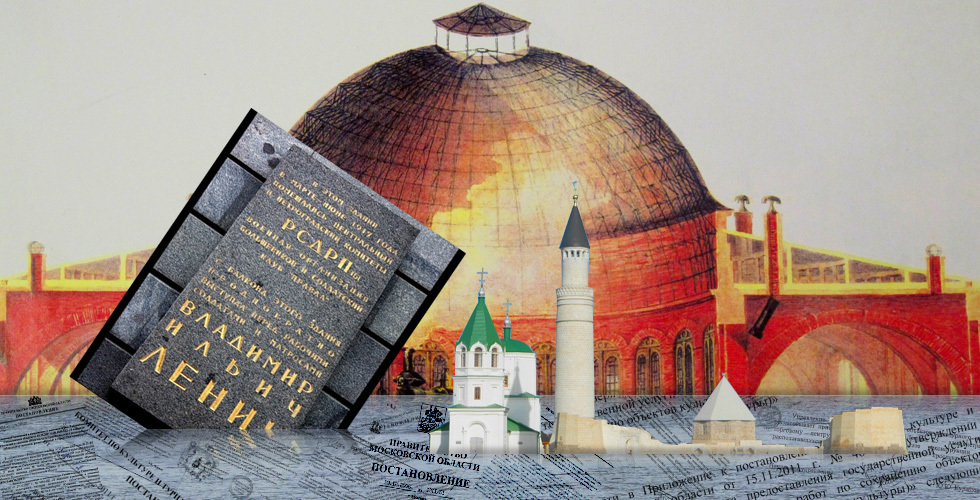
- Like culture as a whole, unfortunately. But you are comparing all the time with the western situation, and I can’t help but remember how it was in the Soviet years, when the attitude towards culture was exclusively disregard and only the board “in this building, Lenin spoke to workers and sailors” helped to save him from demolition. When now there were so much to talk about cultural heritage at the highest level, we need to value this and grab these ideas.
- Speaking of a high level. There was information that the St. Petersburg authorities, with the support of the Foreign Ministry, were going to petition for UNESCO to remove the security status from the suburbs of St. Petersburg.
- I do not have this information, but it does not seem completely unreliable to me. It may well be - precisely because you are on the UNESCO list extremely burdensome for the authorities. But the public will never allow this.
- But this is not discussed with the public.
- Nevertheless, journalists and civilian activists will know everything, but in St. Petersburg, city -defenders are very active. And then, the UNESCO Committee, too, will also not delete something from the list of world heritage, there are still other principles. So they will help the public of St. Petersburg, there is no doubt.
- In the international bodies of such a rank, Russia, Russia, has a very shameful reputation? After all, the cynicism of our authorities in relation to cultural monuments is not only European, but, it seems, by Latin American standards. It's time to call for the boycott of the Olympics and for this reason, too, isn't it?
Do not get on the UNESCO list - it's okay.
- That's what I will say to it. We seek from the executive branch to resolve a particular issue on the basis that we discussed all this with specialists. We, Vopiyk, have such a task - that their opinion be taken into account. And when this happens, when experts are listened to, then the image of the country does not threaten anything. When the official makes a decision without looking back at specialists, then troubles begin with the image. As for our restorers and architects, our best specialists are quite a world level. Yes, they work constantly in contact with Western colleagues.
- I want to understand the sphere of your authority as a public organization. Ten meters from the wall of the Novodevichy Monastery, another object from the UNESCO list, are going to lay the next church. I propose not to discuss how much the church is needed next to the monastery, but it is obvious that it will change the atmosphere of this place. The Moscow City Council is silent about this, although in personal conversations I had to hear sighs: oh, how bad it is, well, you understand everything. Do you have the opportunity to prevent this construction?
- First of all, there is a security zone and a special regulation for construction. Thanks for the signal, we will understand. In general, I must say that the Moscow Government Commission on the preservation of cultural heritage objects works, and works actively. I think in the near future we will consider this issue. Necessarily.
- Is it possible to influence the recall of the licenses of those companies that have established themselves as unscrupulous builders at cultural heritage sites? So that the company Baltstroy, which was disgraced by Izborsk last year, had no chance to build a remake in the territory of the Trinity-Sergius Lavra, as they do now .
- To deprive the license or bring the company to the list of unscrupulous performers - this is due to great difficulties. But according to the Izborsk, the assessment is ambiguous, the director of the Izborsky Museum praised their work.
-And the Pskov Vyopiik, your colleagues-socialists Irina Golubeva and Lev Schlosberg hotly fought with this pseudo-storage . The director of the State Museum is obliged to love what the state does. The Patriarchate also vigorously answered Sergei Gavrilov, the former chief architect of Lavra, that the construction of a five -story building building for the Moscow Theological Academy was agreed, and all floods and incorrectly laid pipes were agreed with it.
- According to Sergiev, Posadu must be asked the Ministry of Culture. Lavra is an object of the federal, moreover, a monument to UNESCO. It is impossible to build without coordination with the ministry there. On what basis was the coordination of the Ministry of Culture issued is a question. And there is not one official sign this, this issue is considered on the scientific and methodological council. At least it should.
- Do I understand correctly that there was no such advice with the participation of your specialists?
- It was not. Although I am a member of the Presidium of the Scientific and Methodological Council under the Ministry of Culture.
- The television cameras showed you on the night after the headquarters of the newly elected governor of the Moscow region - at the very moment when Andrei Vorobyov and you raised glasses with champagne. At least one near Moscow, your glass will help save your glass?
- Hops after champagne for a long time disappeared, and the attention of the new governor to the monuments of the Moscow Region remains. Andrei Yuryevich traveled almost all historical cities and museum complexes of the region and have already done a lot to solve the problems that accumulated there. He understands what to do to preserve the unique cultural and natural heritage of this region. My task is to help in this new governor.
PS from materials to the state report on the state of cultural heritage objects (historical and cultural monuments) of the peoples of the Russian Federation as of January 1, 2013
“As of January 1, 2013, the total number of cultural heritage facilities was 130,662 units on state accounting, of which 125,523 are monuments, 1,3502 ensembles, and 1,637, there were another 18,868 monuments as part of ensembles, and thus the total number of monuments was 144,391. <...> <...> <...> <...> <...>
In the field of accounting of historical and cultural monuments, there are serious problems. In a number of regions of the RSIS Federation, the process of putting cultural heritage objects for state registration and protection actually stopped, for many years the list of cultural heritage objects that have been on state accounting is not replenished. <...> In 2012, out of 83 constituent entities of the Russian Federation, only 19 entities were put on state registration of new objects of cultural heritage, and 64 constituent entities of the Federation did not put a single monument for protection. At the same time, in the lists of identified objects of cultural heritage, these regions have a very significant number of historical and cultural monuments. <...>
The share of buildings and structures, monuments of monumental art and other objects (except archaeological), which have a good and satisfactory condition, according to the regional heritage protection authorities, is 54%. 13%have an unsatisfactory condition, and about 4.5 thousand objects (5%) have an emergency and ruined state. There is no information as of 28% of the monuments, which is an alarming indicator. In satisfactory condition, 31.7% of archaeological monuments are located, the rest are either in a state of destruction, or there is no information about them. At the same time, many experts indicate that these indicators are overestimated and in satisfactory condition there are only 30 to 50% of the cultural heritage. <...>
Some Russian objects of the World Cultural Heritage were on the verge of violation of their authenticity and integrity, which not only caused anxiety among Russian experts, but also attracted the attention of UNESCO experts. Among the problematic volumes, Yaroslavl should be attributed first of all. <...> There are problems with the promising representation of Russia in the list of World Cultural Heritage. <...> Since 2005, not a single cultural heritage object in the Russian Federation has replenished this list, the plan to expand Russia's participation in the cultural heritage of UNESCO needs a serious additional analysis, first of all, the development of a clear, scientifically substantiated concept of the nomination process is required. <...>
The total funding of the work on the preservation of cultural heritage objects amounted to 32.4 billion rubles in 2012. (in 2011 - 28.6 billion). With an average calculation for one monument, this is only about 225 thousand rubles. About 750 thousand rubles were spent on one object of cultural heritage of federal significance, about 110 thousand rubles on an object of regional significance. <...>
К административной и уголовной ответственности за совершение противоправных действий в отношении объектов культурного наследия в 2012 гду было привлечено 534 юридических лица, 191 должностное лицо и 317 физических лиц. При этом 60% мер по привлечению к административной и уголовной ответственности пришлось на регионы Центрального и Северо-Западного федеральных округов».