
Translated material
The birth of a new race
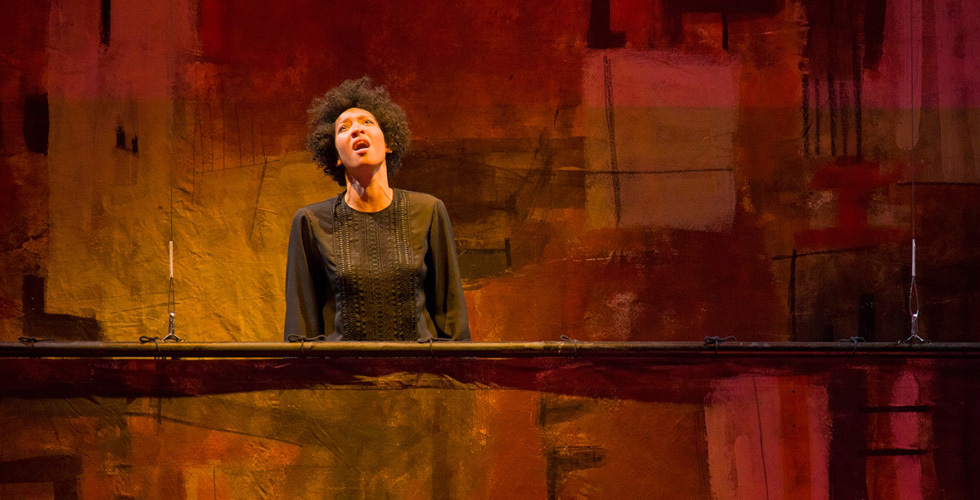
Officially, the opera is called the “Queen of the Indians”, its author is Henry Persell, the British composer of the 17th century. But actually, Persell does not have such operas-there is an hour with a little music for the play by John Draden, where the Incas historically inaccurately fight Aztecs. And that performance for three and a half hours, which turned out now in Perm, has no such direct relation to the old baroque genre.
First of all, this is an example of a new art - even, probably, not today, but tomorrow or afterlife. Nothing similar - in the freshness of thought and musical perfectionism - there was no in our musical theater. Although in this case it is pointless to use geographical restrictions, of course, the “Queen of the Indians” is a fact of world culture, and a very important (premiere in Madrid, with whom Perm in co -products, already in November).
There is no aggression and provocation in this art, various shades of tin do not savor in it, but there is incredible power, confidence, freedom and joy.
Although the new libretto, re -composed for Persella's music (which has become more due to inserts from other works, including the famous Music for a While ” ), not at all serene. Its author is American director Peter Sellars, a legend from the twentieth century, cheerfully stepped into the twenty -first. The famous freak with a hedgehog on his head, with happy eyes and bouques of beads over the colored shirts lived in Perm for a month and a half - which in itself amazes the imagination - and found ideal associates in the local theater and ballet.
And the point is not only that since last year’s Madrid “Iolanta/Persephons” it became clear that a new tandem had developed: Sellars - Kurentzis. Both are ready to lead their flock no more than in a bright future, both of the rituality on the stage are sweeter than entertainment. But in addition to the Curensis in Perm, there is also a baroque orchestra of a completely world level (O'Kay, with imported specialists) and most importantly-the miracle-chor (chormaster Vitaly Polonsky), the level of which in this work is not measured at all. Because he is sky -high.
 © Alexey Gushchin
To sing Persell's brittle passages, lying on the floor and looking at the ceiling, but not at the yota, melt and erase, but still to be audible every of its incorporeal sound, breathing like one whole - this is not all that the production took place. To breathe together not only with Persella’s music, but also with the witchcraft of Sellars, live in it, dissolve in it, believe in it and learn his strange, magical plastic - this is what was required in this case and what was carried out. The choir became the main character of this fantastic event, although, it would seem, the exotic casting of soloists did not leave such an opportunity.
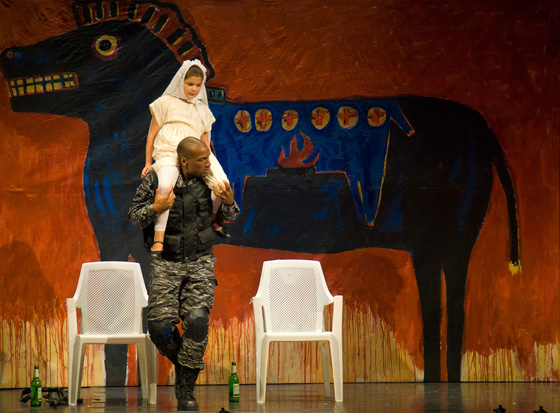
In the new libretto of Sellars we are talking about the times of Conquista, about the bloody conquest of the Spaniards of the Indian tribes - as well as, of course, about us. By accident or not, but one of the Spanish conquerors, Don Pedrarias Davil, is played by a white -skinned tenor Marcus Broucher, and the other, Don Pedro de Alvarado, is black tenor Noah Stuart, characterized by incredible beauty and athletic physique (which is important, because erotica is not a shame and a powerful and excellent component of the performance). In military uniform, with machine guns or bottles of beer in their hands, they seemed to come out of American television news.
The world of the conditional “white race” with a pair of plastic chairs is opposed to Mayan civilization with an endless number of panels of the American artist Granny, immersing in bright, thick, ancient, alien cosmos (there are no usual decorations in the play).
The central theme of the performance - one might say, is just love Story . The dark -skinned conquistador gets the daughter of a local leader, the “Queen of the Indians” named Newchuatzin, who is converted to Christianity and called Donya Luisa, this role is played by a white -skinned American with a Latin cut of the eyes of Julia Ballock. From the clash of cultures, pain, and misunderstanding, and love, and the first child of the mixed race are born, on the behalf of which important words are pronounced at the end of the performance: “Sometimes I wove into Christian prayers poems that my mother quietly sang to me. Who am I? What kind of race am I? Which of the two blood flowing in my veins has great power over me? Or am I belonging to a new race that did not exist before? I look at the Mayan mirrors and do not find an answer. My skin is rather white than dark, the figure is slim, and everyone is talking about my extraordinary beauty. The mirror reflects my image, arising, changing, conquering space and time. Am I really a forerunner of a new race? "
Sellaars inserted texts from the novel by Nicaraguan writer Rosario Agylar into his performance “The lost chronicles of Terra Firma , written in 1980s. They are read by the dramatic actress Maritxell Carrero and, despite the English language, are a very significant semantic component (the Russian translation for the credits was done not by anyone, but by Vera Pavlova). In addition, there are four dancers of different sexes, races and sizes with the plastic of Mayan gods (choreographer Christopher Williams), two excellent counteratradora (Christoph Dyumo and Vince and), inventive costumes (Dunya Ramikova), dizzying light (James Ingalls) and a special bunker - the next millimeter modeling of the female party, which loves to carry himself to carry himself to carry himself. And his audience Theodor Krentzis. This time he was engaged in this with his new favorite Nadezhda Kucher (last year’s “golden mask” for the best female role) in the role of sacrificial Donya Isabel, the wife of a white -skinned conquistador.
In short, if Mariinka-2 is the only opera theater of our country, where there is a feeling that you are in Europe, then the Perm Theater is the only one where there is a feeling that you are in the 21st century.