
Translated material
Protest in quiet Norway
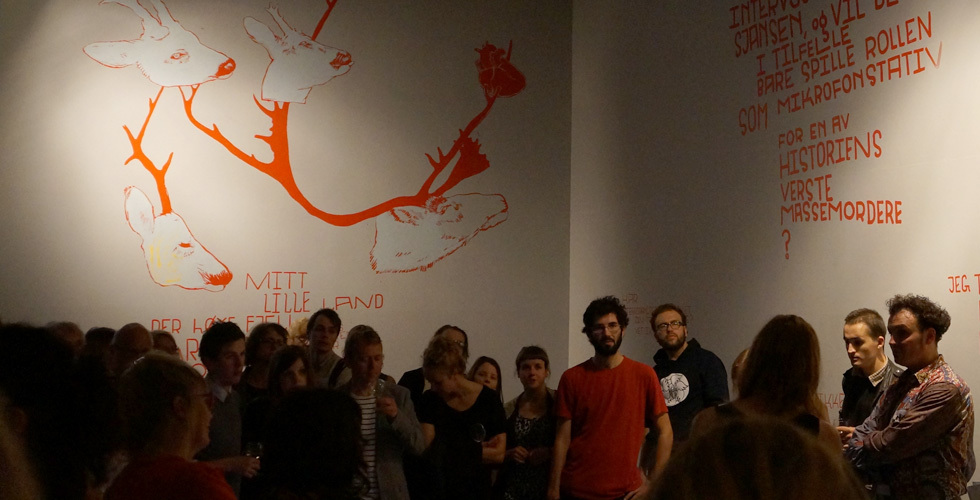
Six months ago, the curators Marita Muukkonen and Ivor Stodolsky told in an interview with Colta.ru about the then project that was being prepared, the name of which was always changing-only the word re-aligned remained unchanged, although there was also no consensus about the translation of this concept and, apparently, it still has not been. I think that the semantic filling of this Re - Aligned is changing all the time. For the curators who made a gypsy pavilion in Venice, and now move around Eurasia with a new long -playing project (you can see the migration routes on the map), such instability is quite organic. This nomadic aesthetics is close to me.
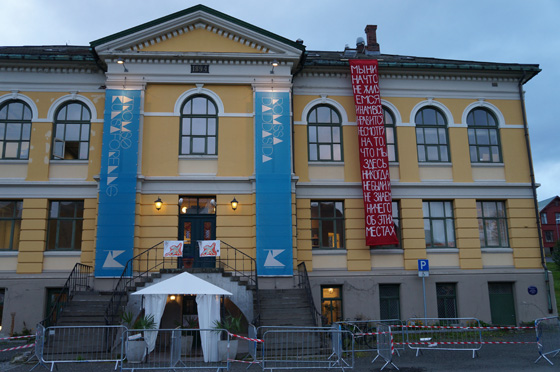
In the relatively small Norwegian city of Tromso, located behind the Arctic Circle and at the same time a very important location for the country-historically and in fact, goes through one of the stages of the project, which is currently called the Re-Aligned Art -or, as translated in the official booklet, “re-engaged art”, although there is also an earlier “newly connected”. In the Museum, Tromso Kunstfordining, which stands in the middle of the lawn on a slope and looks like high school, gathered artists from the European Union, Russia and Ukraine (artists from Belarus were also in the list of participants, but they seemed to be personally present). The Norwegian word "kunstforcing" , present in the name of the museum, literally means something like " art Association " or " Art Society ” , that is, not a standard exhibition hall, Kunsthalla, but an institution that arose as a local self -organization initiative - approximately as different geographical or mathematical societies were created. In Norway, there are many artistic establishments of the same type as this museum in Tromso. And it was this space that became the main site of the project, which included the exhibition and the discussion program. Both requires explanation, since the museum was presented and discussed by activist and protest art.
 © colta.ru
As for activism, any activism is perceived, by and large, in two ways, or rather, even like this: adequate, according to prevailing ideas, two forms of its representation seem. Firstly, actually participation in shares: often direct witnesses of shares feel like participants, if they did not prepare them or even tried to counteract them. Any action is a reality show in which everyone who falls into the "defeat zone" is involved. Secondly, modern activism cannot exist autonomously. An important addition to him, and the proof of this is the activity of the “war” and Pussy Riot , media always serve: blogs, social networks, YouTube , press and television, which activists are very counting on the retranding capabilities, without tired of scolding the emerging distortions and simplification. Everything else does not work.
But we have been dealing with the third form for a long time - exhibitions, which sometimes acquire the features of conferences or festivals. Remember at least a “media man” or an exhibition of protest posters organized by OpenSpace . Ru , about which they said then: the protests have not yet subsided, and you are already operating them. Exhibitions are always in question. However, they still have a certain value - activism is shown as a historical phenomenon, even if it is completely fresh actions. Undoubtedly, this creates the effect of instrumentalization of protest with an institution or curator, and sometimes even “commercialization”, although it is not always clear what is sold and bought. Often it is customary to simply condemn without understanding what is the cause of indignation. It seems to me that there is only one question to such a form of demonstration of activist art or just activism: the shares come off their direct “here and now”, but, unlike video or photo documentation on the Internet, here the viewer encounters them as a vernisage flanner- there is no effect of immersion, emotional inclusion, which is observed when you look at the rollers or photographs individual or more personally.
 © colta.ru Babi Badalov, geopolitical linguistic confusion
However, this is not that some completely negative phenomenon is simply an inevitable adaptation due to the exhibition strategy. She continues to confuse, but people as a whole treat with understanding. Mitting circumstances are related forms - the same conferences or discussions, because there is again a direct effect, at least at the level of a radical statement or a critical response to it (this can be, in particular, criticism of this exhibition itself). That is how Marita Muukkonen and Ivor Stodolsky built their project, combining the documentation of shares of artistic works and discussion.
At the exhibition you can see a variety of works, including those whose authors do not have artistic ambitions. Among those I would classify Murmansk human rights activist Leonid Arch Genius : He, of course, is designated as a “street artist”, but his work shown at the exhibition is pure agitation. He sets mannequins in his native city, “anarcho-dick”, which are equipped with signs with slogans. There was also a lot of videos at the exhibition - from Monstandy, from the bus in support of the Pussy Riot group, etc.
 © colta.ru Roman Minin, Escape plan from the Donetsk region
On two floors of the museum there are many different works. For example, the photo documentation of the works of Timofei for the sake of Yekaterinburg, who wrote simple, even slightly sentimental phrases on apartment buildings (in Tromso itself, in the port district, he applied to the huge dock the phrase “I would hug you, but I am just text”). Such existential activism (although Radya does completely different things that are also shown in Tromso) is characteristic of artists working in street art or who came from this sphere-it is enough to recall the work of Cyril who. Such - literally - statements can cause a smile, but often, as in the case of those guys from St. Petersburg who stood in the St. Petersburg metro with a sign “Good Morning” and which the police scared administrative punishment , allow you to see one of the authorities before the notorious voice of the streets, but also the general clamping of people living in the country, the atmosphere of hopelessness, which all so passionately fell in love.
 © colta.ru Presentation of the project Nikolai Oleinikova
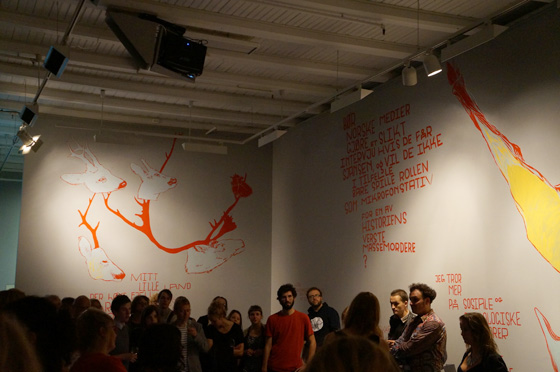
Another work about public moods - ants Nikolai Oleinikov; True, it is not Russian, but the Norwegian situation. Its starting point Specific research was Breivik - a symbol of an inexplicable and extraordinary catastrophe for the Norwegians. The artist suggested that what happened is natural: the reasons, in his opinion, should be sought in the cult of violence, which, as it turns out, is a completely new phenomenon for the Norwegians. Oleinikov gives the following example: residents of Norway love hunting, this is a traditional activity, but over the past ten or slightly more, thematic publications about hunting have filled, according to the artist’s expression, “pornography of violence”. Divided animals and charming, smiling people in the blood of just freshened carcasses; Standing in the middle of an idyllic landscape and holding hands of lovers, from whose backpacks the deer limbs stick out - this is the face of a new culture. “For several decades, nothing like this could be met in these magazines,” said the artist, “if only gutted fish, but in recent years everything has changed dramatically.” The surge of this “symbolic” cruelty, according to Oleinikov, was the nutritious environment that raised Brayvik and not only him. In his “training frescoes”, the artist connects excerpts from the Norwegian press, from which a hidden fascizoid message, and images of chimeric creatures, semi-loves, half-lusters.
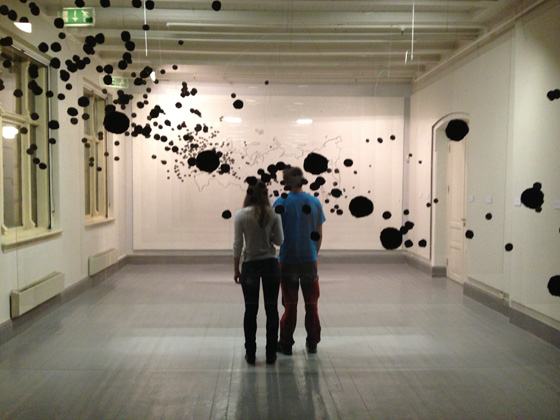
Project " p . S. " Sofia Gavrilova was shown two years ago at the international festival of activist art" Mediadar ", which took place as part of the last Moscow Biennale. These are several sheets of plexiglass, on each of which black points indicate different types of prisons and other institutions of the Russian penitentiary system. If you look from the right side, then all these layers are superimposed on each other and on the map of Russia - a terrible picture of the prison empire is obtained. And as we understand and know from various sources, including such as a letter of Nadezhda Tolokonnikova , this system does not re -educate, it humiliates and kills. The prison geography itself works on further immersion of prisoners in this system, contributes to their return to prison. You can walk along the sheets and see how many places in Russia in Russia, how their location contributes to the formation of the environment that reproduces crime.
 © Evgeny Nazarov Sofia Gavrilova, PS
You are faced with real poetry when you consider the works of Babi Badalov living in Paris, who uses various languages (none of them, by his own admission, knows quite well, but he says a little in Russian, English, French, Turkish, Arabic, Farsi, Azerbaijani and God knows how many languages) to express his position in the world that is not a person who is nowhere to nowhere his own, who was wandering around, running away, hiding and who has been living more and more new homelands. When, during a public meeting with artists, he talked about his life, now and then falling from English into other languages, it seemed that you were listening to the song. I don’t know whether it is worth attributing to what Babi Badalov does, to activist art, but intertwined letters, unfinished phrases, the elm of mixed dialects in paintings and panels leave a strong impression after watching.
Kharkov artist Roman Minin created in two spaces, in Tromso Kunstfoning and in the Small gallery Projects , two rooms with murals. In some places he added a photo, and somewhere the harsh figures of miners were supplemented with patterns. In the museum it was necessary to put on a helmet with a flashlight to watch the paintings of the walls, since the room was immersed in darkness - the viewer was in the face.
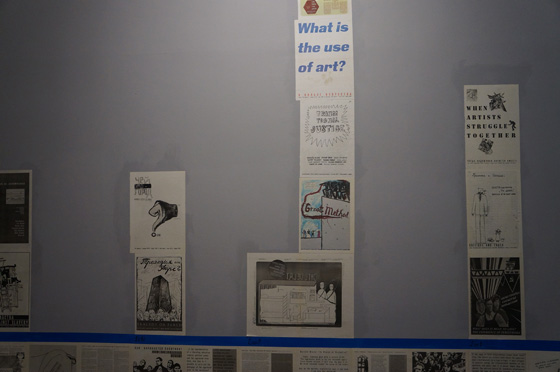 © colta.ru Assembly of issues of the newspaper "What to do?"
The artists Eldar Ganeyev and Stepan Subbotin, which are part of the ZIP group from Krasnodar, did two works specifically for the exhibition. One - three high chairs standing in front of the windows - so that the fjords can be contemplated, however, one window is boarded up, but on each chair there is a seat belt and a stand for a glass of wine. In principle, the usual installation that was funny at the exhibition of protest art. I really like the presence of such work, as it dilutes the excessive seriousness of activist messages - I already had to write about various kinds of artistic reactions to state -owned strategies and straightforward activism . And because of which the “ZIP” fell on the list of participants-the video of the “Bolo of a single picket” -was shown in Tromso and was commented on by her main character Eldar Ganeyev. The other work of Zipov is inspired by the famous act of the musician from Bloodhound Gang . They built a machine for endless washing of the flags of different countries: the panels move in a circle, wash, squeeze, dry. After a few cycles, the paint from the flags begins to wash off and mix - the same abstract canvases are obtained. By the way, this car is in a small space of Kurant , which is guided by the young guys. It turns out that in Norway there is a program to support such tiny artistic initiatives-mini-galleys, artist Run Spaces . There are similar projects supported by the state in Oslo, Trondheim, Bergen and Tromso.
In the oldest Norwegian cinema, which is located not in the capital, but in a small town on the other end of the country, which is already talking about a lot, the show “For Marx” Svetlana Baskova was shown. This picture has already been shown repeatedly in different cities of Russia, despite all those obstacles that it was repaired. For those who do not know: the plot is simple, the workers create an independent trade union at the plant, the owner decides to deal with them in order to continue to get the maximum profit at a minimum of costs, and then - blood, suffering, betrayal, retribution. A big plus of this film is made with a weighty share of populism, and this is exactly what many artists do not like and what is necessary in a situation where it is not like trust in trade unions, but faith in the very possibility of human interaction is irrevocably lost. “For Marx” is extremely activated, although it looks like the usual adaptation of a classic novel.
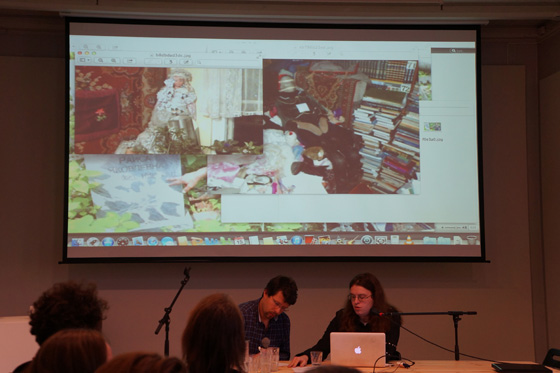 © colta.ru gray purple, report about Anatoly Moskvin
There are many bright and memorable moments in the picture itself, but I would like to pay attention to only one of them. At the very beginning of the film there is a scene on the bus: workers go to the plant, at the same time trade union agitation occurs. One of the workers explains to the other what an independent trade union is good, calls to enter it. Among the workers who travel on the bus, there is one woman, she sits at the very end of the cabin, in the corner. Who is she, what her name is, who she works at the enterprise, we will not recognize. The most fierce activist, turning to the workers with his calls, turns her back to her. He is not that he does not speak with her - he does not see her, for him she has not been from the very beginning. This scene very clearly characterizes what is happening in the trade union and polyactivistic environment, where women, as well as representatives of the LGBT community, are frighteningly superfluous people.
As I said above, the conference is an opportunity to arrange its own action. So, a report on Anatoly Moskvin, a famous figure from Nizhny Novgorod, who dug up corpses, mummified them and turned them into dolls. When it opened that there were about three dozen such mummies in his house, this caused a big noise in Nizhny Novgorod. For the Quir-activist, a gray purple this story was the basis for the manifesto , and now the shares, since another topic of the report was originally announced. In fact, it was a manifesto of the liberation of dead bodies, and such a radical gesture could not remain unanswered. The dispute began in the hall where the reports obeyed, and then flowed into the sidelines.
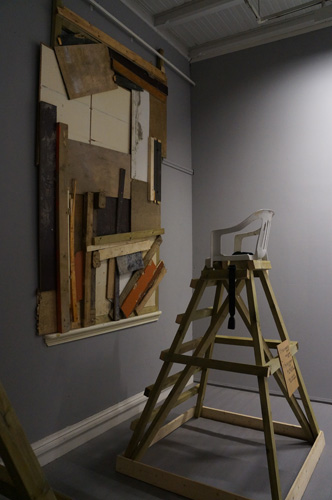 © colta.ru SIP group, three chairs
The most interesting, as always, you know by accident. He talked, standing on the porch of the museum, with an artist named Kero, one of those who have workshops in Tromso Kunstfoning. He himself worked part at that moment as a video operator during the conference, and before that he helped some artists with the installation of their work. As if apologizing, he noticed that many volunteers from among students of art schools and artists who receive little money from the museum are working on the current project. “There are places in the world where even little money is not paid to such assistants, especially in London and Moscow,” I objected to my interlocutor and began to tell that in both cities there were and continues to create trade unions and other organizations so that they could defend labor rights. “And we partially achieved this,” the artist said, smiling. It turns out that since the 1970s, Norwegian artists, self-organized in unions, actively fought for their labor rights. Anyway, Coer devotes his dynamic installations to praechetic workers , who are now full-and not only in modern art. He spoke about this calmly, without activist fuse, because for him it was already indisputable things, although yesterday it was only a demand for a demonstration.