
Translated material
"My career is the result of a conspiracy of marines"
You are probably in a course in the speech of Spielberg and Lucas at the University of South-California-the one where they talk about the chopping of Hollywood in the near future. So, in my opinion, this is too apocalyptic prediction. Although this prophecy of Spielberg and Lucas in some way came true a few months after it was done-this summer really eight large Hollywood films fell into the box office, and more than $ 300 million were spent on them. But I do not think that the studio will collapse due to these failures. Rather, they will be careful and will believe less in special effects. Maybe they will return to the past, to ordinary people as heroes. I think that the studios will now simply change the course, adapt to this situation and stop investing everything in films with superheroes.
When you put a film about normal people, it is very important to choose the right actors. I never work with actors who are unfamiliar. It's not about personal acquaintance-but that before she approve someone, I carefully study samples, other roles of this actor. It is important for these people to play in your film - and it is important to understand what they are capable of. I had one exception - Rutger Hauer. It was 1968. We worked on television on the series about the Middle Ages, which was called Floris, this is such a Dutch "Aivengo". We planned the famous theater actor for the main role, and Rutger simply came to the samples - and then everyone decided that he could not play. It looks good, but does not know how to play.
But two weeks before filming, the theater, in which the actor chose, forbade him to act with us, "in such a low -grade series." I had to take Rutger. It turned out that he studied very quickly - and I already felt that he was my alter ego, my Marcello Mastroianni. But, unfortunately, when we made “Flesh and Blood”, my first film at the American studio, Rutger had already managed to star in Lady-Yastreb and “Running Blade”. He had already begun to build the image of a large American star - and “flesh and blood”, which he signed a few years before it seemed to him, would not help him in this matter. There is a rape scene (as in all my films!), And indeed the script was quite cynical, tough. The film failed completely, and we did not work anymore. It was the end of our friendship with Rutger. I don’t even hope that I can someday at least have dinner with him.
When I was just starting to work on television, at first I was very afraid of actors-for some reason I thought that they could be very dangerous and you need to be careful. But when I still dared to talk to them, I quickly realized that they were no different from me. And I trusted them from the very beginning. Later, finding myself in difficult situations, I sometimes experienced discomfort - for example, working with Michael Douglas for the first time. He is a very powerful, smart person-and we had to argue a lot, for example, he wanted to change something in the script, but I thought that I could not allow it. I did not like to feel an unpleasant, uncompromising tyrant, but in the end everything returned to normal, we worked, and the movie turned out good. You need to talk more often with the actors - and everything will be fine. My advice - trust the actors. If you really believe in what you want to remove, then the actor will take your point of view.
Then they ask me - why did the "flesh and blood" failed? I was to blame for this disaster no less than everyone else - to tell the truth, I was simply not ready for such a picture. There were many problems with casting ... Well, it was difficult for me to make an American film for the first time in English, but in Spain, in a terrible environment. But the main reason for the failure is prohibitive cynicism, the contradictory of the script.
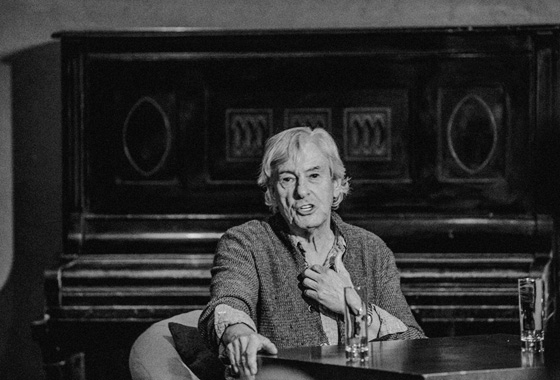 © Nikita Stupin
I do not think that the director must write his scripts himself. I have never written the script myself in life, alone, although I acted as a co -author more than once. In Holland, I worked with one screenwriter - and he always wrote me the first draft, I myself am not capable of this. Do not expect good dialogs from me! But I know how to criticize very well, I can come up with a conflict, an atmosphere, a visual solution. In this sense, he could compare himself with Hitchcock - he also never considered himself a capable script and, even when he took part in the work on the text, did not put his name in the credits!
I actually still study with Hitchcock. I even write articles about him! Often I review his films of the 1930-50s-first of all, paying attention to the plot, to Sassens, to how he supports the plot secret. For me, Hitchcock has always been the most important director. “Basic Instinct”-probably, Hitchcock of the 90s. I like to think that the film about sexuality that he always dreamed of doing, but could not - was not the time. In general, I study with many directors - from Lynch to Eisenstein, but the same as Hitchcock, no one influenced me. Except perhaps Fellini - from whom I learned how the camera should move. Within one room, one mise -en -scenes. No one did it as Fellini.
I was always delighted with “Ivan the Terrible” by Eisenstein - from a political point of view and from an artistic one. I can review the second part every six months - this is a real art, I have never seen anywhere that the violence of power would be broadcast through the movements of the body and soul as subtly and accurately as Eisenstein’s. You have no idea how much I gleaned from Ivan the Terrible - although this is not visible from my films.
It is difficult for me to determine the function, the purpose of the director and how he should be ideally. How difficult it would be to determine the function of Rembrandt. Or Stravinsky. Art should not serve any goal, should not prove anything to anyone-all this is already contained in himself. I can only talk about how he became the director himself. I shot something at the university-and I studied in Leiden. Then I was drafted into the army - then in Holland military service was mandatory - and distributed to the sea infantry. There I began to help the film service, who shot various documentaries about brave Dutch marines. At first I was in the run, then they began to trust me to put something myself. I was lucky - real pros worked in that film service, in essence, I learned everything from them. But I still did not know that the most difficult thing was not to learn how to shoot and mount, but to get a job in a movie after the army.
In the end, I acted like this: I began to agree on meetings with people from television and show them his documentary short films taken in the fleet. Now it seems to me that in these works there was already everything that was later distinguished by my films: a lot of action, shooting, daring installation. Probably, this convinced the television people that at least I can shoot the action. They were just working on the Floris series - and invited me to take up it.
Thus began my career - whatever it may be: good, bad or completely emerging from the conspiracy of the marines.
My move to America was to some extent a forced decision. In the early 80s in Holland, most of the films were shot with the help of a state that allocated to half the budget. And at some point they began to simply refuse financing-my films seemed to the officials too decadent, they showed Holland and its inhabitants not in the best light. I already began to despair, but my wife Martin convinced me that I needed to go to another country. She was still engaged in children and the house, so in principle, I had the opportunity to go to America before - like proposals from there (Spielberg also, by the way, called). But I was afraid to leave and put it off all the time. And when the wife already started talking about this, he realized: it's time. It was 1985, and I went to work on Robokop. In America, I liked it - and I liked even more when Robocop turned out to be a hit. Well, Martina and I immediately sold our house in Amsterdam (after making sure that the fees were large) and moved to the States. In Holland, no one loves successful people.
Leaving, I didn’t know how to become competitive in America - and now I don’t know. However, I will try to formulate several rules on the go. The first is not to be afraid of the unknown. If you want to do something that will be interesting and in fifty years, you need to dare a step into the darkness. All the same, yes, yes, you will land somewhere-even if you do not know what you are doing (as it happens most often). Actors and actresses will still come to the site, and the work will still be in one way or another. But you have to take the first step - otherwise nothing will happen.
The second is not to be afraid to enter into conflicts. We will have to argue a lot with the producers, with investors, with anyone. And you need to fight to death. Understand that confrontations are still inevitable - and they do not need to be afraid. The same Douglas, after our disputes, went to the site and worked so that he could not complain. Fight with all those who want the film to be easier - and those who want it to be cheaper. You will receive twenty to thirty percent more than they wanted to give you initially. Sometimes this is enough.
As for the rest of the rules ... It was very important for me to study other people's films. Not just to watch them, but to watch twenty times to know what other people have already created and what conclusions can be drawn from their work. No need to invent the wheel. Each time you need to try to advance it where no one has been. I am a big fan of history. Cinema stories, art stories, music history. It seems to me that if you understand only the cinema, you will be limited.
I can advise young directors one thing-just do something. Not every film gives you the opportunity to engage in art, but each film can be made closer to art. Do not immediately try to make a big movie, earn a million and all that kind. Five minutes are already interesting. Just try to make a small film out of nothing - you will not earn anything, but you will not lose anything, but learn a lot. Agree to work on television if you are offered it. I learned the profession in the two years that I worked on TV. Agree on any work with actors - in the theater, in advertising, anywhere. With each experience you will be more professional. Do not fall in love. Although, of course, a variety of situations are possible on the set. This will affect your perception. But the most important thing is just to take every opportunity to work, the smallest and most insignificant projects. In two or three years of such work, you will learn everything you need, and you will be ready for big films.