
Translated material
Demarch enthusiasts
It has been exactly one year since the beginning of the coordination council of the opposition
On October 27, 2013 it will be exactly a year since the beginning of the work of the Coordinating Council of the Opposition. Last week, preparations for the new elections began. Whether they will take place - the New Times found out
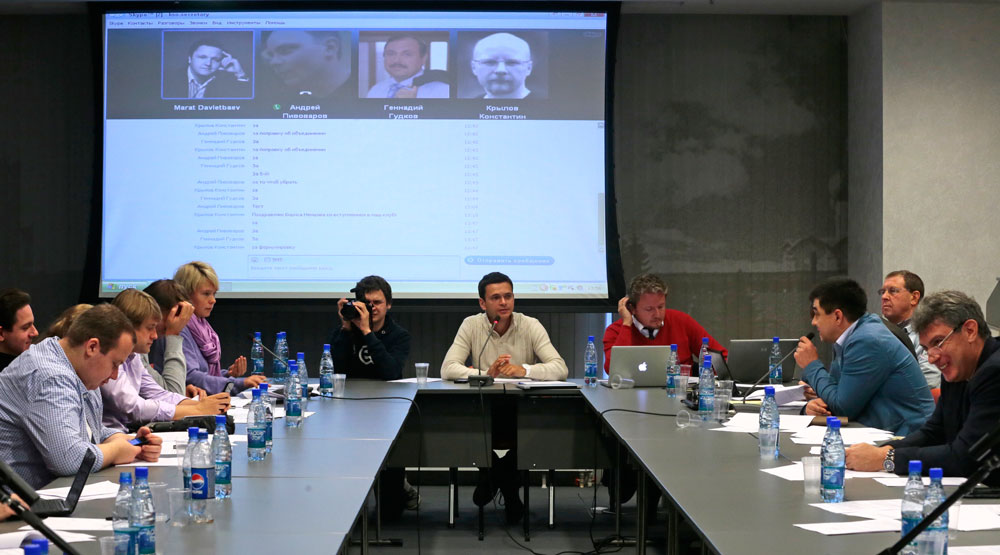
“The poor servants do not. The elections of the Coordinating Council should be made by the members of the KS. There are no gnomes who will come and do everything, ”Alexei Navalny spoke harshly at the last meeting of the KS on September 21, 2013.
A year ago
* See the New Times No. 26 dated August 27, 2012
The preparation of the first elections in the Constitutional Court, which took place on October 20–22, 2012, and the creation of conditions for online and offline voting in Moscow and regions took three months*. The general budget of the project, which was then led by the IT businessman not very well-known to the general public and the deputy of the Yekaterinburg City Duma Leonid Volkov, amounted to 3.5 million rubles. The money was collected at the expense of candidates (for registration they paid 10 thousand rubles) and donations. More than 100 thousand voters registered, 82 thousand voted. 45 representatives of the non -systemic opposition were elected.
But the second time Navalny, nor wolves do not want to engage in elections. Volkov generally leaves politics - he goes to work in Luxembourg. In his LiveJournal, he wrote so: they say, this is no longer my story. And according to The New Times, and Navalny himself in the Constitutional Court is likely to be elected for the second time. But he has not yet commented on it. They say that he is now more occupied by elections to the Moscow City Duma, which will be in the fall of next year.
What is done
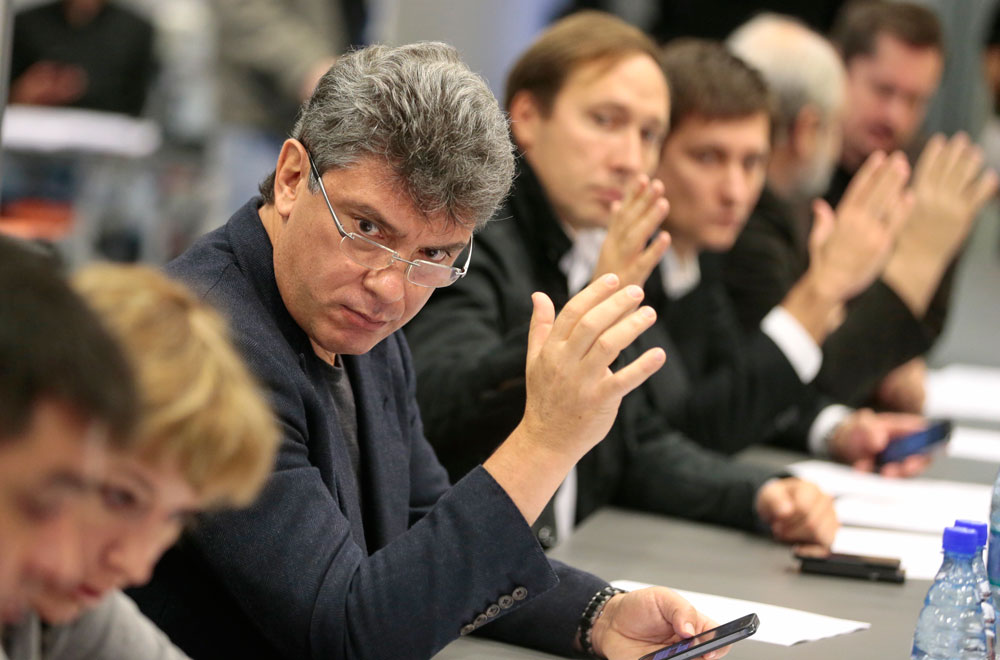
Boris Nemtsov is one of the few members of the Constitutional Court who has not yet decided whether he would run again
The main goal of the KS was stated the implementation of resolutions adopted during the mass protests of 2011-2012. In addition, eight tasks were set, which were recorded on the Council website. What is made of this?
With the reaction to important events, as well as “civilian and political initiatives on the ground,” the situation was good: for example, the “Dima Yakovlev law” answered “march against scoundrels” in January 2013, to cancel the directors of the mayor in Dzerzhinsk of the Nizhny Novgorod region - a special resolution. They did not forget about political trials: the Constitutional Court adopted the resolution “On political prisoners and prisoners of conscience in Russia” and organized a procession on the anniversary of events on Bolotnaya Square on May 6. Another Council coordinated mass protests (there were four, including two mentioned) and put forward legislative initiatives: at the last meeting, a draft amnesty was approved for accused in riots.
With other four points, it turned out worse. The KS had to participate in election campaigns and carefully monitor the electoral process as a whole. Three members of the KS really took part in the September elections, but even at the last meeting on September 21 there were disputes about whether they were right. Andrei Illarionov twice took a microphone to blame his colleagues of legitimizing the undemocratic elections and playing the power. And the participation of the Constitutional Court as an integral structure in these elections was limited to the verbal support of the candidates.
What was done on the point “Conduct information and educational work” is also not very clear. Although Boris Nemtsov said on September 21 that such work was held during the election. But is it a personal merit of the CS? Well, the advice completely failed to establish feedback with voters - this is the members of the KS themselves.
New elections
Long before the last meeting of the Constitutional Court, at which the results of work and new elections were discussed, it was clear that the council would not be preserved in the current composition. The ranks began to grow up for a long time: someone now lives abroad, someone is under house arrest or in a pre-trial detention center, and someone just left, because they got tired of sitting at meetings.
Of those who remained, many have already announced that they would not participate in the new elections. So, TV presenter Tatyana Lazareva admitted to The New Times that she quite quickly realized that "he occupies someone else's place in the Constitutional Court." Dmitry Gudkov believes that since the authorities began to allow the opposition to the elections, one must use and win this, and not sit in the Constitutional Court. And Ilya Yashin generally believes that as an institution this structure did not take place and there is nothing to do there.
The degree of legitimacy of such a “parliament” and trust in it, of course, will be lower if the bar is 80 thousand will not overcome
But there are doubts - Boris Nemtsov, for example, has not yet decided whether he would advance, and wants to first see what the initiative group in the new election for the next meeting on October 19 will prepare. But the nationalist Konstantin Krylov supports new elections in every possible way, because over the year the Constitutional Court has become a real place for discussions and had a huge impact on protest activity, it is difficult to just evaluate this influence.
But how will new elections be organized?
In a conversation with The New Times, Leonid Volkov explained that it is not difficult to repeat, organizationally - more difficult, but it is also possible, but it is also possible, but he does not expect enthusiasm on the part of voters: “Many people have no expectations, so I don’t think that it will work out again to sell this idea.” According to him, a year ago, many of those who were engaged in the organization of elections were sure that this would be elected for a long time every year. But the political situation has changed rapidly. “In addition, I have always been an opponent of the idea of uniting the opposition - such structures are usually not viable, and the KS also showed this,” Volkov adds. - But we need discussion sites in order to make decisions at the right points that will satisfy different sides. It is necessary to discuss how to divide single -mandate districts, to carry out primaries, and in this direction we took a big step forward, including thanks to the year of work in the Constitutional Court. ”
** Last time, in addition to the general civil list, there were lists of representatives of the left -wing forces, liberals and nationalists and there was a vote restriction so that all Kuria received a representative office in the Constitutional Court
At the end of the last meeting, the duties of “gnomics”, which will make new elections, took over the initiative group: Evgenia Chirikov, Andrei Illarionov, Anton Dolgikh, Akim Palchaev, Sergey Davidis, Vladimir Thor and Konstantin Krylov. Evgenia Chirikova told The New Times that the first collection of the group has already taken place and technologically new elections will be maximally focused on continuity. Will there be Curia **? Most likely not, because such a structure was seriously criticized by almost all members of the Council.
Chirikova says that it is not yet clear how long it will take to prepare and hold the elections - there is no plan and schedule yet. How much money is needed this time? There are only preliminary grades, they are not announced. Evgenia Chirikova willingly says only about what the new Constitutional Court should do: “I hope he will be closer to the lives of ordinary people. We will discuss real life issues. For example, what are these people who are engaged in the seal of the shelf in the Arctic, have a low tax rate, and those who, for example, bakes bread, pay such high taxes? ”
But at least how many voters should vote so that the elections take place? From conversations with other members of the Constitutional Court, it became clear that the option “if there is less than the last time, then the COP will not be elected” until it is considered. Boris Nemtsov only said that the degree of legitimacy of such a “parliament” and trust in him, of course, would be lower if the bar is 80 thousand will not overcome.
Voters think
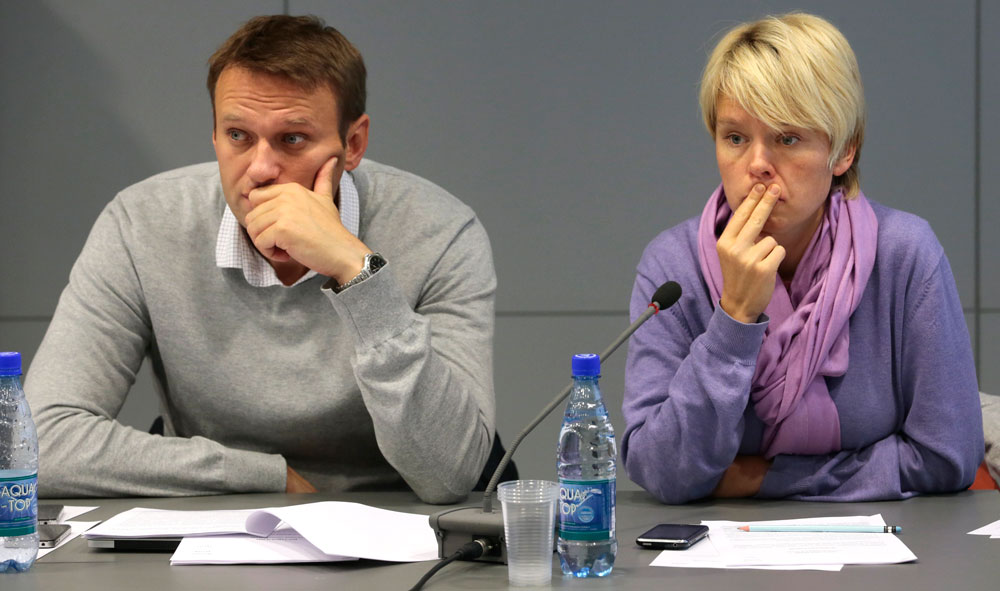
Alexey Navalny will not be engaged in new elections. The initiative was taken by Evgeny Chirikov and six more members of the Constitutional Court
The New Times interviewed 15 ordinary voters who voted in the KS elections in October last year: what they expected from this structure, which they consider it success that - failure and most importantly - whether they will vote for the second time.
Almost everyone called the election themselves the main success of the Constitutional Court - “honest”, “democratic”, “mass”, “technological”. Ten people mentioned the election debate: it was “cool”, “right”, “really”, “almost like adults”. And almost everyone said that they quit monitoring the work of the Constitutional Court and online-gash. Because members of the KS began to swear, tortured the audience with regulations and formalities, and many simply stopped going to meetings.
Half of the respondents admitted that they did not have any specific expectations, and therefore there were no serious complaints about the activities of the Constitutional Court. The advertising manager Marina Zayko had only a certain feeling that the CS should engage in the organization of a single opposition movement and establish contacts with people from various spheres - pensioners, doctors, etc. For Metallurg, Anatoly Zubarev, the creation of the Constitutional Court was a “purely emotional element”, although there were some vague hopes: he hoped that the CS could radically increase the number of protest shares, and this would push the government to some kind of change. A graduate student Pavel Grishin and businessman Ivan Yanklovich admitted that the fact of the election was important to them and the fact that different opposition representatives sat at one table.
But there were also people with claims among voters. The system administrator Pavel Gavrilov did not understand for the year, “why is it all at all”: “It's great that we all gathered here today” - this is fine, but besides the manifestos, do not understand whom do not understand whom the KS did not produce anything at all. They shot a huge hall and argued for several hours due to the formulation of some proposal in the next combat sheet. It is stupid and pointless, given that in addition to the Constitutional Court itself, no one read these combat leaflets. ”
The IT manager David Mzareulyan hoped that the KS would represent the interests of the participants of the rallies in 2011-2012, to form a political agenda, to go out with it on a dialogue with the authorities, but quickly realized: “The agenda of the meetings forms a sensible wing in the Constitutional Court, and Udaltsov, Bondariki and the similar ones, which they only do, write the sheets of the resolutions. The KS did not react to the laws that introduce censorship on the Internet, the CS did not participate in the Moscow Mayor’s elections ... Well, if the body regularly misses the most important events in the country, then why is it needed? ”
In practice, paperwork, endless discussions, squabbles turned out. But it is worth asking the question: what, in fact, could the CS do?
The film producer Vladimir Piskunov counted on the association of the opposition, but saw only squabbles and gossip. And the student Maria Yasakova complained that the politicians who she chose at the meetings literally fell asleep.
At the same time, 8 out of 15 respondents said that the second time they would not vote for sure. Some, thanks to the past elections, saw leaders who were able to engage in great politics and mobilize the electorate without a coalition with other protest forces. Others are disappointed with the possible indifference in the second elections in the Constitutional Court of many “stars” from the opposition. And, for example, Ilya Simanovsky, scientist-physician is generally sure that "now you do not need to add legitimacy of a deliberately doomed organization."
Four people admitted that they would vote. Because they remember the first elections, they realized that this is important, and they believe that at least some kind of site where opposition representatives gather and discuss pressing issues is still needed. Three more are ready to vote with reservations. Marina Zayko, for example, says: the main thing is that the candidates make clear positions and explain what they plan to do. And Pavel Gavrilov literally demands that before the elections, the CS clearly formulates what he is needed for.
The essence of the process
Political scientist Dmitry Oreshkin admitted to The New Times that he also participated in the KS elections, so his opinion can be partially considered the opinion of the voter: “I did not expect anything special from the KS. I considered it as a proto -parliament, where young unsystematic politicians will be able to train in finding common interests and ideas, where they will learn how to intrigue and build coalitions. ” According to him, the disappointment of many voters is understandable - many expected real actions from the Constitutional Court, almost a revolution, and in practice there was paperwork, endless discussions, squabbles. But it is worth asking the question: what, in fact, could the CS do?
Then Oreshkin recalled the “great charter of liberties”, which in the XIII century signed the English king John the Land: in it, the English barons put forward the monarch a whole list of material and political requirements that guarantee compliance with specific rights and freedoms. And the king was forced to sign it, because his opposition had real business and political resources. “What does members of the COP have? What could they present to the authorities? Yes, they developed their political program, but they have no resource to promote it: they do not control anything, they have no serious budget, ”says the political scientist. - All that the members of the KS could do, they did: discussed the agenda, the date of the rally, who is for whom. Therefore, to blame them for non -constructiveness means not to understand the essence of the process. ”
The political scientist called the result of the work of this structure the appearance of a strong leader, who now, after the election, has a real political resource with whom he can go to big politics - "almost like the boys from the 13th century, who had something to present to John to the landless." But this does not mean that now the project needs to be closed. As a kind of organ where politicians develop muscles, the CS, according to Oreshkin, took place and can continue to work in the same quality: “Actually, the parliaments exist for them to grow strong leaders.”
Photo: Mikhail Metzel/ITAR-TASS