
Translated material
Rustam Rakhmatullin: "You will have to go out more often"
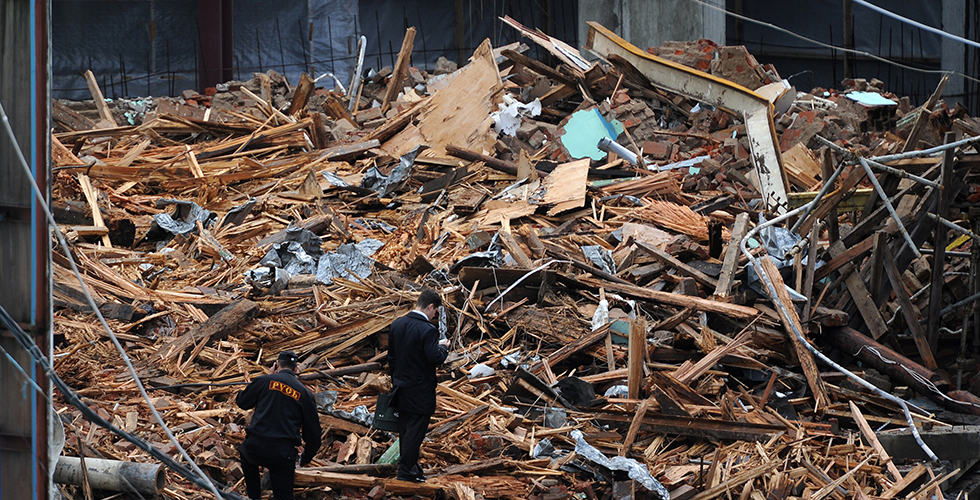
On September 16, the exhibition "Urban planning counter -revolution. Moscow 2010-2013. New losses ”, organized by the Archnadzor public movement and the Moscow, which is not, moved from the Gallery“ Cultural Alliance. Marat Gelman project at the Winzavod at the Artplay Design Center , where the next day it opened . Today it closes, but the coordinator of the Archnadzor movement Rustam Rachmatullin promises a continuation.
- What was the reason for the exhibition? She was preparing specifically for Moscow elections to attract more attention?
- The exhibition "Urban planning counter -revolution" ripened to the final of the election campaign. Our participation in this campaign consisted in preparing the Charter of the Protection of the Historical City of Moscow , which we proposed to sign all candidates. As a result, it was signed by everyone except Sergei Sobyanin. The exhibition, in fact, has become an illustration of this problem.
-The non-signing of this charter Sergei Sobyanin, in your opinion, can be regarded as an open confession that the Moscow government will not be engaged in the preservation of the architectural heritage?
- The lack of an answer is also an answer. If the candidate is not signed under the proposal to declassify historical and cultural examinations and publish them on the website of the Department of Cultural Heritage, he thus refuses to make processes in the field of maintaining heritage open. And this speaks for itself. If the mayor does not support the creation of the Heritage Council under the city government, which could prevent illegal demolition of buildings and the emergence of false historical and cultural examinations, this is a clear position.
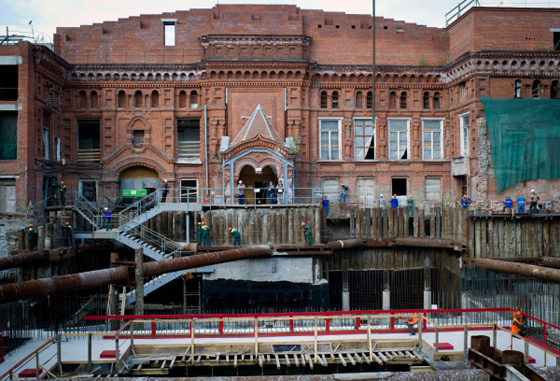 © RIA "Novosti" Manor of Shakhovskys
- That is, the Sobyanin policy in this sense is not much different from Luzhkovskaya?
- The situation with the preservation of the architectural heritage over the past three years has changed by many parameters . She became different, but this does not mean that she has become radical better. We list those monuments or objects of the historical environment that were destroyed at the exhibition. Statistically, this may be less than in previous years, but each of them is invaluable. There cannot be statistics to our protests. We are talking about specific cases - here the cathedral mosque died, so the princely houses of Shakhovsky and Volkonsky died. We are answered in the spirit of "but we restored seven hundred facades." But this is not an answer, it is a departure from the answer. That is why I am full of pessimism regarding the future. I think that the events will develop further even worse than now. Those trends that have been in the bud will be growing in growth. First of all, already tested methods of manipulations will be used: with the regime of protection zones, as it was with the Catherine’s hospital and the Volkonsky House; with security status, as in the case of Dynamo stadium ; with the subject of protection, as was the case with the "children's world" ; with a historical and cultural examination, as with a circular depot ; And even with the address, as with the Shakhovski estate. So the conclusion is disappointing: city -defenders will have to go out into the street more and more.
- Do you think these outputs and protests can take action?
- The more massive - within the framework of the law - there will be protests, the higher the likelihood that the city hall policy will change. Citizens must demonstrate their categorical demand to maintain a cultural heritage - not only monuments, but also the entire historical environment of the city. In many cases, they answer us: they say, this house is not a monument, do not worry. But behind a similar statement, as a rule, there is a whole story when the house is no longer a monument or not a monument. We know how easily any building can be withdrawn from the list of objects declared and even identified (undergone examination). The war does not go on pieces of paper, but in the hearts. For a city defender, every such story is a heart story.
If the mayor does not support the creation of the Heritage Council under the city government, which could prevent illegal demolition of buildings and the emergence of false historical and cultural examinations, this is a clear position.
- Nevertheless, we see that, for example, the long and persistent protests of Muscovites against the reconstruction of the Volkonsky House did not lead to anything. The building was built in two floors, as was planned.
- On the one hand, this is so if we are talking about the situation on the spot. On the other hand, the city hall learns something, and such exacerbations serve as a prevention for the future. According to my information, the city hall realized that in the case of the Volkonsky House, she made a serious mistake, and she was made at the level of the Urban Planning and Earth Commission (GZK), where the decision was made to extend the project and the urban planning plan of the land plot (GPZU) was approved. With the optimistic development of events, the long -term consequence of the protest on the Vozdvizhenka may be adjusted the work of the GZK, as well as the Moscow Architecture Committee, which directly issues permits, and the Moscow City Council, which evades the coordination of architectural projects in security zones. If this does not happen, it will be possible to say that the protest did not give any result. Alas, we know that the Moscow City Council expects to legitimize its non -participation in the approval of projects, that is, to amend the city law.
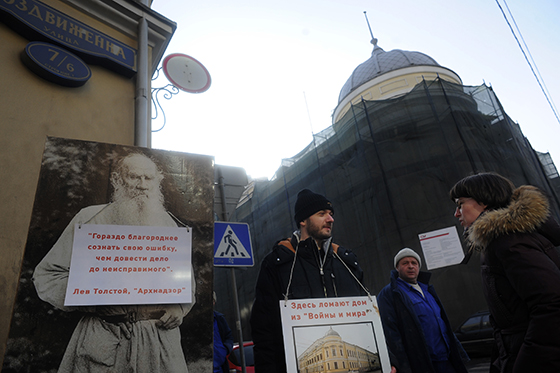 © Ita-Tass Picket at the Volkonsky House on Vozdvizhenka
- I have repeatedly heard from the directors of large museums, journalists and even officials, that at the top of your movement began to be afraid. How do you feel - the authority and influence of Archnadzor have grown in recent years? You began to listen more to you, for example, in the city hall?
- Authority and influence in society, in the expert circle and in the media, are certainly developed. But the Moscow government has people who would like to exclude us from the decision -making process. Probably, there are others who know the rule: "You can rely only on those who resist." But in the structure of the city government there are almost no sites where we could meet. There is no scientific and methodological council under the Moscow City Council, although the law requires it to be. The Architectural Council under the Moscow Markergiteture is formed as a meeting of practitioners. In the “Tolerance” of the Arkhnadzor commission, it has one voice, and the control package belongs to bureaucracy.
- I want to return to the exhibition "Urban planning counter -revolution." Was there any reaction to her from the city hall? Maybe informal calls, requests to postpone the opening for a couple of weeks, after the election?
- There were no requests, and there was no open reaction, but there was a pressure on the gallerymen until trying to expel the gallery of Marat Helman from the occupied premises at the Winery.
- And what reaction did you count on?
- We hoped that Sergei Sobyanin would sign our charter. And comments on each demolition presented at the exhibition, from time to time, received from officials at different levels. Official statements are known at the Shakhovsky estate, and at the Volkonsky House, and in a circular depot, and in the “children's world”, and in the Dynamo stadium, and in the Cathedral Mosque, and in the Catherine Hospital. All of them are usually demagogical. As a reaction to our exhibition, we would like to see the movement of the city hall towards complete openness. To publish texts of historical and cultural examinations. So that collegial expert councils under our “specialized” departments are created or restored.
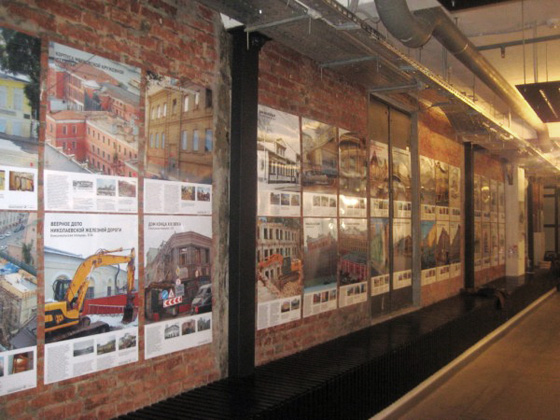 © Arkhnadzor exhibition "Urban planning counter -revolution. Moscow 2010-2013. New loss "
- The exhibition shows 43 objects, but in Moscow there are much more monuments and historical buildings that are under threat of demolition or reconstruction. By what principle did you select these stories?
- Half of the objects that are presented at the exhibition are at risk of destruction, the other half has already been destroyed. The first, you are right, there are much more in the city. It is difficult to choose for a small exhibition - after all, only in our “Red Book” , published on the Archnadzor website in 2009, 250 addresses. The exhibition did not fall on the chambers of the printed court on Nikolskaya, the chambers of Pozharsky in the Bolshaya Lubyanka, the chambers of Troekurov in the courtyard of the State Duma - the most ancient and significant of the monuments that are empty today. We have chosen resonant stories of the last three years.
-After the closing of the exhibition, the project will continue in some other form?
- We do not close the exhibition, but move it around the city. From September 17, it was accepted by the Artplay Design Center. There is an idea to show it in the regions. In addition, the need to update our Red Book, because the number of objects under threat of demolition or illegal reconstruction has grown over four years has grown. From the 2009 list, very few addresses moved to the conditional “White Book”, but the conditional “black” is replenished regularly.