
Translated material
How art grows up
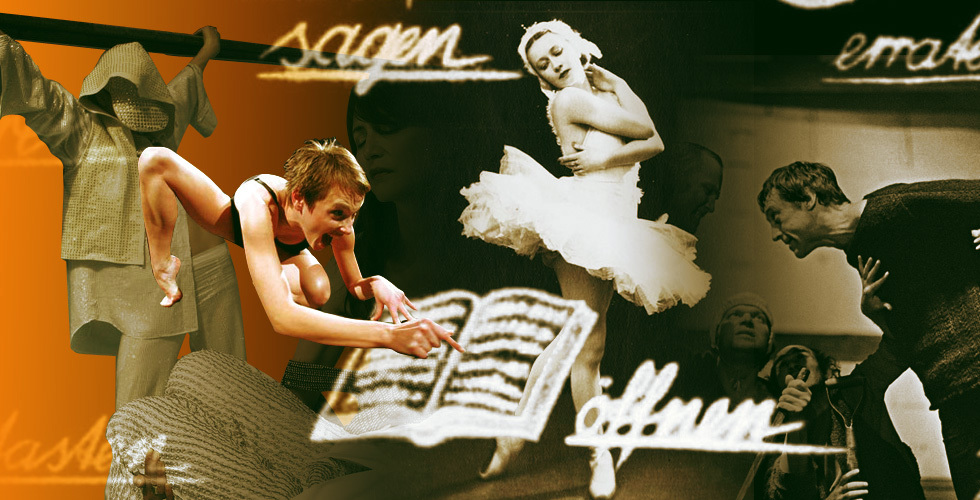
The “post -dramatic theater”, which separate theatrical critics spoke so much about the need, finally appeared in Russian. In less than 14 years.
By the time, when the “Foundation of the director and teacher Anatoly Vasiliev” published the cultural book of European theater studies, in Europe they managed to evaluate, exalt, criticize and even tried to reset it from the “Steamine of our time”. But we have an outstanding scientist himself, and his work, analyzing the amazing metamorphoses of the modern theater, to this day did not really ascend the ship. So there was nothing to discard. What is Leman! Neither Richard Shekhner still ascended the steamer, translated, it seems, to all languages, including the Chinese, nor the teacher of Leman Peter Schondi. But their books became classic long before the "post -dramatic theater."
This did not happen because of the bad officials now conducting the reform of the Russian Academy of Sciences. Not because of ideological obstacles or an iron curtain-they have been gone for a long time. This happened because of the curtain, which the Russian science of the theater, looking down on Western wise men (“I want to show my education and always talk about incomprehensible”), voluntarily separated itself from Europe.
Leman’s monograph written in 1999 is really difficult reading. In it you can meet many seemingly far from the theater (Benjamin, Baudrillard, Delez, Adorno, Habermas) and 35 thousand of terms. In the Russian version, they are not only translated, but also taken to the fields in the original language. This is an excellent and witty move - the book is generally published with great taste, just leafing through it gives a genuine pleasure. But from time to time, the move, as it were, hints: some concepts that have long taken root in the main European languages do not have rigidly fixed analogues in Russian. We have words, they have a look at the fields! - Terms.
The first question that comes to mind after reading the “post -dramatic theater”: do we have the theater studies now? And if there is, what is Leman's book? These are two very different worlds. The point is not even that Russian theatrical thought after the 20s sought not to analyze, but rather a fictionalistly describe reality, but that modernity has long been no longer perceived in Russia as the subject of theater study. Science is sitting in archives, it is reflection about the past. Here we have our obvious and sometimes outstanding achievements. And the new theater - what to analyze it: it is at best - a squalor, in the worst - the advance of enemy forces at his native borders.
The scientific instrumentation of domestic theaters who wrote in the 60-80s more or less corresponded to the subject of description. True, when meeting with the work of Robert Wilson or Tadeusz Kantor, our theatrical thought of the 70s, I believe, would have stalled, but there was practically no meeting. In the 90s, when the borders opened, the tools began to be hopelessly outdated. It is as difficult to analyze the theater of Katie Mitchell or Angeliki Liddell as inserting a flash drive into a printing machine. At best, we heard a ringing about Western terminology. In one academic Russian magazine, I somehow had a chance to read an article by a doctor of art history, who assured readers that the post-dramatic theater is much worse than the repertoire. There is about the same meaning in this statement as in the statement that mannerism is worse than the entreprise, and salty is better than wooden.
In this situation, the translation of the book by Leman, made by the famous Indologist and the old associate Vasiliev Natalya Isaeva, can be called a scientific feat with full basis. After all, she had not only to translate, but also to overcome this long -emerging gap between the theater thought and local. And I, right, do not know who else could accomplish such a feat: in addition to the knowledge of foreign languages, knowledge of modern philosophy and modern theater is required here, and in Russia, unlike Germany, these humanitarian spheres almost do not intersect.
We will distract, however, from the Russian context. We will try to better understand what this very post -dramatic theater is, the existence of which Leman insists. Is he not a chimera? The famous scientist describes him with purely German meticulousness. This is the theater in which we will not find everything that we have long been accustomed to the dramatic theater - “the principles of figurativeness and narrative” (that is, simply put, the plot), “logical connections and touching theatrical feelings” (and they are appreciated by Russian viewers and Russian critics!), “Flat, mechanistic psychology” (even attempted, reptiles!). This is a theater in which the artist no longer reigns on stage, but “is used only as one of the game buttons” (it is good that Leman’s book was not read by our folk USSR), which avoids, in the words of art, the logic of “vain doubling of reality”, “breaks with the mimesis, is like that breaks Jackson Pololok, Barnet Newmen or Saia” and “becomes a place of meeting of different meetings of different meetings of different meetings arts ".
But the more Leman catalogs this new reality, the more unsteady and elusive it appears. What is not in it is not easy to list, but even more difficult to describe what is in it. The post -dramatic theater, according to the lime, monologue, choralene, visual, musical, kinematographic, bodily and amazingly many times. Sometimes it seems that elusiveness and multiplicity are one of its main properties. Recognizing the presence of this new reality, you involuntarily begin to think: here is Christian Lupa, the artist is not a “game button”, but the center and the focus of theatrical action, but Robert Lepage - if he does not have a narrative and plot, then who is he? But the Lupa or Lupazh Theater is also a part of a new postdramatic reality. Isn't it?
Leman himself admits that "it is impossible to imagine Aristotle or Lessing, which would give out the only possible theory of post -dramatic theater." This is the "Theater of concepts diverging in different directions." I would clarify: this is not a direction in art (even a lot of directions), but rather a certain situation that is related not only to the theater, but - and this is important to emphasize - to all spectacular arts. Listing the sources and properties of the post -dramatic theater, Leman does not distinguish the main trend from this variety. He, as it were, equates all the features of a new reality, and meanwhile, it is not difficult to highlight the main one of them.
If you formulate it very briefly, it consists in the fact that modern spectacular art has lost a happy opportunity (I would even say, luxury) be naive and great at the same time. Painting, literature, music went this way noticeably earlier. But spectacular arts - a drama theater, opera, ballet, circus - due to the very specifics of their existence (after all, any sight, unlike manuscripts, scores, paintings, etc., is designed for perception here and now) for a long time retained the charm of naivety.
The fact of the performances of the “Old Theater” could be judged by the etchings of Auguste Domier, who talented and passionately captured the scene and - which is even more interesting - the auditorium of the 19th century. No matter how great dramaturgy plays on the stage, it was still adapted to the circumstances of naive theatrical art. The loss of this naivety, although at first in homeopathic doses, began to occur in the twentieth century, the eyelids of directing. Leman has a wonderful passage about how Stanislavsky, Craig or Kopo saved classical texts from the “power of the primitive tradition”. In the second half of the twentieth century, the complication of the artistic language already becomes a trend and affects that it is characteristic, not only of the drama theater. It was at this time almost simultaneously to replace the classic ballet, even to the plot (Balanchin), that will receive the name Contemporary Dance . Its origins, of course, can be found at the Dalcrosa school, in the experiments of Laban and Marie Vigman, but as a mass phenomenon it arises in the second half of the twentieth century. In parallel, similar processes of “complications” begin to occur in the opera - and in how they begin to put it, and in it as such. And even the circus - an old naive circus - eventually turns into Europe into a “new circus” and acquires a philosophical dimension.
One of the main signs of the post -dramatic theater, according to the lime, is the emancipation of the theater from the literary basis. But in a striking way, the drama from which it is emancipation itself also becomes part of the post -dramatic reality. In the tragedies of Shakespeare, comedies of Moliere, the spiritualistic dramas of Calderon, the romantic opuses of Victor Hugo or the ideological drama of Ibsen, there is a plot, intelligible characters, albeit complex, but also intelligible relations of heroes. And some flags that allow viewers to navigate the play. In the plays of Heiner Müller or Sarah Kane, as well as in the performances of Robert Wilson or Jan Lauers, you will no longer find them. Shakespeare or Sophocles in adapted form can even be read to children, but Yona Fossa cannot adapt to children's consciousness with any efforts. And any, even the most “simple” and not the most successful, modern dance is a much larger puzzle for him than a classic ballet performed by the brightest and most talented stars.
The presence of intelligible structural supports inside the ballet, drama, performance (with Efros or Vilar, in Tovstonogov or Strelir), as if implied their presence in life itself and acted reassuringly on the viewer. Having watched the performance of Victor Bodo, made based on Peter Handke's play “The hour when we knew nothing about each other” and devoid of all possible genre or plot subpoencies, my very refined friend said: yes, this is talented, but there is no joy-let us deceive us, but let them give hope that reality is meaningful. A very characteristic and significant claim.
Monologism, chorage, visuality or cinematography, focus on the psychophysics of the artist, like that of Anatoly Vasiliev, or absolute indifference to her, like Hayner Goebbels, are all important but substantial signs of the new theater. He can be so, and Syak, and everyone. But he necessarily involves growing up art, which no longer treat the viewer with any illusions. He does not put the flow of being into a certain more or less intelligible scheme, does not imply the presence of a certain general knowledge and common emotion in the hall, does not allow it to exist as a single organism, but requires a personal choice and personal solution of each viewer.
“The overlapping of the entire artistic act in favor of observers” sometimes causes serious irritation, and in Russia it is most often described as the loss of professionalism: they can do nothing - neither dance, nor play, nor the characters, nor the plot clearly build, nor the Salto, and they are smart. But Leman defends this new reality as a true knight. Any attentive reader of the book can be convinced: this is not just a peaceful cataloging of theatrical reality, this is almost a manifesto. For Leman, there is nothing worse than the "smoothed routine of classical representations."
The former theater, in which the dancer, singer, artist or circus, artlessly demonstrates his skill on the stage and the viewer acts as a passive appraiser of his skill, of course, will remain. But he is destined to become part of the enteric - a kind of world theater “Hollywood” or “Bollywood”. Nevertheless, artistic discoveries will take place in the theater of post -dramatic, infinitely problematizing its own boundaries, more and more active in the space of modern art and increasingly reminiscent of some spiritual practice - one for those on stage and those who are in the hall.
So Anatoly Vasiliev is not in vain assures that Leman’s book should cause a scandal in our theater world. After all, she, in essence, transfers 95 percent of what goes on our scenes and what they teach at our universities.
It would be wrong in this tar barrel, however, not to add a full -fledged spoonful of honey.
When Leman released the “post -dramatic theater” in 1999, in a huge list of directors whose work confirms the presence of a new reality, he included only one representative of Russia - Vasiliev himself. I just didn’t find anyone here anymore. Now, in 2013, his choice is much more extensive. For several days spent in Moscow, he watched the Moscow Art Theater Gatsalov’s Moscow performance “The Tale of what was and what was not” and Dmitry Krymov’s “Tararabombia”. And I was convinced that we now have a post -dramatic theater. There were no books until recently, but the theater itself took it and was born. And this once again indicates that he is not an invention of a charismatic author, but an objective reality given to us in sensations.