
Translated material
Sandra and emptiness
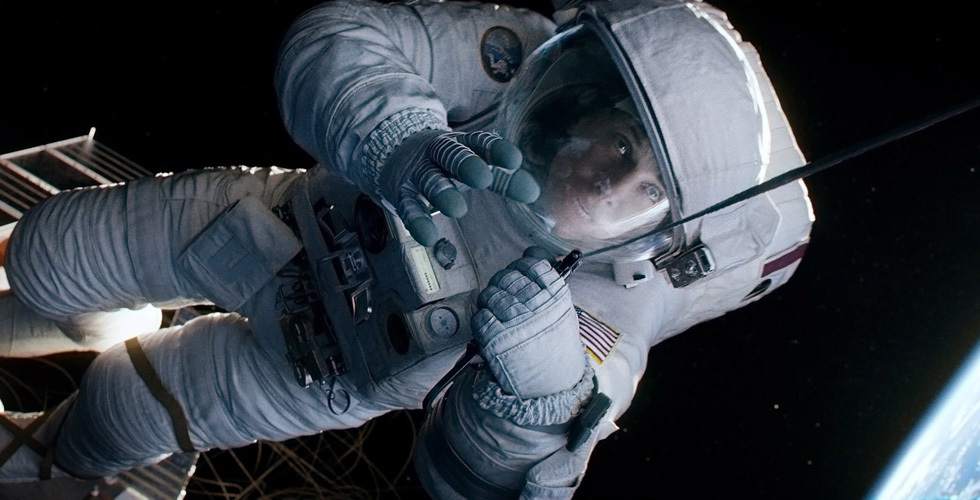
The sounds in the airless space are not heard - and the “gravity” of Alfonso Kuaron would be better to watch without sound, in the unusual IMAX of the grave silence, as we would watch the “Passion of Jeanne d'Arc” - after all, it seems obscene to alleviate the suffering of Jeanne with tape plays. Essentially, “gravity” is the passions of the medical engineer Ryan Stone (Sandra Bullock): in the morning he is sick, the body breaks, the temperature is like a corpse, the pulse is affected, but you have to climb into the outer space, repair some kind of panel-and here the Russians launched a fucking chain with their rocket, and just difficult, non-female work turns into a real procession. Desperately clinging to the hand of a colleague (Clooney, who quickly takes to open space), over the slings of the ISS parachute, for the antennas, for the vacuum, the engineer Stone bravely fights death. He jumps from one space station to another, he invents something there, he is cunning, tries-but a cloud of fragments of the blown up Russian satellite again and again rushes through the orbit of a machine-gun burst. Death is inevitable and is located behind, for six hours, look, Sandra-Stone.
Sandra turns around and looks. Actually, this is the only thing that she can do: about the side of the ship, a white mattress drawn on a computer, another familiar digital trick, is heroically. From the actors there are only faces, eyes hidden behind the glare glass of helmets - Bullock's face and becomes the planet, the geography of which is actually studied by Kuaron. For psychological discharge, he sometimes releases the actress in his underpants and a T -shirt, arranges a fire in space (even in the “events of events” of Paul Anderson, we heard that it was very beautiful, and finally saw how much). The director with Melesov passes forces cyclopic metal structures to collapse, and the firmament - rotate, but all this is so, a compromise, a candy wrapper. He does not need CGI and 3 D so that the fragment of the solar battery sailed into the hall, but then, in order to assemble all the tears of engineer Stone in a convex liter bubble - and start it to hang out into the center of the screen (this is not a metaphor, but a literal description of the most sad scene of “gravity”).
The line between the exalted tragedy and the vulgar manual on SELF-IMPROVEMENT passes through Cuaron just through this tear, disarming and outrageous at the same time. Good news - Koaron is really a visionary, a medium capable of transmitting great images. Bad-he, in general, does not really understand what he does. What is he doing? Constantly underestimates the great tragedy of life (is the desperate heavenly struggle of the heroine Bullock against the inevitable is not a transparent metaphor of our earthly existence?). At first, the inevitable husk of Hollywood humanism, supplanted in the sound row of the radio, into the non-stop chatter of the Clooney Balagura, gives what was happening some kind of backet shade (like "happy days" in orbit). But in the third act, a mandatory, as a morning raising of a flag, faith in a person invades a hostile airless space, subordinating the starry sky to the ideological imperative “a person can do everything”. A wonderful transition point here is the episode in the ISS rescue capsule, when the Bullock is ready to die, it turns on the radio and begins, sobbing happily, howl, singing around, singing some Chinese bugs. The director himself arranges this scene as a unambiguously sentimental: the earth in the porthole, grass at the house, etc. But turn off the radio communications, and you will see: the astronaut is the same arrow dog.
The reverse transformation of this experimental animal into humans - or rather, into a Ubesman - is well and in detail described in Soviet heroic literature and monumental art, here Koaron, alas, turns out to be only a second -bit imitator of Mukhina, Deineeki, Field and Nikolai Ostrovsky. Overloads grow; The homeland knows; Here they are, people when they open; Meresyev took a few more cautious steps ... Sight enough march of space explorations, which the Stone Stone Sverinner would sing in space.