
Translated material
Mordorlag: Checked on yourself
Zara Murtazalieva spent 8.5 years in the Mordovian colony
On September 23, Nadezhda Tolokonnikova, convicted by Pussy Riot, announced a hunger strike, protesting against slave working conditions in the Mordovian IK-14 and demanding a transfer to another colony. The Investigative Committee of the Russian Federation conducts an audit on the application for threats to her from the deputy chief of IK-14 Yuri Kupriyanov. Some facts that Tolokonnikova spoke about have already confirmed members of the Human Rights Council under the President of the Russian Federation, who visited IK-14. Zara Murtazalieva, the former prisoner of the IK-13 colony, which is located through the road from IK-14, knows well what Tolokonnikova is talking about. Murtazalieva spent eight and a half years in Mordovia, freed herself in September 2012 and left for France, where she received political asylum. The New Times publishes an excerpt from the book, which the former convicted person wrote about the years spent in the Mordovian zone.
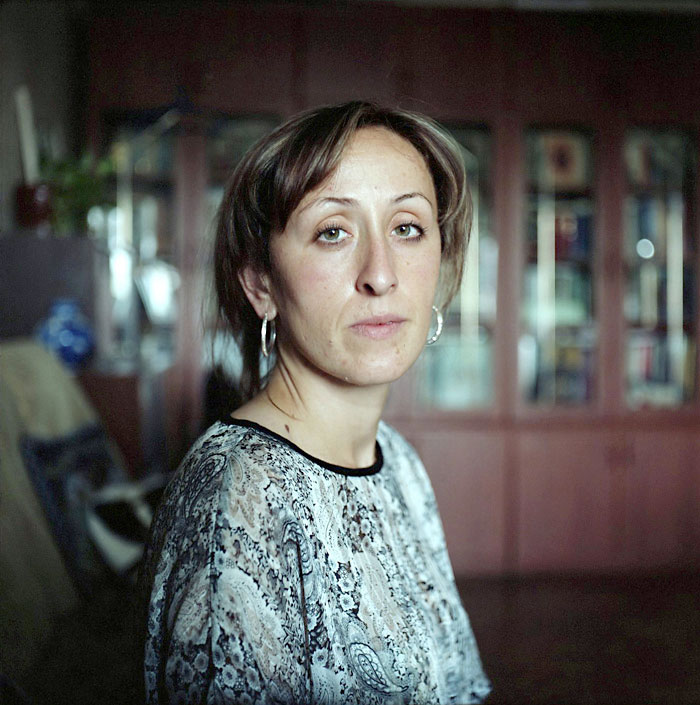
Zara Murtazalieva a week after the release. September 2012
In 2005, when I just arrived in the colony, there was a pass regime there. That is, in order to get out of the detachment and get to the headquarters, to the toilet, to the bathhouse, it was necessary to take a toon-transplant, to sign it in the magazine and, only when a person is gathering five, we are building a colony.
Three to four years later, the tokens were canceled in our colony. But they were not canceled in IK-14, where Tolokonnikov is now sitting. The first years that I sat in IK-13, we marching and sang, each detachment sang our song. For the best song, the detachments were awarded places, gifts were given - TVs, microwaves, refrigerators, irons, videos. All these gifts were brought by our relatives. For all these “luxury”, brought to the colony, the convicts softened the conditions of detention, removed violations, recorded rewards in personal cards, which was important for those who sought too. Our parents drove everything: from the rifs to the floral seedlings, which we then planted in the flower beds. Parents knew: without a “humanitarian”, the life of their children in a colony can turn into a nightmare.
Morning
The day in the colony began with a rise at 6.00. Many girls got up at 4 hours to have time to wash-in the detachment for 150 or more people there were only 10-12 shells, of which eight to nine were in service.
At 6.15, charging began. She was cursed by all prisoners from small to great. Often the administration forced to charge five to six times. After charging - breakfast. We were built five and went to the dining room - for the passage of breakfast it was possible at best to get a report, which means a penalty, or at worst - to get into a schizo. Breakfast is fresh cereal, and sometimes porridge from several types of cereals thrown into one pan and cooked hastily, with milk, half -diluted water.
After the dining room, all brigades were built on the parade ground and waited for the withdrawal to work. The conversations of convicts were punished by punishment - additional circles on the parade ground. When there is a 40-degree frost outside, walking in circles on a parade ground is a real torture.
Promka
It was possible to get to the industrial zone only by going through the checkpoint (checkpoint), where each convicted person was thoroughly searched. It is forbidden to carry tea, coffee, bread, sweets and much more on the industrial zone. Sometimes women hid bread behind the bosom, sewed additional hidden pockets where they hid tea: it was unbearable and boring to sit without tea, and many could not stand it without Chif (Chifir), on which long years of conclusion are sitting: he invigorates at night, warms up during the day.
Promzone is a dilapidated building crumbling from all sides. There are three sites, three sewing ribbons - 15–20 old cars are on both sides. Between them is a long iron table. Above the table - lamps. The floor is composed of rotten wooden boards: it was always scary that you can fall under the floor, break your leg or break your head.
In the cracks of these wooden floors, scissors fell, we had to open rotten boards and pull them out of there. The rules are such that until the whole tool received at the brigade is handed over, we cannot leave the sewing factory, even if we have to sit until the morning. There were times when the convicts who wanted to annoy us stole the scissors and threw them out into the street or to the toilet. Then we waited for hours while we were taken out of work and while the head of the colony deigns to forgive us. Antisanitaria, a flowing roof, non -working ventilation, the lack of elementary working conditions ... In the same territory there was a cutting workshop, where they froze clothes. We sewed everything - from camouflage shape to mittens and cotton teligars. If you see in the store products with the East-Service or Sirius label, you know: it is sewn in the convicts in Mordovia.
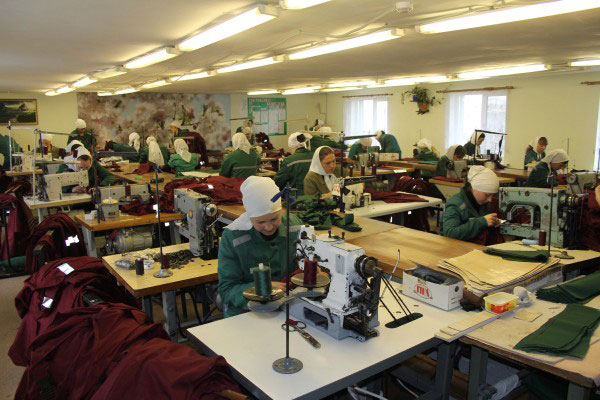
Sewing workshop in the industrial zone IK-13
Hands
In ten days, the brand new is obliged to learn how to sew and give the norm - 200 units, which in eight hours makes a very good seamstress. This means that the chances of the newly arrived prisoner are reduced to zero, and ten days to study no foreman will give her. If in two or three days the new one does not learn to sew, the prisoners will be taught very quickly. Everything is very simple: a few days later, the foreman will begin to scream at her, he will call her the last obscene words. If the new one does not understand, either the foreman or her “six” will take up the matter. They will take the brand new to the bended (the room where the finished products are stored). There they will be beaten up, intelligibly explaining how to sew. It is useless to complain somewhere.
The working shift looks like the whole industrial zone is a solid galley, and it has slaves on it. The foremen walk along the ribbon and shout: “Come on, move their hands, you, you fell asleep, b ..., where is the serving? I don’t hear the motors work! " So they spur lagging behind, and some get not only screams, but also blows.
The foreman is always right: when a new one comes to the brigade, the foreman should find an approach to her or simply “break” her - the brigade works either at fear or respect. The third is not given.
The first time, while I was not used to new circumstances and did not start to get tired at work madly, I was afraid to return to the hut after industrial and go to bed - I was scared of a stink emanating from women who were not used to washing. We forcibly drove some of them into the washbasin and waited until they put themselves in order. I scared me snoring - that sick, that healthy obese women.
In the summer in the hut in a room for 45-50 people it was impossible to breathe and sleep. The dream turned into torment, because Mordovia is famous for mosquitoes and mosquitoes who eat you alive in the summer, leaving terrible sores and blisters on the body, and then scars. It was especially difficult when midges appeared. The midges are terrible in that they gnaw a piece of flesh, and a huge bruise remains in this place - the bite is inflated and filled with incomprehensible liquid. Gradually, the body adapted and got used to new circumstances. The convicts often joke: "The first five years are hard, then you get used to it."
"Show"
Once, a Moscow commission came to the colony with a check. A few days before her arrival, the administration warned us that the slightest complaint could have serious consequences: “Remember, they will leave, and you will stay!” Indeed, they left, and we remained, and if one of the brand new convicts, not knowing the rules, risked complaining about the administration, then after the commission left, he rotted for 20 days in a schizo.
Before the arrival of the commission, we always prepared intensely for the show. A diverse assortment was urgently imported to the store at the colony, and rewritten prices for lower ones. We signed for a higher salary. Carpets were laid in the detachments, expensive curtains were hung, where necessary - tinted and whitewashed, pulled a musical center, a microwave oven and another “luxury” from the warehouse. We were explained that if they ask us where we have a refrigerator in the detachment, a washing machine and other miracles of equipment that we usually do not use, we need to explain that all this was bought for us with budget money, a respected and beloved administration.
Upon arrival of any commission, I always asked the question: do the inspectors do not see or do not want to see that when they enter the colony, it seems that all the convicts are extinct: so that they do not say excess, they are driven by the units and led the inspectors only to the proven convicts that will not say excessly. Do they really not see that in the detachment for 160–180 people only seven to eight toilets? Do they really not notice that the clothes in which the woman is dressed does not correspond to the climate of Mordovia? Quite stupid, the question seemed to me about what salary we have. Of course, the convicts lied and overstated their salaries two to three times, but it would be enough for the members of the commission to go to the store, see prices, demand a card of any prisoner in accounting and see how much it buys the products. But the inspectors did not want to see this and left, leaving us disappointed and confident in the futility of these commissions and our insecurity from lawlessness in the colony.
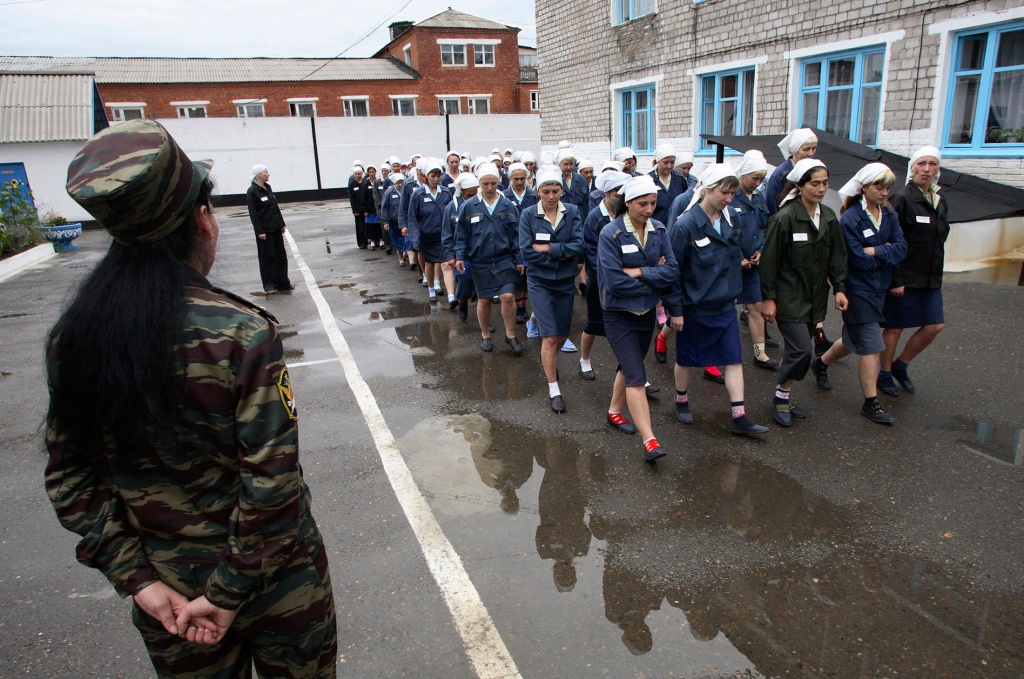
Convicts of the system are walking in the zone. 2013
Riot
Only once did we feel that we can still change something in this system. It was December, and in Mordovia there were terrible cold. On benches in front of the barrack, convicts were sitting, who were not allowed into the hut. They were punished "in the white." If the brigade has not passed the norm, then the foreman can punish the lagging seamstresses or “white”, that is, to deprive the right to enter the hut, deprive the right to eat and drink before the end. Such was the law in all brigades, in the entire colony. The prisoners, and sometimes the whole brigade, having worked 9-10 hours on the industrial, sat on these benches in the hope that the hill (foreman) would have mercy on them. But often they remained to sit before the end, then they were allowed to sleep from 10 a.m. to 11 a.m., and then they had to go out to work on a night shift. And it was just such a case: there were many women on benches.
Someone called the phone, and the foreman of the detachment ran to the duty unit. About twenty minutes later she returned and shouted: “The boss called, everything was on the parade ground, the boss said that if there was no spring in the colony by morning, we will stand on the parade ground two more shifts.”
Curses were heard, then everyone began to be insulated, hiding his hands in mittens, someone was wrapping a towel under a scarf. Everyone knew perfectly well what it was to do “spring on the parade ground”: the parade ground should be cleared of snowdrifts to asphalt. In the entire colony, a thaw was supposed to occur. Lack of shovels, brooms, scrapers for snow cleaning turned this work into a long tedious process, which, as a rule, ended with frostbitten arms, legs and noses. One of the foremen shouted: "Put the buckets right away, drown the snow!" The brigade rushed behind buckets and water. While the snow was rowing on the parade ground, the couple guarded the buckets: one was in the chief, water boiled in others, then to melt the snow. The so -called thaw in our colony could occur on any day of winter.
The main meteorologist here was our chief Nutskin Dmitry Petrovich. All the weather in the zone depended on him. We all fell on the parade ground, periodically throwing snowballs at each other. The zone took up "spring." In less than an hour, we heard screams: the foreman of the 21st brigade of Irma Kekutia and the head of the security department screamed at each other. Irma was one of those who pretended to be loyal to the administration, but in fact she used her good relations with the authorities to protect the convict that worked in her brigade. Now, on the parade ground, she cursed with the security chief, trying to explain to him that her team should go on a night shift on the industrial zone and that the convicts would not be able to work on Schweik after cleaning snow. But the security chief was adamant. He was not going to discuss the order of the head of the colony.
"
Everyone knew perfectly well what it was to do “spring on the parade ground”: the parade ground should be cleared of snowdrifts to asphalt. The thaw was supposed to occur throughout the colony
"
Irma unfolded anger and shouted through the whole parade ground: “Yes, go to x .., goat!” The security chief in the first minute was numb, due to the noise of the shovels, many did not hear what was said by Irma, but those who heard handed over to others-the parade ground froze in anticipation. The security chief shouted Irma: "Up to me!"
| *Samoen - a cell that stands at the entrance to the duty unit, where the punished convicts are planted. |
On the parade ground, everyone began to pour and build assumptions what would happen next to Irma. Half an hour later, along with the security chief, Irma went down to the duty unit, and they went to the duty officer. “Asshole” - the so -called convict, prone to escape, - just went to the duty unit to be noted. They had to sniff and tell us what was happening there. The first we came to us Zubin Natasha. She said: "Irma in the sump*, he beat her, and she stands there undressed."
We decided to stay on the parade ground and demand that Irmm be released from the cage and called the head of the Mordovian Federal Penitentiary Service to the colony. We crashed into brigades and lined up opposite the duty unit. The senior duty officer Vasily Ivanovich came to us.
"What are they lined up?" He asked. We agreed in advance that when the authorities asks what we were rallying against, we will talk together so that they do not look for a disorganizer among us and then do not present a colony to the head of the colony for further punishment of one as an instigator. From different corners of building, first quietly, then it swam louder and louder: “Return to Irma, we will not leave until you let go of the foreman!”, “Call here the head of the colony and the head of the Federal Penitentiary Service!”, “She will die there!” When the security chief appeared, the one that I was imprisoned by Irma, we all shouted in chorus.
We did not disperse after an hour or after another. The DPNA (the assistant to the head of the colony) was forced to inform the head of the colony that we had an emergency and that convicts were refusing to go to bed.
An hour later, Netskin arrived in the colony. He did not talk to us. He quickly went into the duty unit and in the windows lit by light, through the bars, we saw how he screamed on his subordinates. He shouted so loudly that we almost distinguished words. He yelled that if he was fired, they would have to answer with him. We listened to him and rejoiced. It was our victory.
Soon, the already dressed Irma came to us, frozen, but also happy that we all fought for her. We hugged and kissed her, and Irma cried and through tears tried to say to each of us: "Thank you, girls." The next day, she threatened the security chief of the complaint to the prosecutor's office, but then took his apologies. As we later found out, the “owner” himself asked her about this (this is what we called the head of the colony) - she had no other option.
Photos: Igor Starkov, press service of the Federal Penitentiary Service of Mordovia, Ilya Naimushin/Reuters