
Translated material
Forbidden Islam
Report from the underground mosque
According to the All -Russian census, about 350 thousand people representing nationality professing Islam live in Moscow. The FMS adds a million migrants to them, most of which are visitors from Central Asia. According to unofficial data, up to 2 million Muslims live in Moscow, and, according to some estimates, about the same amount can come here every day to work from the nearest areas. In the Russian population, Muslims are caused by fear and rejection, in the unofficial chapel houses, the authorities see the foci of radical Islam in the everywhere that open everywhere. The New Times went to the underground mosque, talked with those who feel in Moscow by stranger and who are perceived as a stranger, and found out how similar problems are solved in other cities of Europe
The industrial zone in the Dubrovka metro area, gloomy hotels, tram tracks, the taxi driver suspiciously looks at bearded men converging from all sides to the unremarkable brown gate. “Yoshkin Cat, they closed this mosque here, but they still come! What kind of people?! " He grumbles.
There is an announcement on the gate that Friday prayer is not carried out, and parishioners are asked to find another place for prayer. But people still come: how without prayer. We are in one of the many “unofficial” Moscow mosques that are not subordinate to the mufti. Anyone can come here, at the entrance they do not ask nationality at the entrance, but the Azerbaijanis-Sunnis-Salafites*-long beards, concentrated glances, some skullcaps on their heads gather here. There are visitors from Central Asia and a couple of Slavic persons.
| * In Islam, there are three main directions - Sunnism, Shiism and Charidzhism . About 90%of all Muslims - Sunnis, Shiites up to 10%, Haryidzhits - less than 1%. The split in Islam occurred on the leadership of the community of believers. Shiites believed that only the descendants of the prophet along the line of his cousin and son -in -law Ali can stand at the head of the Ummah (to be imams, or caliphs). The Sunnis believe that the community leadership should not link with blood kinship with the prophet and he himself did not say anything about this. Shiites prevail in countries such as Iraq, Iran, Azerbaijan, Bahrain, Harijita in Yemen. Salafism is one of the radical directions in Sunnism, which sets the goal of returning to the origins, to the main texts - the Koran and the Sunnah (Biography of the Prophet). |
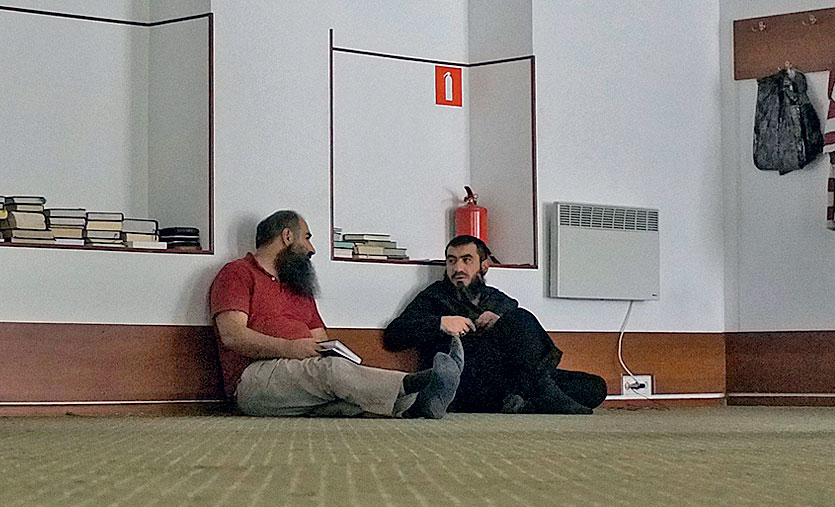
The mosque itself is a white two -story building behind a high fence: a small hallway with shoes for shoes and a box for sadaki (donations), a restroom equipped with a green carpet, a chapel room with a wooden minibar (department) and books in niches (a Qur'an in Arabic and Russian, its interpretation and other religious literature). In anticipation of Imam, those who came to sit on the floor in Turkish, take the Qur'an, read prayers, silently moving their lips. A five -year -old boy who came with his father approaches an unfamiliar elderly man, wakes him up: “Hey uncle, you can’t sleep here.”
"
Finally, Mudejin pronounces a chant that is understandable even to the uninitiated Allah Akbar, and the prayer itself begins
"
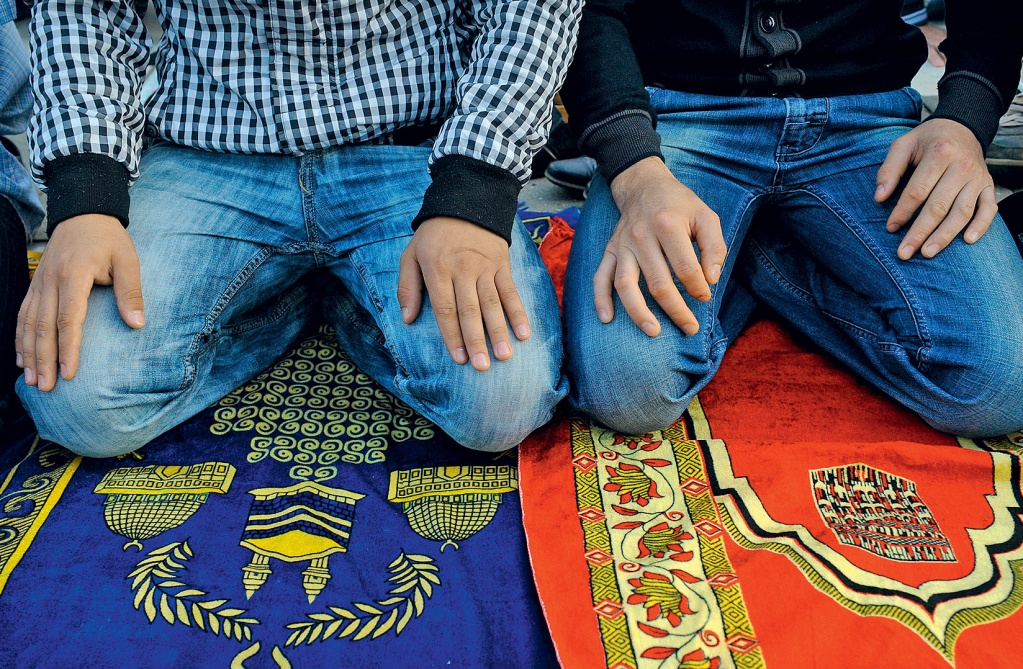
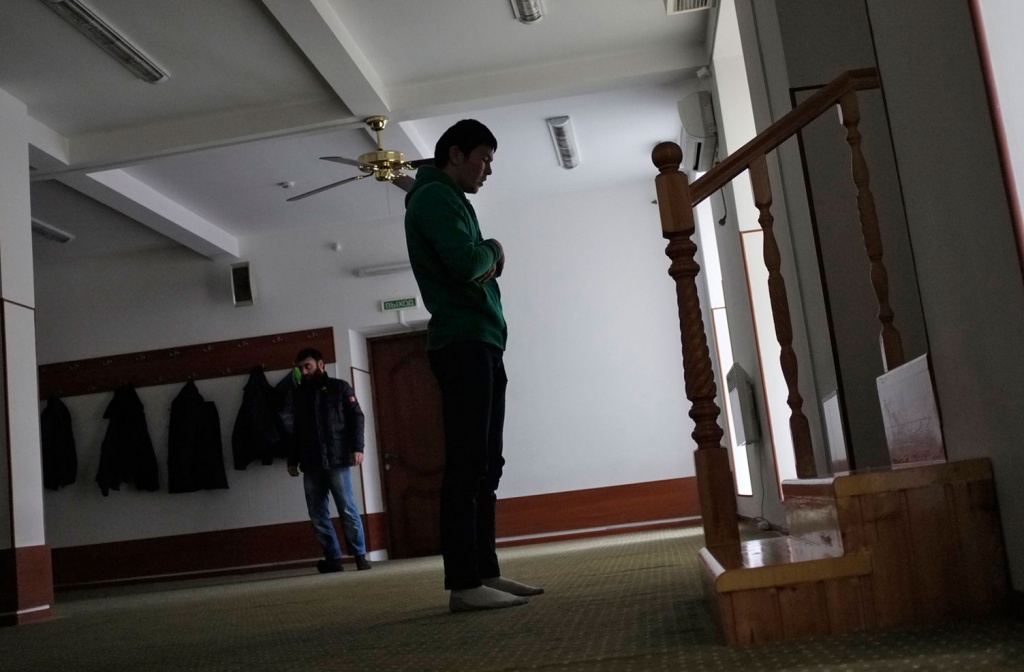
Finally, the imam is dressed in the traditional white long -legged clothing. The mosque is full, the back rows listen to the sermon standing. On both floors, up to 400 people are placed, not a single mobile phone violates the even speech of the imam. “Each business,” he says, “should be based on a godly intention.” For example, as you can’t just make battles before prayer, not tuning in to communicate with God, you can’t do a single business in life with evil intentions. Every week, preaching is read by different imams, today says in Azerbaijani, although there are sermons in Russian. Finally, Mudejin pronounces a chant that is understandable even to the uninitiated “Allah Akbar”, and the prayer itself begins: lined up in the ranks, like on the beds, men rush to their feet, then kneel down again, reading to themselves the Surah of the Qur'an. Everyone is now alone with God, but at the same time with other Muslims, because this is the main rule of any prayer, and especially on Friday: the more people, the more rewards from God.
Imitation of the Qur'an
| ** The Oktyabrsky District Court of Novorossiysk on September 17, 2013 recognized extremist published by many thousands of circulations the semantic translation of the Qur'an Azerbaijani scientist Elmira Kuliev. The Council of Mufties of Russia called this court decision “shameful”, and the All -Russian Muftiyat, on the contrary, said that the translation was made in the Salafitian tradition uncharacteristic of Russia |
After prayer, they do not diverge immediately, they gather in groups in the courtyard and in the mosque itself, they talk. This is not to say that they look at the Russians here with some special interest, but if you came for the first time, they will come to you, ask how things are, are there any questions. The 18-year-old Azerbaijani Kenan, a student, the future architect who came to Moscow with his parents from Nefteyugansk, offers to spread his wrists with aromatic oil: “You will smell good, brother”. Having learned about the purpose of the visit, he says: “Praise to the Almighty, that there are people who are not afraid to come to us, write about us that we are not terrorists.” Kenan is staring intently with huge brown eyes, in which, in addition to the interest in the beginner, gratitude and some kind of calmness inherent in many religious people glow, regardless of faith. “I am sure, brother, that if you write about religion, you yourself become a Muslim,” says Kenan and begins to talk about faith, about Islam, about the prophet. Another Azerbaijani helps him, introducing himself to the Renat: “If you want to write about Muslims, read the Koran. The best translation of Elmir Kuliev ”**. In general, a lot is said about God here: proselytism is one of the most important tasks of Islam. Many believe that if at least one infidel is able to turn at least one, a place in paradise is provided.
They quote, however, not only the Qur'an. To the surprise of The New Times, Kenan suddenly begins to recite ... Pushkin:
The land is realized - the sky of the arches,
Creator, supported by you (...)
He is merciful: He is Mohammed
Opened a shining Qur'an
Yes, we will drain to the light,
And may the fog fall from the eyes.
"Here, even Pushkin wrote about the omnipotence of the Lord!" - exclaims almost theatrically Kenan, and his voice rings in the cold autumn air.
Salafit is not so terrible
Of course, Salafism is considered the only true direction of Islam in the mosque on Dubrovka. “Salaf - translated“ Landscape ”. The associate of the prophet, ”Kenan patiently explains. “The Salafites keep the path of Salaf, the path of purity, as is written in the Qur'an, without any allowances.” The desire to return to the origins is characteristic of any religion, it is not new for Islam. “It’s as if a Christian was guided by the biography of the apostles and tried to literally follow the Gospel,” the chairman of the Islamic Committee of Russia Heydar Dzhemal (also by nationality of the Azerbaijani) explained to The New Times. - This is the doctrine of the vicious, satanic, unjust nature of the modern world order, in which Islam is the only doctrine, the community struggling for divine justice, the island of Pravda among the ocean of corruption and injustice. Salafism is universal, this is a means of exposing the masses driven into the corner. ”
| *** Sufism is a mystic-ascetic current in Islam (Shiite and Sunni), setting the priority of the believer to know God through self-improvement, in which the spiritual mentor, alive or dead, rising his spiritual genealogy to the prophet helps him. **** Wahhabism is a movement in Sunni Islam, formed in the 18th century and named after the Arab theologian Muhammad ibn Abd al-Vahhab. Wahhabism is an official religion in Saudi Arabia. |
The Qur'an and the Sunnah (the biography of Muhammad) are the main texts of the salafites that reject most of the late texts and comments offering the rethinking of the original sources. Not just monotheism, but direct worship of God is another feature of the Salafites who do not recognize the clergy or any intermediaries between man and Allah, this is their main difference from Sufis, sometimes leading to bloody clashes ***.
"
Over the past three months, the administrations of most markets terminated the contracts for the rental of chapel pavilions and forbidden to pray
"
Salafism, as a direction, took shape in the middle of the 20th century, and for the iron curtain of the countries of the former USSR only in the 1980s penetrated. “The first Salafi community arose in Dagestan in the 1980s,” the senior researcher at the Institute of Ethnology and Anthropology of the Russian Academy of Sciences Akhmet Labelkapov told The New Times, “however, they were immediately christened“ Wahhabis ”**** and quickly closed them. Then there were Chechen wars, Wahhabis began to be mistakenly called forest militants, under the same comb terrorists and extremists raked and the Salafis. ”
According to the scientist, the Salafi movement is heterogeneous, and the general radical installation on the literal fulfillment of the rules of the Sharia can be followed by both the ascetes-salafites living in the western countries and the fighters of Al-Qaeda, the main goal of which is the Holy Jihad for the establishment of Muslim rule throughout the globe. “There are not so many radicals ready to take up weapons, especially in Moscow,” Ahmet Labelkapov is sure. “Most of this is not radicalism, but simply an unexpectedly awakened religious feeling, but in neophytes, you know, eyes always burn.”
Behind the new faith
There are really a lot of neophytes here. Kenan began to read prayer only six months ago, his parents were non -religious and at first looked at his son askance. His Russian friend Sergei, also from Nefteyugansk, a football player, a student of one of the capital's universities, accepted Islam two weeks ago. “I used to go to church, but I felt bad there. The pressure is some constant. I could not stand it. And in the mosque I am calm and good. " Sergei's parents took his new faith in bayonets, many friends turned away: “They look at me like a madman. They say that I got into some sect. And I just began to live by law. I used to live wrong, did bad things. ” When asked what kind of bad things, Sergei explains: "He drank, smoked, went to discos."
Similar stories and more adult parishioners. Azerbaijani Magomed 53-year-old caretaker came from Irkutsk. He worked there all his life as a driver (although he never received his rights), there was a wife and daughter, but - he drank a lot, lost both work and family. Islam saves, now does not drink, prays, tries to put it on the rights. His 40-year-old friend Ilham, also Azerbaijani, only from Ulyanovsk, read the first prayer six years ago. He also lost his family and business at some point: “Everything was, and suddenly nothing became. This is the Lord led me to ensure that I would take the right path. " And only Tajik Kurban said to our group said that the namaz reads from the 4th grade, his grandfather taught him to pray, and goes to Dubrovka to be close to the house. In the hands of Kurban the Qur'an in Arabic. In Arabic, he does not say, but he knows how to read: “We, in Tajikistan, one brother went to Pakistan to study, then returned and taught me to read. I am pleased to read in Arabic, calms down. ”
Islam in a big city
However, not only life turmoil or youthful mysticism leads to the Muslim mosque. For many visitors, faith becomes the only point of self -identification. “Before that, they were Avars, Ingush, Nogais, and, being in a large city, they suddenly realized that they were Muslims, and this Muslim identity became the main one,” explains Ahmet Labelkapov. - In addition, Islamic communities are very active, people find support there, moral comfort. This all leads to the fact that people suddenly become active believers. Some part is radicalized, begins to follow a more stringent currents, and when it returns to their homeland, there are often problems with them, because they begin to think that Islam is not so correct. ”
For the radicalization of Muslims, the Russian government itself, de facto pursuing Muslim minorities, does a lot. The announcement that there will be no Friday prayer appeared on the gates of the mosque on Dubrovka it is no coincidence: on Friday, June 7, law enforcement officers who detained 300 people appeared here. A similar raid was also held in another Moscow Muslim community, Darul-Arkam on Paveletskaya: here on April 26, police officers and the Federal Migration Service were blocked for several hours, checking the documents. In the mosque itself, they conducted a search, detaining 140 people. Today, at the Gate of Darul-Arks, there is also an announcement that there is no Friday prayer, although in fact it is carried out for a limited number of parishioners. “Here are your journalists that they detained 140 radicals, and they don’t write about what they let everyone in,” one of the members of the Adam community complains (according to the Ministry of Internal Affairs, among the 140 detainees, two people who were undergoing an extremist orientation crime were held accountable for violation of migration laws). Adam himself is from Chechnya, the prayer also began to read just a few years ago. “Of course, residents did not like when two thousand people gathered here on Fridays, all parking lots were busy, many prayed behind the gates. But where else do they go? " Previously, there were lectures in Darul-Arkama, there was a kindergarten and an Islamic school, now the community is re-registered to continue to work, albeit not in full. “They tell us that people are leaving for us to fight from us,” says Adam, “but what is our fault?” We do not know what is on the mind of those who come to us. In the sermons, no one calls to go to the forest. Let the police come, listen, we don’t feel sorry for. ”
In the Ministry of Internal Affairs itself, The New Times did not answer the questions, saying on the phone that there were no problems with underground mosques, and all raids are carried out only to identify violators of the passport regime. Practice, however, shows that this is not entirely true.
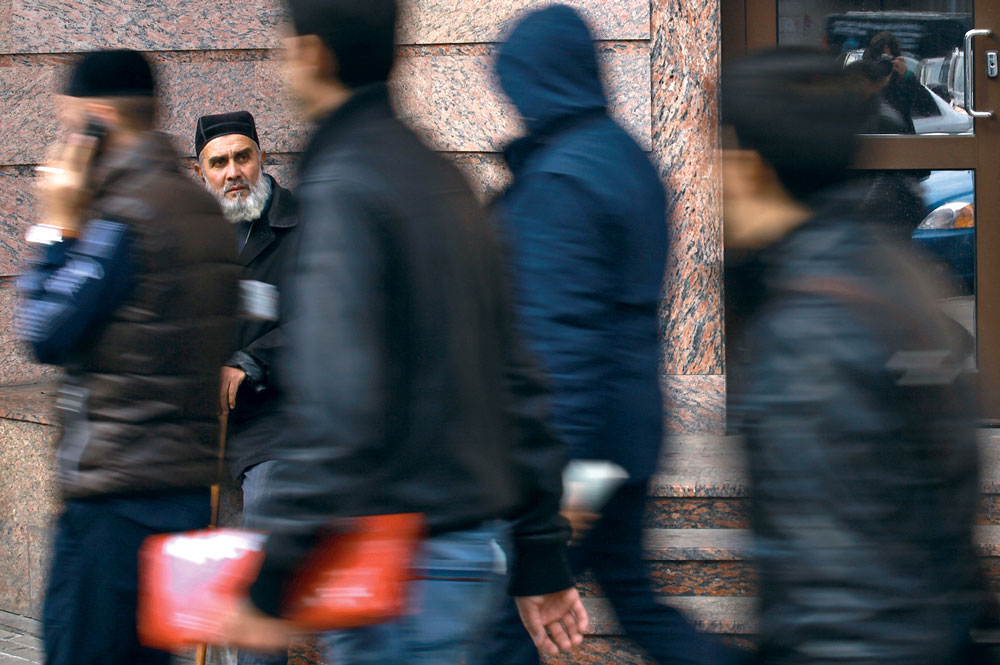
It is forbidden to pray
| ***** Flying is the food allowed by the laws of Sharia. |
When Moscow mayor Sergei Sobyanin promised to put things in order in the capital's markets at the beginning of summer, this was followed not only by mass detention of migrants, but also by the mass closes of prayer rooms and mosques. “We need to read the prayer five times a day,” explained the New Times Hadji Murat, who arrived in the 90s from Tajikistan, the owner of the free ***** cafe in one of the Moscow markets. “In the mosque, it is imperative to be only on Friday - on sermons, on ordinary days you can pray anywhere, but it is still better to pray together.” Traders in the markets threw away and filmed individual pavilions for the chapel, where in most cases there were cameras so that no one had questions. But over the past three months, the administrations of most markets terminated the contracts for the rental of chapel pavilions and forbidden to pray. “The administration doesn’t care, there are mountain Jews there,” says Haji Murat. - They called from the FSB, they immediately reacted. What are the markets! I have a house outside the city, we celebrated Uraza-Bayram, sat several families, twenty people, children, women ... Then it came to the district police officer to check the documents, it says that we had a thousand radicals gathered. I show him that there are no radicals, there are only children. He checks his passport and leaves, but the holiday is spoiled. How can you come to someone home without a warrant, without everything? It’s good that at least a polite came across. ”
However, according to the Heydar Jemal, the closure of prayer rooms and prayer houses is a normal process in the country where law enforcement officers need to receive for something stars, and the rest of the time to pull money from the markets.
Forty forties
According to the imam of the memorial mosque on the Poklonnaya Mountain Shamil Alyautdinov, only two million Muslims - citizens of the Russian Federation living in Moscow, it is necessary to build a minimum of mosques for 5-10 thousand people each (Shamil Alyautdinov refused to answer the questions of The New Times, referring to employment, but these numbers were voiced in the interview of Radio Freedom 11 October 2010) the guilt for the fact that the mosques are not built, the mufti, although not very actively, falls on officials. “The mufti is completely sabotages its tasks to defend the interests of the community,” Heydar Jemal argues with this. - These are cowardly Tatar officials from religion, who are preoccupied with personal survival. They sit in their bureaucratic ghetto, in the "oven", as it is called on the street, and saw money. "
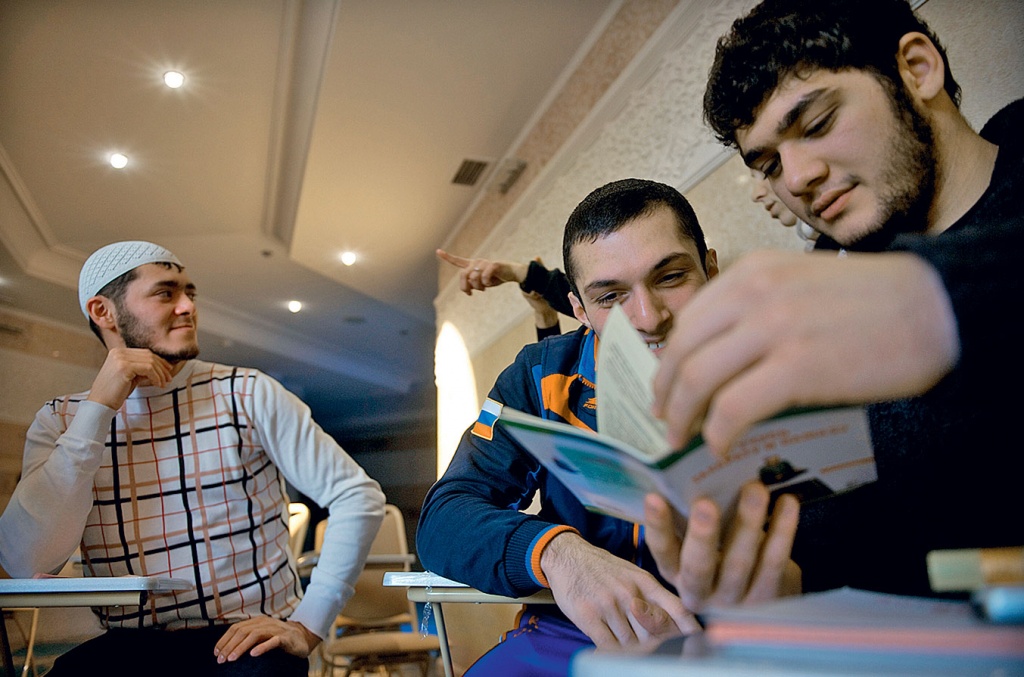
Practice, however, shows that attempts to build at least one mosque turn around by a sharp confrontation of local residents. So, in 2010, the Muslim community raised money and received permission from the Moscow authorities to build a mosque on Volzhsky Boulevard. However, after numerous protests, the city hall changed her opinion - and the mosque was never built. The official reason is the preservation of the park, in the place of which the mosque was supposed to be. Однако сотрудники префектуры на условиях анонимности сказали The New Times, что на самом деле никто не хочет, чтобы мусульмане пустили корни в Москве: «Сначала мечеть, потом мусульманское кладбище, потом что? Пока мечети нет, есть возможность мигрантов выселить, когда она будет построена, придется жить с ними рядом. А русским куда деваться?»
Впрочем, по мнению представителей самой мусульманской общины, проблемы с местными жителями надуманны. «Это все было организовано ДПНИ (Движение против нелегальной миграции. — The New Times) и прочими националистическими движениями, — уверен Гейдар Джемаль, — которые выдавали себя за жильцов. Представители муфтията ходили по квартирам, спрашивали жильцов, большинству было все равно». Эту информацию журналу подтвердил и председатель Духовного управления мусульман Азиатской части России муфтий Нафигулла Аширов: «Все эти протесты подогреваются властями. На самом деле с жителями всегда можно договориться. Когда у нас сносят памятники и строят на их месте бизнес-центры, на протесты никто не обращает внимания, а тут власть решила прогнуться». Поддерживает эту точку зрения и этнограф и политолог Эмиль Паин. По его мнению, политика разжигания межнациональной и межрелигиозной розни сознательно поддерживается властями. «Есть возможность устраивать молитвы в парках или в каких-то других общественных местах. Это, конечно, вызовет недовольство населения, которое сегодня поддерживается в различного рода предрассудках. Но не всякий общественный протест заслуживает поддержки, — считает ученый. — Нужно развивать бóльшую терпимость к проявлению религиозных чувств, иначе религиозное противостояние может обернуться резней».
Официальный же курс мэрии озвучил на заседании дискуссионного клуба «Валдай» 16 сентября Сергей Собянин, по мнению которого, дополнительные мечети Москве не нужны, а существующие переполнены из-за наплыва мигрантов. «Москвичей там — 20–25 %», — заявил мэр, не сказав, впрочем, почему мигрантам нужно отказывать в праве на исправление культа.
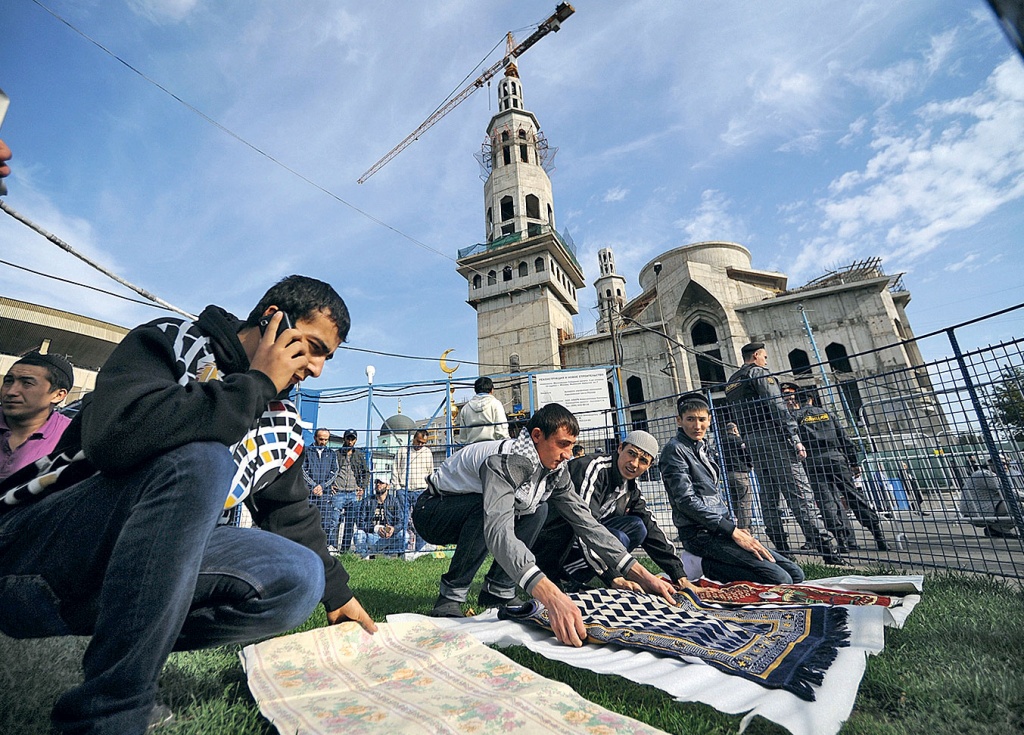
Молитва на стройке
| ****** Сунниты условно делятся на четыре богословско-правовых толка (мазхаба), названных по именам стоявших у их истоков суннитских теологов: ханафитский , которому следуют мусульмане Центральной части России и Средней Азии, а также большинство кавказских народов; шафиитский , популярный у чеченцев, дагестанцев и ингушей, а также в Сирии, Ливане, Палестине и Индонезии; ханбалитский , распространенный исключительно на территории Аравийского полуострова; маликитский толк, распространенный в африканских странах. |
Называя цифру — 100 мечетей, Шамиль Аляутдинов, скорее всего, не учел верующих, исповедующих другие направления ислама и не желающих молиться в подконтрольных муфтияту мечетях. «Со времен развала СССР московская мусульманская палитра кардинально изменилась, — объясняет Ахмет Ярлыкапов. — Если раньше тут жили в основном татары, последователи достаточно либерального ханафитского толка******, то в последнее время приехало много шафиитов с Северного Кавказа. Иногда они вместе молятся за ханафитским имамом, но потом устраивают на всякий случай повторную молитву со своим имамом, так что Шамилю Аляутдинову даже пришлось издать специальную фетву о том, что молиться нужно вместе». В Москве есть и шииты (в основном азербайджанцы), предпочитающие вовсе не молиться в суннитских мечетях. Да и салафиты с Дубровки официальные мечети недолюбливают: «Много лишнего они там говорят, — качает головой Ренат, — к тому же отходят от правил, говорят, бороду не обязательно носить».
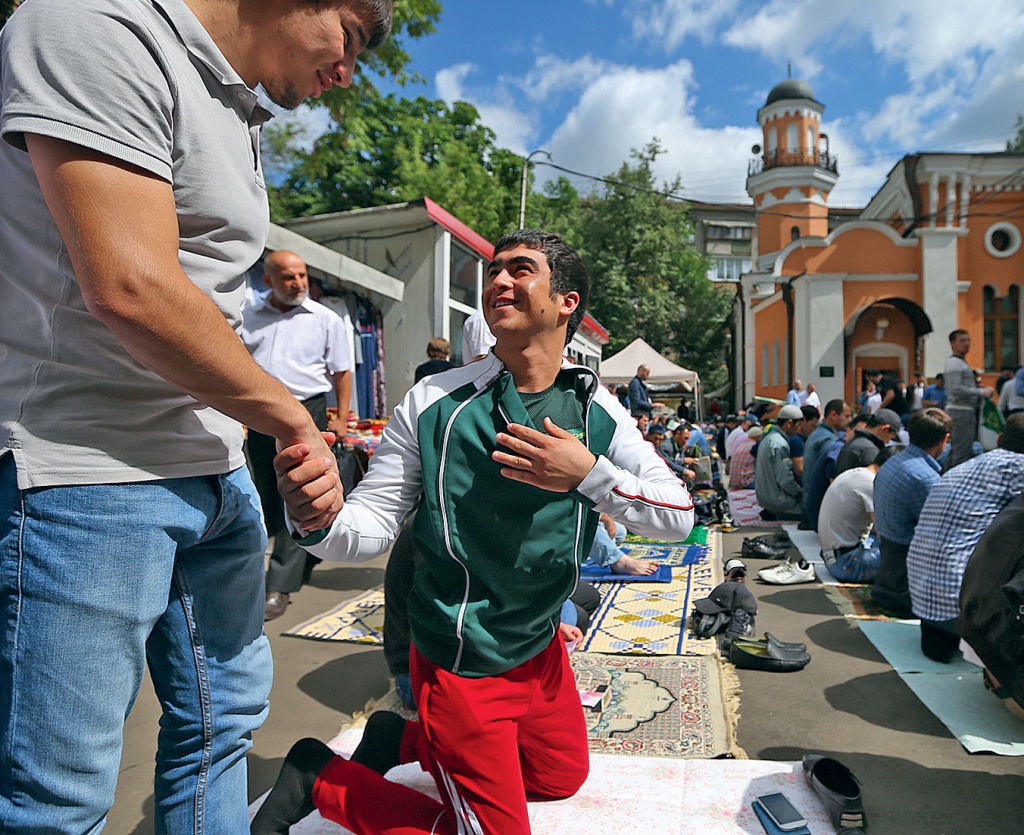
Сегодня помимо мечети на Поклонной горе в Москве действует Историческая мечеть на Большой Татарской улице и мечеть в Отрадном. Московская соборная мечеть на проспекте Мира «реконструируется» с 2005 года, старое здание 1904 года постройки при этом снесли, а новое превратилось в долгострой. «Огромные деньги были собраны у мусульман на ее строительство, бюджетных средств там вообще нет. Но все разворовано муфтиятом!» — восклицает Гейдар Джемаль. Впрочем, даже и недостроенная мечеть собирает каждую пятницу до десяти тысяч человек, что, безусловно, отразилось на инфраструктуре района: на каждом шагу стоят халяльные лавки, в округе несколько халяльных ресторанов, в которых можно пообедать после намаза. Одни старушки продают полиэтиленовые подстилки под ноги, другие — нарезанные куски обоев, служащие молельными ковриками, третьи просто просят милостыню у «братьев мусульман». Вот только молиться особенно негде. Во временной деревянной пристройке не помещается и сотни человек, так что мусульмане, пройдя металлоискатели, расстилают свои коврики прямо на асфальте, тут-то и помогают полиэтиленовые пакеты от старушек.
"
Сотрудники префектуры: «Сначала мечеть, потом мусульманское кладбище, потом что? Пока мечети нет, есть возможность мигрантов выселить, когда она будет построена, придется жить с ними рядом. А русским куда деваться?»
"
Московская осень не слишком благоприятствует уличной молитве. Дождь льет прямо на коврики, ветер треплет расстеленные на земле газеты, строительная пыль превратилась в месиво под ногами, так что клади на него газету не клади, все равно испачкаешь брюки. Судя по лицам, в основном тут приезжие из Средней Азии, хотя есть и представительные азербайджанцы в директорских костюмах, и молодые ингуши в зауженных бежевых брюках и с новыми белыми айфонами: перед Аллахом все равны, и в московской грязи тоже.
| ******* В московских мечетях проповеди традиционно читали на татарском, поскольку татары составляли костяк московских мусульман, однако в начале 2000-х к татарскому языку добавился русский. |
Проповедь на двух языках — татарском и русском*******, хотя, как говорят пришедшие узбеки, для многих эти проповеди слишком сложны. Но главное снова — просто молиться вместе. Намаз неожиданно прерывается беготней полицейских: оказывается, прихожане перекрыли въезд транспорту на стройку. «Вашу мать, ну что вы сюда запёрлись? Кто вас просил? Вон там ваше место», — кричит полицейский, разводя руками. В запретном отсеке собралось минимум две сотни человек, выгнать их невозможно. «Мы не запёрлись, мы помолиться пришли, уйдем все через десять минут», — отвечают ему. Полицейский продолжает материться, его коллеги зачем-то озабоченно бегают из стороны в сторону, потом уходят, оставив на страже молодого сержанта. Silence. Rain. Из динамиков вырываются арабские молитвы. Голубоглазый сержант безучастно стоит посреди моря спин, распростертых среди арматуры, заграждений, бетонных блоков и грязи. Им не до сержанта. У них — свой разговор.
фотографии: Кирилл Калинников/РИА Новости, Петр Быстров/Коммерсант, Артем Сизов, Валерий Шарифулин/ИТАР-ТАСС