
Translated material
Alien like a mirror
What is the difference between Pakistanis in London from Koreans in Vladivostok and "who came in" in Moscow
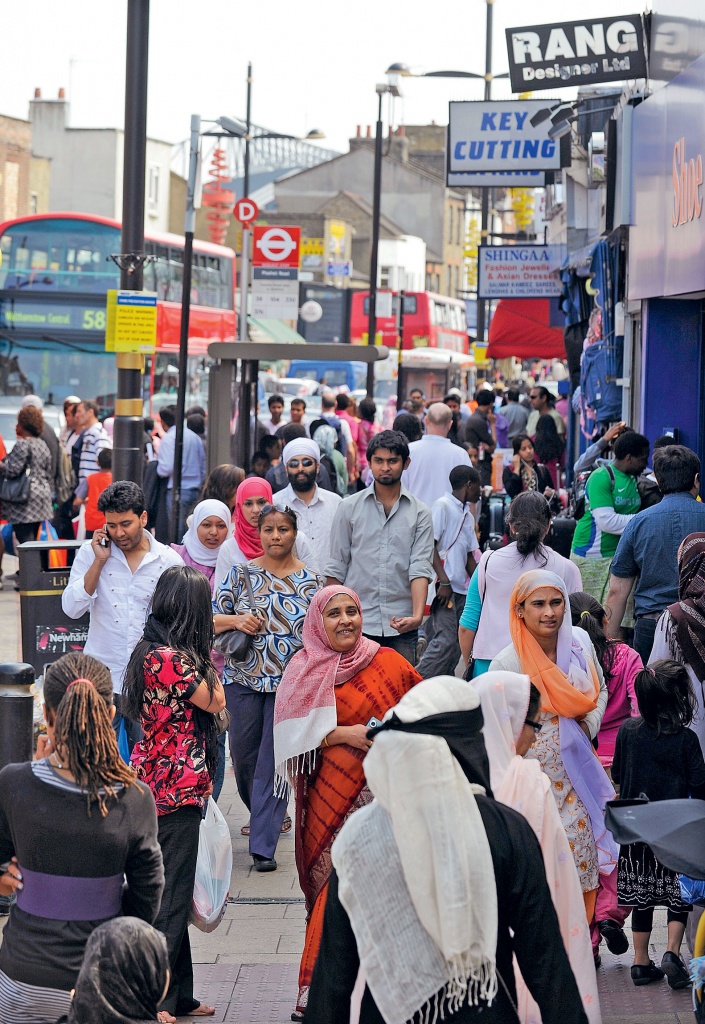 |
| “I found that the white-skinned Anglo-Saxon Protestants among the inhabitants of London make up a rather insignificant minority” |
In the fall of 1988, I first ended up in the city of London. It is easy to guess that for an impressionable 22-year-old young man who grew up in the USSR and for the second time in his life in Kapstran, there were enough reasons for surprise in the British capital at every step. People were amazed on the streets, their clothes and manners, struck the catering and consumer goods, the number and thickness of daily newspapers on street trays, impressed musical theaters and bookstores, puzzled the royal decrees nailed on the walls of the houses, and the terrifying state of public transport (the wagons of the London metro at that time had a wooden half, which was not a wooden one, which was not a wooden one, which was not a wooden one, which was not a wooden one. It is worth gluing on the way home from a pub or from the stadium and it is almost impossible to wash it later) ...
But most of all these grimans and miracles of capitalism were struck by the discovery, which could not prepare a graduate of the Moscow Special School or reading the communist The Morning Star, nor political information at the institute, or the “International Panorama” on central television, nor a twenty -coo -cape weekly weekly “abroad”. I found that the white-skinned Anglo-Saxon Protestants among the inhabitants of the British capital at the end of the twentieth century are a rather insignificant minority. The very first overnight, where I stopped in London for 18 pounds a day, having reached a suburban train from the Khitrovo airport to the Paddington station, had a large Arabic sign, and its staff struggled English words to explain with me. Having spent the night there, I went to look for Trafalgar Square, but before the Nelsonova column I came across Chinatown, where the Chinese signs above the shops and restaurants were much more noticeable. There, by the way, I had breakfast, having opened for myself the unfamiliar words “Dim itself” and “Tsindao”. And having quenched the hunger, I looked after the cigarettes in the nearest prodmag, where I was waiting for my acquaintance with representatives of the most numerous ethnic group of non -native residents of London. At that time, the Pakistanis were at that time. And today, 25 years later, among the London shopkeepers, pilots, government officials, they still make up the majority. The only thing that has changed since then was that I lived in different countries of the eastern hemisphere and traveled to the west from the Atlantic to the Pacific coast, I forgot how to attach any importance to this. Pakistanis, Schmakistians. I myself, by the way, are not an English lord.
Today, in Russian megacities, many of my fellow citizens are discomfort from the consciousness that they are surrounded by Tajik janitors, Uzbek builders, Caucasian bombers and other non -Orthodox brothers in mind from all sides. In Vladivostok, from where I have been writing these lines, the role of the “came up” from the end of the 19th century has been played by Koreans with the Chinese.
"
National, ethnic and cultural minorities are hostile to the “indigenous population” just as much as this population sees the enemy in them
"
I really understand the fellow citizens: it is sometimes uncomfortable for me that a significant part of passers-by on Moscow streets does not speak Russian. Once again, I had the opportunity to verify this in early September, when I distributed the campaign materials of Navalny in Cuba at the Dobryninskaya metro station. But there is one simple thing that I managed to understand over the past quarter century, having lived in Jerusalem and London, Limassol and New York, Moscow and Venice, in the States of Goa and California ... National, ethnic and cultural minorities are hostile to the “indigenous population” just as much as this population sees the enemy in them. The ratio of ethnic and religious minorities to the “titular nation”, like a mirror, reflects the ratio of the indigenous population to themselves. Where people see them, they behave like people. And where they see only a threat in them, they become a threat.
Maybe I’ll say a blasphemous thing, but the difference between Moscow and Paris, London, Shanghai or New York is not that they don’t dance anywhere on the streets of Lezginka. The difference is that only from us from street dance you can inflate a large political problem. And if there is a desire to solve this problem, then you need to start not with Lezginka, but with our attitude to it.
Photo: Paul Hackett/Reuters
Continuation of the topic - in the material "Forbidden Islam"