
Translated material
Too human
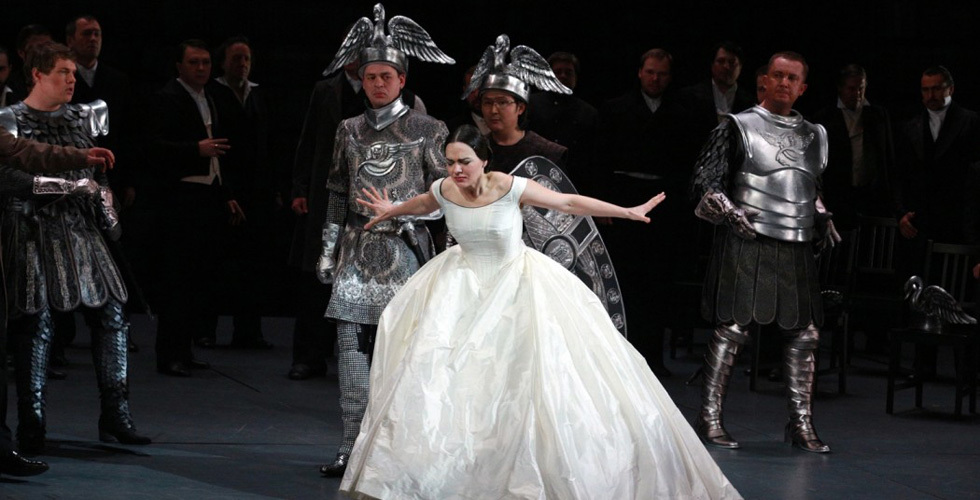
The first premiere of the season at the Stanislavsky and Nemirovich-Danchenko Theater, initiated by the Wagnerian anniversary, is a new, quite heroic experience in mastering an unwell musical style with its own. There were already Pelleas and Melizanda Debussy (several imported craftsmen were still invited to these products), Britten’s “Summer Night Dream”-and now the first Wagner in the history of the theater.
On their own - this refers to soloists. They kept the Wagnerian blow very steadily. The most harmonious was Anton Zhaev in the party of tungsten von Eshshenbach, a singer of high relations in love. The singer of passion, actually Tangaer, - Valery Mikitsky - honestly coped with the party, but could not prove that she was pleasure. In addition, he really overdo it with the same type of suffering on the advance (however, this is a question for the director). The mighty beauty of her voice was demonstrated by Natalya Muradimov as a sacrificial modest of Elizabeth, but only vowels were heard from the German language, and this is not German. Venus, the embodiment of the opposite feminine, was somewhat frightened by Larisa Andreev.
In general, a risky journey to the Wagnerian musical world was stable by the control of the factory of Bollon, a French conductor invited to this production. The fluid of the element, with which Wagner's work is associated, was not observed here, but there were strong ensembles and a dynamically built form, emphasizing the style of a large French opera (“tangaiser” is still an early, neglect).
Andreis Zhagars was invited by the director of the performance, just during the staging process, which was dependent in indefinite relations with his main place of work -the Latvian National Opera . Jagars on the Russian stage, which has already staged performances in the New Opera, the Mikhailovsky Theater and Perm, are not a cat in a bag, but quite definite expectations of tireless Europeanism and exquisite Riga glamor, which were fully justified.
It must be warned that Zhagars is almost always not only Jagars. As a rule, a scenographer Andris Freibergs and costume artist Christine Pasternak are attached to him. This time, a choreographer Rad Pokltaru, who put dancing in the grotto of Venus, was added as a bait, but, the taste of musical critic, Wagnerian music crushes them like a plywood hurricane.
As for Freiberges, this is always the key to quality and taste. In this case, the pole of the Wagnerian myth is painted with the green color of the venein winter garden with swaying video pads and the gray-beige color of the library of the city of Vartburg, where the singers are competition. Between these extreme points is a meaningful foggy area with a mirror reflection on the ceiling, under which the processions of the pilgrim rushes to the Pope.
And Pasternaka is a guaranteed fashionable defile, in which the finest irony and frank chic coexist in some incomprehensible way. In the production of Jagars, there is always a place for him. In Tangaiser, this happened, oddly enough, not in the scene of a bacchanalia in the grotto of Venus with his simple -minded negligence, but just in the library, during the training of guests fastened to the singing competition. Swimming crinolines with the ingenuity of textures and the refinement of the color scheme for some time generally obscure both music and the plot. Then, competing, dressed in hilarious masquerade armor, each scales on which requires separate consideration come out. Perhaps the appearance against the backdrop of all this stylized Bidermaier Tangazer in a bright artistic cloak and with a brutal haircut a la Fedor Bondarchuk is the most expressive scene of the performance. There is a hypocrisy of the reduced burgher world, and loneliness do not understand why the tangiazer who got there, and the ridiculous aggression of the fake knights, whose high ideals resemble exclusively about the deputy of Mizulina.
However, here is the main problem of setting. As it is already clear, Zhagars from the conditional Middle Ages transferred the action of the opera to a very specific, Wagnerian 19th century, that is, from a myth - to a very human reality. Moreover, taking advantage of the presence of the second, the Parisian editorial office (the Dresden premiere of Tangayzer was held in 1845, the Parisian-in 1861), gave the Venus kingdom an accurate residence permit. This is Paris, and Venus communicates with Polyglot Tangaiser in French (the main part of the opera is still in German). That is, we are telling a story about how from one woman-in a pink peignoir and brothels-for some reason he went to another, tile burgher, but hesitates from misunderstanding and, since you can’t throw a pope from the Wagnerian song, it goes to ask him for forgiveness-it turns out that for Parisian sins.
But somehow it is difficult to believe in the possibility of a conversation between a thangeiser-groom and dad is even more difficult-in the sincerity of the Tanniazer remorse. And this character has no other nasty-actually one of the most complex and charming in Wagner-in this case does not loom. In Wagner, he is an allegory of a romantic artist rushing between carnal and spiritual, eros and holiness. And to remove it from the allegory and setting it to Bidermaier is a stylistically exciting, but dangerous activity.