Photo: Grigory Dukor / Reuters
 Slon launches a new joint project with the international network of scientists “ Ponars Eurasia ”, whose participants are developing new approaches to politics and security in Russia and Eurasia. As part of this project, we publish analytical articles of Ponars, among which are famous political scientists, historians and sociologists from the USA, Europe, Russia and other CIS countries. This is another view of Russia, its policy and its politicians. Today we publish the new material of the series - an article by Brian Taylor from the University of Siracuse about whether the Putin regime is so tagated as it seems.
Putin's "Twisting of nuts": sources, tools and challenges
The authorities, led by President Vladimir Putin, began to put pressure on Russian society since Putin’s return to the Kremlin in May 2012. This “twisting of the nuts” was carried out by parliament, law enforcement agencies and courts. Resonant processes passed, including the courts over Pussy Riot and Alexei Navalny, a campaign was initiated against “foreign agents” among non -governmental organizations (NGOs), punishment for participating in unauthorized protests, the determination of state treason was expanded and responsibility for those who “insult the believing” or “propaganda homosexuality” was introduced. When analyzing these repressive trends in this article, attention is focused on three key theses: 1) “Twisting of the nuts” should be considered not only as a response to protests of 2011-2012 and to activate the opposition movement, but also as a denial of the basic principles of Medvedev era, which were based (especially in the rhetorical and symbolic plan) on a more liberal and advanced vision of Russia. 2) Although tightening makes the impression of a focused plan, carried out from a single center, the unfolding process also reveals obvious signs of bureaucratic and clan rivalry and amateur performances and is not only a product of a single and well -functioning machine. 3) The Kremlin clearly captured the initiative, but the current campaign is fraught with certain risks, including problems that may arise in the future within the law enforcement agencies themselves at the forefront of the offensive.
The funeral of the Medvedev era
The idea that Dmitry Medvedev as the president was a fairly significant figure so that the time of his reign deserves the definition of the “era” looks implausible. He was clearly a younger partner in the so -called tandemocracy, playing the role of a weak locomotor, which was supposed to be pushed aside after Putin's triumphal return. However, in this case, the differences in the style and image between the two leaders were important enough for Medvedev’s presidency to cause certain expectations among part of the Russians. The IPAD owner itself and Twitter user least met these expectations. His initiatives as the Center for high -tech innovations Skolkovo played a more significant role, representatives of Silicon Valley and the Massachusetts Institute of Massachusetts were involved. Among such initiatives and military-industrial policy, in which transactions with foreign partners became a way of pressure on the Russian heavy industry and pushing it to modernization, and economic and legal reforms, which were based not only on general recommendations, but also on specific initiatives of liberal scientists and representatives of civil society. Less than the modest results of all these efforts emphasized Medvedev’s weakness as the president, but this did not completely cross out their political influence on the liberal elites and some groups of the population. Probably the most striking example of the liberalization and modernizer discourse associated with the Medvedev era is an interview given in December 2011 by the chief Kremlin ideologist Vladislav Surkov after the parliamentary elections and the followed by the first protests that were held in the same year. Surkov spoke about the impossibility of protecting the existing system, called the protests “real and natural” and proclaimed the protesters “the best ... [and] the most productive part of society,” whose “rational requirements” should be adopted. December 2011 was, however, the beginning of the end of the Medvedev era. The policy that the authorities conducted the authorities since May 2012 gives a serious reason to believe that Putin and other more conservative elements accuse Medvedev and Surkov of opening his hands that threaten the regime. Although Medvedev is still in the post of Prime Minister, many of his initiatives are rejected or even criminalized. Surkov left his post as deputy prime minister in May 2013 in the middle of the investigation by the Investigative Committee (SK) of the Skolkovo case; Surkov was addressed that he used Skolkovo money to finance the opposition. The SK is also investigating the so -called case of experts, making it clear that a group of lawyers, economists and human rights activists allegedly intended to “create the illusion of the need to liberalize criminal legislation”. This investigation led to the departure of the prominent economist Sergei Guriev to Paris. Although SK, apparently, believes that this group of experts worked in the interests of Mikhail Khodorkovsky, the main in terms of the degree of influences of this “terrible group of pests” (as the journalist of Novaya Gazeta, Leonid Nikitinsky in May 2013) was then President Medvedev. The general leitmotif of the policy of “twisting of the nuts” (regardless of whether it was chosen consciously or not) is that Putin no longer hopes to be the president of all Russians. He had to sacrifice the intelligentsia, the owners of the small business, the so-called creative class and "Internet purges". In exchange for this regime, he oriented his policy on more conservative elements of society: security forces, heavy industry, working class, Russian Orthodox Church and a paternalist electorate, dependent on support from the state. From the political and economic elite, many representatives of which are striving for financial and cultural integration with the West,
now require “renationalize” , declare their foreign assets or abandon them, as well as demonstrate their loyalty to Russia. Since the cultural and economic ties between Russia and the liberal West are still strong, and the government remains a large number of liberals, these trends are not absolute and universal, but they definitely contrast with the Medvedev era.
Poorly controlled police state
The dream of European absolute monarchs of the past was a well -ordered police state. Such an idea probably at some level is suitable for Putin, who was once called Alexander Rar "a German in the Kremlin." Putin gives the impression of a person with strong self -discipline. Can it be considered equally disciplined by his subordinates? In some respects, the current “twisting of the nuts” looks rigidly coordinated and extremely centralized. A combination of new laws designed to complicate the life of the liberal opposition (laws on NGOs, treason and unauthorized protest actions) with other initiatives intended to portray supporters of such an opposition as anti -Russian forces (“Pussy Riot”, laws against propaganda of homosexualism and insulting feelings and insulting feelings. believers). Different law enforcement agencies are engaged in the implementation of these initiatives that take on the main role in various fields, which involves the presence of coordination and centralized control. However, all these actions can be organized worse than it seems: in the end, this is Russia, not Prussia. Take the law on foreign agents. He entered into force in November 2012. However, in January 2013, the Minister of Justice Alexander Konovalov made it clear to the Russian parliament that he was not in a hurry to fulfill it. Obviously, Putin did not like this, who in his speech at the FSB college in February critically responded to “structures controlled and funded from abroad” and noted that the law should be fulfilled. However, this signal was most clearly perceived by the FSB or the Ministry of Justice, but by the Prosecutor General, which in March began a large-scale campaign for checking non-profit organizations financed from abroad. Prosecutor General Yuri Chaika seized the initiative, exposing foreign agents in his speech in July 2013 even in the Presidential Council for Human Rights. However, the zeal of the Seagull is more likely to be associated with his ongoing struggle for influence with the Chairman of the IC, Alexander Bastrykin, than with any agreed plan. The cases of Perm and St. Petersburg who made up in July, which made decisions in favor of non-profit organizations, also give reason to believe that in this case there is no strict influence of the “vertical of power” dictating the line on all issues. In the same way, the pursuit of Navalny in the framework of the “Kirovles case” at the regional level turned out to be almost stillborn. Bastrykin - obviously, a key player in the process of "twisting of nuts". However, it is difficult to understand whether he works in the direction of a pleasant Putin (he studied at the Faculty of Law together with Putin and was personally selected for the current position) or acts on his own initiative to demonstrate his loyalty. The persecution of Navalny Bastrykin also had strong personal motives, since Navalny believed that an investigation should be conducted against Bastrykin himself on charges of several alleged crimes (the threat of murder to Novaya Gazeta journalist Sergei Sokolov in June 2012, inaccurate statements and tax return on the availability of business and real estate in the Czech Republic). Bastrykin’s tarnished reputation may be useful for Putin: according to the remark of the political analyst Tatyana Stanovaya, a vulnerable Bastrykin can be an ideal person to perform “dirty work”, showing the initiative “even where, perhaps, it is not necessary”. The mysterious case with the persecution, arrest of Navalny and then his release the next day as a result of the appeal is also easier to explain to the rivalry of various groups in the highest circles than the action of some well-thought-out scheme that is controlled at the very top. The last question about the coordinated “Twisting of the nuts” concerns the role of the FSB. SK and Bastrykin were ahead of many episodes, including the processes of Navalny and Pussy Riot, a “swamp business”, as well as an investigation on Skolkovo and the Expert case. The prosecutor’s office took the initiative in the campaign against “foreign agents”, and the Ministry of Internal Affairs was at the advanced supervision of demonstrations; The Main Directorate for Countering Extremism (Center E) was also involved in collecting information about the opposition. FSB - at least publicly - plays a less significant role in the “twisting of the nuts”, which is especially surprising, given the Simple Putin and the widespread idea of the dominance of the Chekists (special services) in Russia. The technical capabilities of the FSB (listening to telephone conversations, Internet moneting), of course, provide it with a very specific role, but this role is much less noticeable in the process of “twisting of the nuts” than the actions of other departments; The same applies to the role of the head of the service of Alexander Bortnikov. Russian expert Andrei Soldatov suggested that Putin himself was dissatisfied with the passive role of the FSB and that even for the president it is problematic to track and control from outside the FSB, given the traditions and privileges of this organization.
Controllers control
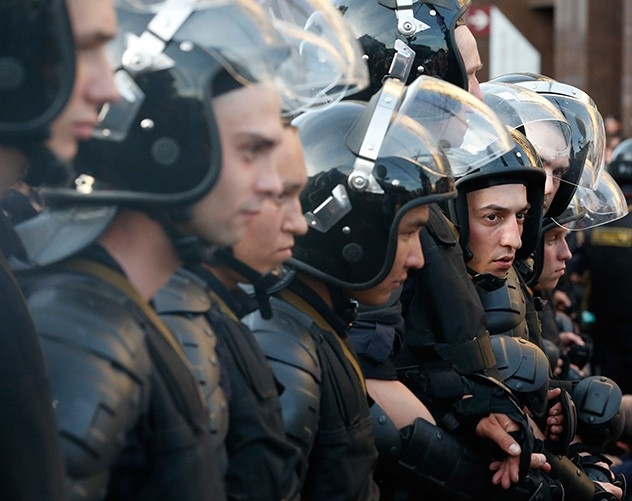
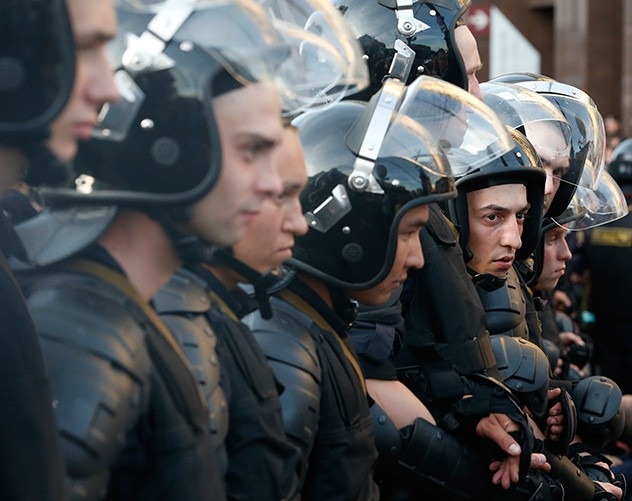
In general, the efforts to “tighten the nuts”, undertaken since May 2012, should be perceived by the regime as successful. The authorities have expanded the use of what political scientists Stephen Levitsky and Lucan Wei are called "forcing low intensity" - supervision, oppression, investigations, arrests. This keeps in a state of concern for real and potential opponents of the regime. However, if Russia is rather poorly controlled than a well -ordered police state, then in the future problems with the police themselves may potentially arise (in a broad sense). In particular, the following characteristics of the law enforcement system can be the problems for the consistent “twisting of the nuts”: the rooting of corruption and predatory practices in these organizations, as well as doubts about the reliability of the police in the face of social protests. An important feature of the Russian poorly controlled police state, in addition to its clanity and competition between bureaucratic departments, is corruption. Employees of Russian law enforcement agencies not only serve those in power, but also work for their own pockets. In the context of universal pressure on active and potential oppositionists, inspections on the facts of the arbitrary and frankly criminal behavior of investigators and the police became perhaps even less than before. Legal justifications in the “Kirovles case” case (“sale of forests at improper prices”) were so shaky that many observers expect an increase in the onslaught of businessmen from law enforcement agencies, as it was already after the “case of Yukos/Khodorkovsky”. However, a police state cannot function properly if law enforcement officers are motivated not only by the task of the service of the regime, but also to the same extent corruption considerations. According to the well -known expression of the former comrade -in -arms of Putin in the service of the FSB, Viktor Cherkesov, "it is impossible to allow the soldiers to become merchants." Cherkesov, however, exaggerated the problem: it looks like people in Russia to combine these functions is not something out of the ordinary, although it is quite difficult to fulfill them equally well. Another risk, at the moment purely hypothetical, is still worth mention, since it is potentially very serious. The Ministry of Internal Affairs as a whole and the special forces of the riot police were able to relatively effectively cope with protests in Moscow. The suppression of large social protests in Moscow or in the regions can cause more difficulties. Such protests can occur due to many reasons, including ethnic and economic. The clashes between ethnic Russians and young men from the North Caucasus were the impetus for social protests in Kondopog in 2006, on Manezhnaya Square in Moscow in 2010, in Pugachev in July 2013. The possibility of further clashes on ethnic grounds, including large -scale violent conflicts, should definitely bother the police and the regime as a whole. Economically motivated protests can also give an occasion for concern, especially given the low current and predicted indicators of economic growth. Events like the 2005 protests against the monetization of benefits, the demonstrations of 2008 in Vladivostok due to the increase in duties on the import of foreign cars or protests of 2009 in Pikalevo due to non-payment of salaries at a single plant in the city-exactly the type of incidents that the authorities would like to limit and control as much as possible. Russian police officers and employees of Putin began to flourish, they acquired high salaries, prospects for a wealthy old age and, possibly, receiving an apartment (if you do not climb into a wound and not fall into unpleasant stories), maintaining the chances of enrichment on the side. But at the same time, there are no special signs of their strong ideological devotion to the regime, which would guarantee their resistance, if necessary, suppress large -scale protests by violent methods. The plan for the full translation of the internal troops of the Ministry of Internal Affairs on a professional basis by 2016, in addition to earlier steps to increase the number of riot police officers, gives reason to assume: someone in the Kremlin thinks that the time may come when it is necessary to cope with large-scale protest actions, and political and social. The use of force is obviously the most extreme option; In the meantime, Putin retains his popularity. This analytical note should definitely not be perceived as a prediction of the upcoming destabilization: the complex “tightening of the nuts” described above can be evaluated rather as successful than as an unsuccessful one. But this does not mean that Russia is an ordered police state: there is a lot of disorders in Putinism, even though the Medvedev era is a thing of the past.
Original : Brian Taylor.
Putin's Crackdown: Sources, Instruments, and Challenges . Ponars Eurasia