
Translated material
Marianna Gade: "Every poet must hate the language"
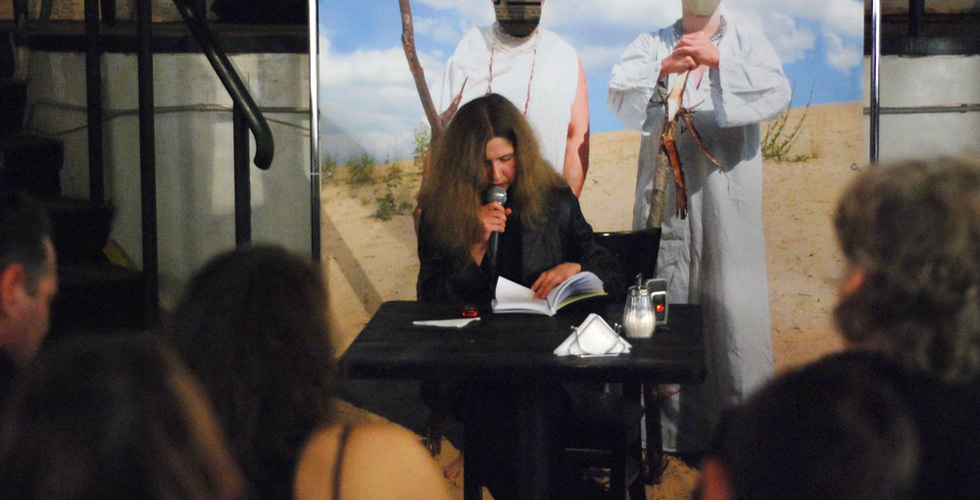
- Marianna, you are one of the youngest laureates of the award Andrei Bely, often appear at literary events, but constantly keep a blog in a living magazine. Communication through the network is more convenient for you? And how important is the feedback: commentary, accidental acquaintance?
- The network is convenient in that it provides an opportunity to see what is happening in the life of people interesting to you, or rather, what they considered it necessary to report their lives, not necessarily entering into interaction, well, or entering the minimum, “like” putting a brief comment so that they see that you see them. And eliminates the need to repeat the same thing several times. When you communicate a lot with people “in real life”, willy-nilly repeat the same blocks of information, sometimes you somehow modify them, transform the situation in accordance with. And in such cases I have approximately the same effect that everyone was probably observed someday: if you repeat some well-known word many times in a row, it suddenly begins to seem strange, devoid of meaning. Something like this happens when you repeat stories many times, quite truthful, from your own life or the life of friends. At some point, they are abundant, lose reliability in your own eyes. There is a certain virtual, semi -inventive character with which it is difficult to correlate itself. On the network, this somehow more organically exists, as a special cultural form. Those. In the virtual space, it is normal to be a virtual. Again, it does not require movements in space. By the way, I had somewhere to read that a person during a conversation remembers an average of 4% of information. And, as you can guess, these four percent are not necessarily the most important. On the network, at least, we can always return to the beginning and read again carefully if suddenly something eluded us.
- Is there such an activity that would cause you metaphysical horror?
- Well, I was always scared to imagine how astronauts feel in space. As they fly, fly, blackness and silence are ahead, and they know that it will be like that - if everything goes correctly - another six months, or a year, or two years, and all this time there will be the same silence, the darkness is ahead, and the same environment, and the same people are nearby. I don’t know how they do not go crazy there. Although sometimes they go.
- How much of you as a writer are worried about Gender’s questions (in life and letter), or rather, who do you feel/imagine: a man or a woman?
- Here are the problems of Gender in my own life and creativity do not affect me at all. It seems to me that it is very boring to represent yourself as a man or woman. This is some kind of role-playing game that we got from our ancestors. And for our ancestors, of course, she had some sense. Well, that is, females with cubs are sitting, for example, in a cave. And males with a spear go hunting. And this is convenient and appropriate. And when modern people in all seriousness begin to play these games, get used to these roles, then it looks, well, as if the child took some adult object from their parents (for example, a phonldoscope) or there is a welder’s helmet at a construction site. And if you ask why he would seriously explain this. But he is actually not a welder.
Star, I’m already awe.
I’m usually talking about myself and write in a male gender, just not in a female one. In a female gender, I feel very awkward, approximately like in a skirt. The pants are usually more convenient. Although in the summer in some hot country is just more convenient in a skirt. But you feel very strange at the same time. As if naked. And if we talk about yourself in a female gender, then you also somehow feel unprotected, vulnerable. Child. Well, it is assumed that after all, a woman should be half a child in order to understand and guess what he feels. By the way, another kind of activity that causes me metaphysical horror is women who raise children. It seems to me that they are even worse than astronauts in the void, blackness and tin. By the way, they also go crazy sometimes.
- If you recall what is called childhood: how did you feel about reading at this age? They forbidden you something, did not allow you to read? How much was what I wanted?
-Oh, if there was something good in my childhood, it’s just that no one followed my reading, I read absolutely everything that came across my arm. I bought, for example, the newspaper “Scandals”, or “AIDS-info”, or some other nasty and read from crust to crust. He absorbed the detectives in tons, giving preference to where some torture, or scenes of sexual violence, or psychopathic personalities were described, was especially happy when a child turned out to be a psychopathic person. Agatha Christie, I remember, had such a plot. Well, he loved poetry, which is already there. He loved the verses of Vladislav Khodasevich very much, at the age of 11 they gave me the “heavy lyre” by Khodasevich, the reprint, and she completely fascinated me. Before that, I have never met such verses. They were strange exactly like a person - a particularly growing person, a child - sometimes suddenly strange. Suddenly, some kind of act, cruel or just wild, or even an act, just a thought arises in his head, and now he stands, looks at this thought and cannot understand: as if this thought was not at the same time at all, he did not think about this-and at the same time he himself in this thought as in anticipation, he, which he had not yet, has yet to look at this thought. Another very beloved poet was Sasha Black, his book was found in the house, still samizdatovskaya, his poems, sometimes very long, spari by heart, some now I remember.
-Your texts began to appear in print in the early 2000s, did the authors of this period affect your work, that is, those who began to publish at the same time?
-Yes, of course, they influenced in one way or another, not even some of some authors, targeted, but the very sense of the environment, volume, and a peculiar albeit. At some point, it even seemed to me that, perhaps, we are Ayia-Sofia with a countless many eyes, like Mandelstam. Then, however, let it go.
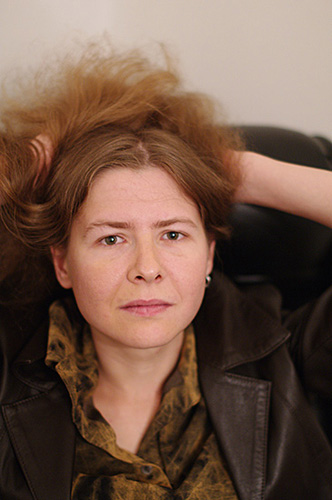 © Marianna Gade
- Why, after graduating from the Faculty of Philosophy, did you continue to educate in the academic environment (graduate school?) And went to teach in the province?
- Everything was not entirely true. We moved to Pereslavl-Zalessky, even when I switched to the fifth year of the Faculty of Philosophy. Before that, we rented a room in a village house in the village of Chobota, next to Peredelkin. There was a fire and the house burned down. Since our funds were extremely scarce, we could not afford to stay in Moscow, and my spouse was just then offered to teach Pereslavl at the University of the city and provided housing, we had no choice but to accept this proposal. As for me, I never taught in Pereslavl, however, I held one seminar on critics of Kant for graduate students in whom my husband read.
As for graduate school, I always had very bad health, just in the described period I almost went into another world, and I had neither the strength nor, the truth, desires to say, desire. I have not at all the mindset that is suitable in order to engage in scientific activity, say, I am completely unable to remember information that does not cause interest in me, but for some reason it needs to be remembered. I would have made a very bad scientist from me, I think. And the artist has the right to be biased - yes, perhaps, is obliged.
-You lived in Pereslavl-Zalessky, how did you feel yourself in the village, where the buildings are not much higher than a person?
- About Pereslavl, at that time I wrote a lot of different prose, often rather gloomy. This is really a very beautiful city, but very isolated, it seems that they even somehow bought up so that they would not spend the railway tracks there, there is only a narrow gauge railway, along which you can ride a piece of line back and forth. I was scared by the idea of staying there-I am a rather autistic person, it seemed to me that in such an autistic town you can get stuck for a lifetime, turn into some kind of local attraction, but I still was a rather young man, despite poor health, had certain ambitions, on the one hand, on the other hand, the need for the mind, which, in truth, was inextricably. Although I know at least two young poets, and the good ones who came from Pereslavl to Moscow, and at the time of my stay there were just graduating from school.
Gender’s problems in my own life and work do not affect me at all. It seems to me that it is very boring to represent yourself as a man or woman.
- Are there any authors, phenomena, objects of the outside world, before which you experience awe and/or can you call your teachers/opponents?
“Star, I’m already awe.” I can say that I vaguely recall that once there were times when I really felt awe in front of certain objects that scared me and attracted me. Over time, I myself turned into such an item and now I can’t hardly understand my experiences then. It is completely strange with teachers: in youth, people are often inclined to perceive as teachers of those people who produce art products that cause their admiration-and are inclined to see, possibly, teachers, mentors in some life issues. And then suddenly it turns out that for the most part of the fundamental issues of the point of view, you diverge radically. And somehow it is necessary to realize in its entirety the fact that creative activity is separate, and a person is separate. And he can be, by our standards, completely terrible. What does not change our attitude to his work. Perhaps this can only really learn from people, for which books are not suitable.
- On Wikipedia, your prose is characterized by the following words: " existentialism , modernism , postmodernism , structuralism ." How do you correlate your textual activity with similar definitions?
- Let's just say that all of the listed phenomena at one time were extremely interested in me, and I read a lot about them. But, of course, it is quite funny to imagine a phenomenon to which the concepts of such contrary to each other would be applied as, for example, existentialism and postmodernism. Well, that is, an absolutely schizoid such a creature that carries out an existential act of being, experiencing itself as a simple fragment of a narrative told a long time ago and not about it. This creature causes sympathy for me, and I, perhaps, is ready to identify myself with it. Not every day.
- In the review of the Awards of Andrei Bely 2007, they wrote about you: “The book of the Moscow poet Marianne Gade“ The Dead Lanter ”has a lot in common with the novel by Alexander Ilyanen. This book is also designed for a smart and educated reader: German, French, English, Latin inserts are not translated here and are not commented. It is assumed that the reader knows all these languages. Countless references to all European literature and philosophy are not explained: the person who takes this book in his hands reads Kant, Deleuz, and all-all-all. ” What do you think, for reading (your books and others), the perceptions of the read are mandatory, certain knowledge?
-Yes, it was in my youth, when I studied at the university, I devoted a lot of time to the study of languages, some foreigner scraps, quotes from what I read and the like constantly turned around in my head. Subsequently, by the way, this disappeared. No, I do not think at all that the hypothetical ideal reader should know this all-all-all. Something he, of course, should know. At least to read to be able to. But in general, the smaller a person has pre -learned installations, the better. Now for me this old book is already something else, I look at it detached and I see not at all what is written in the review. Not a scientist who turns to the same scientist, a smart interlocutor who understands him at a glance. By the way, there is a lot of errors. This, so to speak, is an attack of “longing for world culture”, created in a situation of complete anomia, when no language that can be somehow communicated with others has been created with others, when the previous laws have dilapidated and lost meanings, and new ones are not even laws, but many competing schemes, each of which has its own supporters, its advantages and temptations and its own, of course, dark sides, and now in world culture This person seeks to find protection, refuge. Something that could be captured and say: "Well, this is exactly what I was looking for." And, of course, he finds nothing but drafts - and you thought. To understand this, it is not necessary to read everyone-all-all, although I admit that the person who read the Deleuz will understand it faster than a person who has not read. But if you imagine that without a dealer nowhere, then, sorry, it turns out that Deleuz wrote ... Well, not true. I invented something, but we believed him, ally, and we repeat. But if Delez described something that really happened, then we recognize it by the description, even if we have no idea what the next terrible word this is called in modern Western philosophy. Some experience if he was with us. Or he was not, but it could be.
- You are at least twice, in the “UFO” number and the book “Sluggies of Garrots”, made up autocomines for their texts. Could you do this with short prose, for example, with one of the stories from your last book “Glass Wolves”?
Forest
A cloud of small jacket butterflies tremble above the ground, a light rumble comes from their wings. In the case there is a person and masturbates on the forest.
-This is exactly the case when, in my opinion, comments are too. This is just observation from nature, when what was happening seemed to me very cinematic. They closed their eyes and introduced them. As a piece of sleep or a film, torn randomly, but quite self -sufficient. In essence, what I try to do is somehow reproduce dreaming experience when we sleep and experience the extraordinary significance of what is happening, some kind of completeness, which we are in reality then, and when we take retelling, it turns out that the human language is not good for this, that a nonsense is obtained in which this initial fullness is not present. If at least it turned out to be reproduced a little, then I, as the author, fulfilled my task. And if not, you can try to reproduce this in reality, for example.
- In the new book you can see scattered rhetorical issues. Part is accompanied by answers, part - no. Here are several examples for readers.
He asked him: do you want to know what the soul feels when he comes to the world? (And threw an apple to him. And at that moment when he caught him, he almost bent in half, because the apple was heavy, like a cannon core, he could not hold him, and it fell to the ground, and a dent remained in his palm.)
- They say that the ferret is so squeamish that it will rather allow itself to be caught, which steps into the unclean. But what is "unclean" from the point of view of the ferret?
- Why does the daffodil rush into the water?
- Do you know that both evil and good penetrates a person through the same holes?
- And who do you want to become when you grow up, girl? - Tymoshenko tried to dick. The girl dreamily rolled her eyes:
“I want me to have many, many enemies.” And so that they all hate me.
Why do you need these questions, what do you study them?
- Rhetoric questions are asked, as a rule, to prevent non -nicheatic ones. He himself asked, he answered, he himself explained why the answer is wrong. But seriously, then, as a rule, the texts are the result of a certain internal dialogue or trialog, a tetralog, in a word, some kind of disassembly of subpersonalities. At the same time, some observing instance, stoically listening to all this Beliberd. Her appointment, in general, at the right moment, to see in this, so to say, the distinction of the maiden choir something that seems remarkable to her, and fix it. So frequent rhetorical issues can be considered as residual phenomena of this process, as a rule, is quite stormy.
- In “Glass Wolves” and “Balsamins, you often face the phenomena of nature and human, change the usual myths and fairy tales, violate the boundaries of the crystallized world. It seems that you sometimes project what could happen, but only in the text of Marianna Gade. And what is it impossible for you in the language that it will not be written?
- Returning to what has already been said - for the most part I am interested in the possibility of verbalization of the fact that by definition it cannot be expressed in the language. The human brain, as you know, consists of two hemispheres, one of which can speak, and the other does not. But it knows how to sing. And at the same time, how we feel in the world, this applies to the field of activity of the right hemisphere to a greater extent. Despite the fact that we get all the instructions from the left. Выходит, что язык — тот самый инструмент, который писатель или поэт использует, — изначально нам враждебен, репрессивен или просто глух к нашим надобам. Мне кажется, что если рассматривать язык именно как средство коммуникации, как систему сигналов, то каждый поэт или прозаик, любой, кто взялся возиться со словами, должен язык с самого начала ненавидеть. Все, что он дальше с языком будет делать, он будет делать для того, чтобы лишить его этой первичной репрессивной функции, вывернуть наизнанку, употребить для чего-то, что для него, языка, противоестественно. Разумеется, это будет действовать ровно до того момента, пока вот данный конкретный языковой выверт осознается и переживается как нечто новое. Как только это новое усваивается языком, включается в обиход, рутинизируется — оно перестает быть новым, становится частью речи, еще одним инструментом подавления. Так что на вопрос этот не вполне понятно, как отвечать, — что не будет написано? Да ничего, в сущности, не будет, что ни напишут — все зря. Через какое-то время.
— В книге есть рассказ, в котором берут интервью у режиссера триллеров, ему задают вопрос: «Вы стремились к тому, чтобы зритель поверил в реальность происходящего на экране?» Какое отношение имеют и сам вопрос, и взаимодействие понятий «экран/реальность» к вашему письму?
— Этот текст, если хотите знать, навеян историей создания первого фильма «Пила», когда у молодых режиссеров был очень маленький бюджет, они не могли себе позволить заказать манекен, так что исполнитель накачался транками и в течение шести дней лежал на съемочной площадке, изображая собственный труп. Как хотите, а меня это впечатлило. Я даже думаю, что это, на самом деле, ответ на ваш вопрос.
— Часто ли вы выходите на улицу и/или интересуетесь происходящим за окном, ощущаете повседневную историю частью личного опыта?
— Да, я люблю гулять в лесу, путешествовать, когда есть такая возможность. Половина моей писанины про то, что, так сказать, за окном. И, разумеется, ощущаю повседневную историю частью личного опыта, чьего же еще. Вот глобальную историю как часть личного опыта пережить почти никогда не получается. Что, конечно, не вполне правильно.
— И последний вопрос: известно, что Премия Андрея Белого — это «1 рубль, яблоко и бутылка водки». Что вы сделали с яблоком?
— Яблоки и водку честно разделили между всеми награждаемыми, дабы скоротать торжественную процедуру.