
Translated material
Caucasian shout
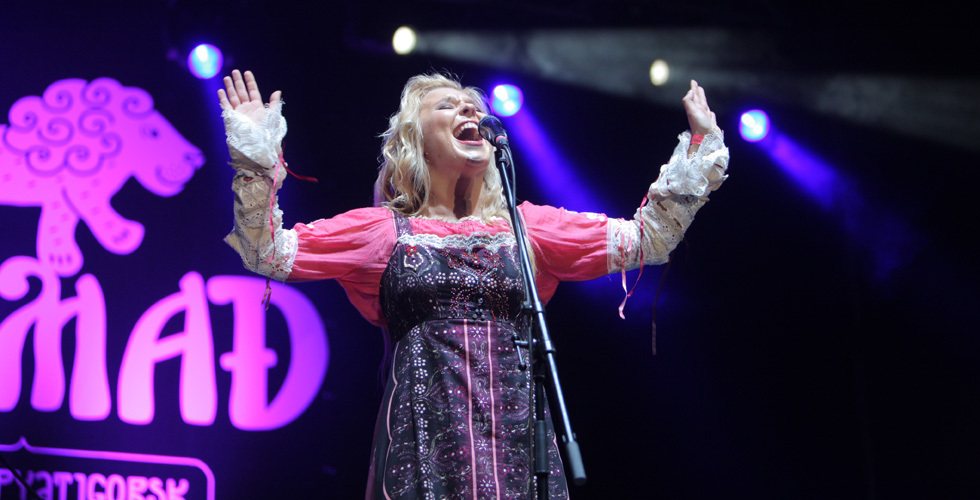
“And that’s all? For this, we knew dirt from the scene? " -An ethnographer and master of play on the shepherd Rok, Sergei Starostin, looks at wet journalists who take turns basking at the reflector in the festival press show. Starostin was asked a couple of questions from the series “Why do you need ethnic music at all”, and then silence hung. The situation was saved by a young journalist in a blue scarf on her head (as it turned out, the special corner of the Chechen television channel Diamokhk): “Tell me, have you not performed on WOMAD before?” “I performed! -Sergey Klevensky, playing in the group of Starostin, “Once upon a time,” joyfully started. -I spoke in 2006 at the Spanish Womad with the project “ Maler and I”. Only there everything happened in some kind of pathos palace, there was no one for the people, but here the faces are very thorough. ” “Well, his own,” Starostin muttered.
The art director of the Russian WOMAD Alexander Cheparukhin had serious fears that these same “their people” would not come. Firstly, he said, the weather (and rain poured without stopping all two days), and secondly, the lack of world names. “We wanted to bring Peter Gabriel, but he has a European tour right now. We thought to call Robert Plant with his The Sensational Space Shifters , with whom he spoke at the British Womad last year, but did not work out. We planned to invite Portishead , for the sake of which half-Moscow would have gone here, but not this time. ” As a result, the first Russian WOMAD was seen in a town event organized for a fun residents of Caucasian mineral waters on the eve of the Sochi Olympiad. But - everything turned out to be much more interesting.
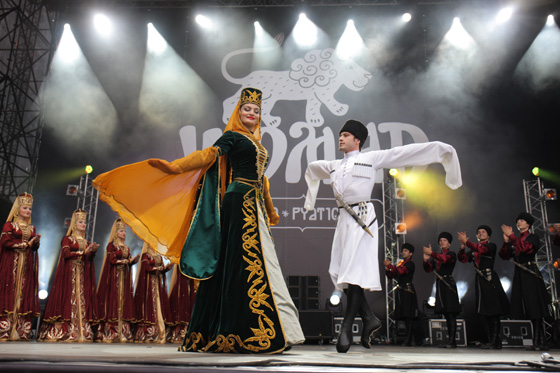 © Dina Khafizova and Alexander Kuptsov ensemble "Diamokhk" from Grozny
"Will we drive to the duel's place?" - the poetess Vera Polozkova, invited to the festival as an entertainer, was worried. WOMAD took place on the spurs of Mount Mashuk, where in 1841 the poet Mikhail Lermontov mortally wounded Nikolai Martynov insulted by him. According to the organizers, the place for the Russian Womad was transferred three times. From the very beginning it was planned to be held in Kislovodsk, but the resort park it was completely relic, and the city administration did not allow him to trample. After that, the idea arose to hold a festival on the border with Karachay-Crossia with amazing views of the snowy peaks of the Greater Caucasus, but it was abandoned due to the impossibility of ensuring security for artists and spectators (too wild places). In Pyatigorsk, the first thing was watched by the clearing of songs - a huge natural amphitheater on the same Mashuk - known, among other things, in the summer there are city holidays such as “Russian Flag Day”. Finally, the venue was approved only two months before the festival - Mount Mashuk, the territory of the former children's camp, Komsomol Polyana. Very close to the obelisk installed in the alleged place of the duel.
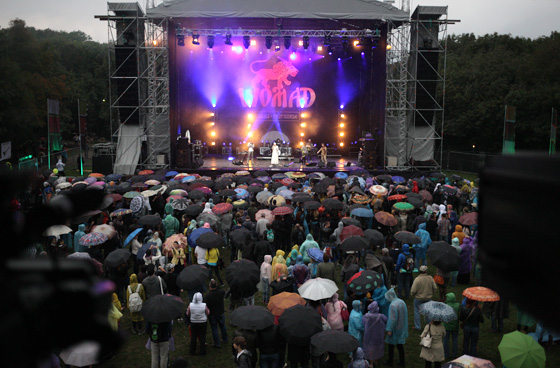 © Dina Khafizova and Alexander Kuptsov on stage - Inna desired
WOMAD -franchise festival. For the first time spent by Peter Gabriel in 1982 in the town of Shepton Mallet, famous for the oldest prison in the UK, he almost immediately broke around the world. Today, Vumad also has its own UAE and Canary Islands. Gabriel initially focused on ethnic music - at first the festival even had a World Music . Subsequently, they got rid of the prefix, but the tradition has been preserved: the country that accepts WOMAD should add something of its own, interpretation to the international program. For example, at the Abu Dhabi festival, the Tarab group is responsible for the national identity Al EMArat , performing an instrumental muzak for traditional Arab rhythms.
In Russia, difficulties arose with national identity. The Caucasus alone has fifty ethnic groups, and each has its own culture, its own music. “They tell me: we want all the peoples of the Caucasus to present their musicians,” said Cheparukhin. - And I explain to them: it will not work. And they to me: then many will be offended. " As a result, seven Caucasian groups took part in the first Russian Womad , including the Diamokhk children's ensemble from the Grozny and Male Choir Kona from Vladikavkaz . It was difficult to determine the belonging of musicians to a particular ethnic group without programs. There were incidents. On the first festival day on the alley under the pouring rain, a group of teenagers led by a woman playing button accordion performed a dance that Russian people are simple-mindedly calling “as-ss”. The children danced great, a dense ring of spectators with iPhones was formed around instantly. "Who is this?" - trying to shout Bayan, I asked the elderly man standing nearby. He did not understand the question, he had to make a reservation: "Well, in the sense - who of the Caucasian peoples?" The man flashed his eyes and abandoned: "Someone-who ... Chechen, of course!"
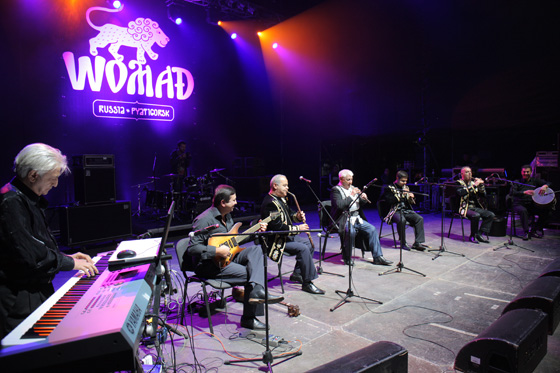 © Dina Khafizova and Alexander Kuptsov Jivan Gasparyan
On the same day, Alexander Khloponin, the presidential envoy in the North Caucasus Federal District. He walked around the territory, accompanied by a retinue of twenty people and, it seemed, was not particularly interested in what was happening. Toward evening, it turned out that he had come for the sake of Pelagia - the headliner of the first day. The guards led the official for the scene, on which at that time it thundered “oh, not evening”, then they put them in a jeep and took them into an impenetrable Caucasian night.
"Then many will be offended."
Womad could come to Russia twenty years ago. The British took the first steps in 1993. But after they were met at the airport by people who roof the Luzhniki stadium, their desire fell off. The second attempt-and Alexander Cheparukhin briefly told about it-was made in 1997. And only now the parties managed to find a compromise. As it turned out, the merit of the Krasnoyarsk zoologist-sector Andrei Kataev, who has been developing tourism in Siberia for many years (for nine years Kataev spent in the village of Shushenskoye festival “Sayan Ring”, which can be considered a kind of analogue of Womad ; this year the festival changed the name to the “world of Siberia”), but several years ago, who had moved to the Severnya several years ago Caucasus. “When I was invited to raise tourism in the Caucasus,” Kataev explained, “I immediately remembered Womad . I had long dreamed of bringing him to Russia and even made some attempts to spend it in Siberia. And when I wrote an economic rationale for “visit the Caucasus”, one of the main points indicated the need for a cultural event of an international level in the region. ” Alexander Khloponin, who has been familiar with Kataev since his governorship in the Krasnoyarsk Territory, gave a green light without long thoughts. It was not difficult to persuade the British - even though the British Foreign Ministry published a document in which he recommended Britain citizens to refrain from traveling to the North Caucasus. “A card was attached to the document,” says Kataev. -On it, the Stavropol Territory was painted with a “safe” green color, Kabardino-Balkaria-yellow, and other areas of the North Caucasus-bright red. ” WOMAD Director Chris Smith saw this card, but did not change his intentions. According to Kataev, he was more frightened by the political activity of the art director Alexander Cheparukhin, one of the peaks of which fell on the election campaign of Alexei Navalny in the mayor of Moscow. “And there may not be a festival,” Chris Smith shared his concerns with Andrei Kataev a couple of weeks before the festival.
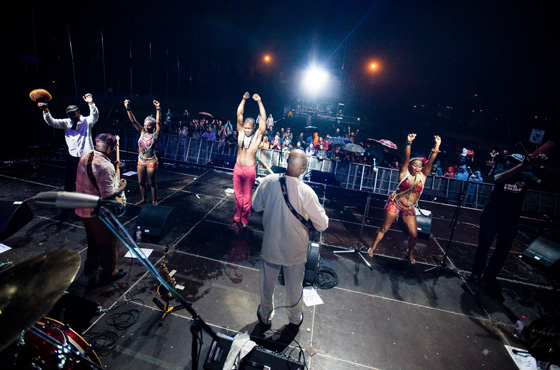 © Valery Latypov Sean Kuti & Egypt 80
Actually, the main question was about this, which was interested in all Moscow journalists invited to WOMAD without exception. Rather, not even a question, but an exclamation of surprise: how it turned out that Cheparukhin, a noticeable Moscow oppositionist (not to mention Peter Gabriel himself, who handed over to Cheparukhin manuscript letters Pussy Riot , and also devoted the song to all modern victims of political repression. - Ed. ), allowed to hold a mass event in the most troubled region of the country? Chris Smith answered everyone. “ Wow , ” he said when he was asked what he felt at the moment when the festival was already closed. And there was a little bit in this meowing sound, but most of all - relief.